This site is an independent publication named after its domain. It is not affiliated with NIST, Kansas State University Polytechnic Campus, Mississippi State University, any sponsor or any contestant; this page only compiles what the competition’s former website at this address published.
The First Responder UAS Triple Challenge was a prize competition run by NIST’s Public Safety Communications Research Division (PSCR) in 2021 and 2022. Its competition website is no longer available, and the name now also turns up results for an unrelated Michigan event. This record rebuilds the basics from copies of that website archived between July 2021 and August 2022 and names the archived page behind each fact.
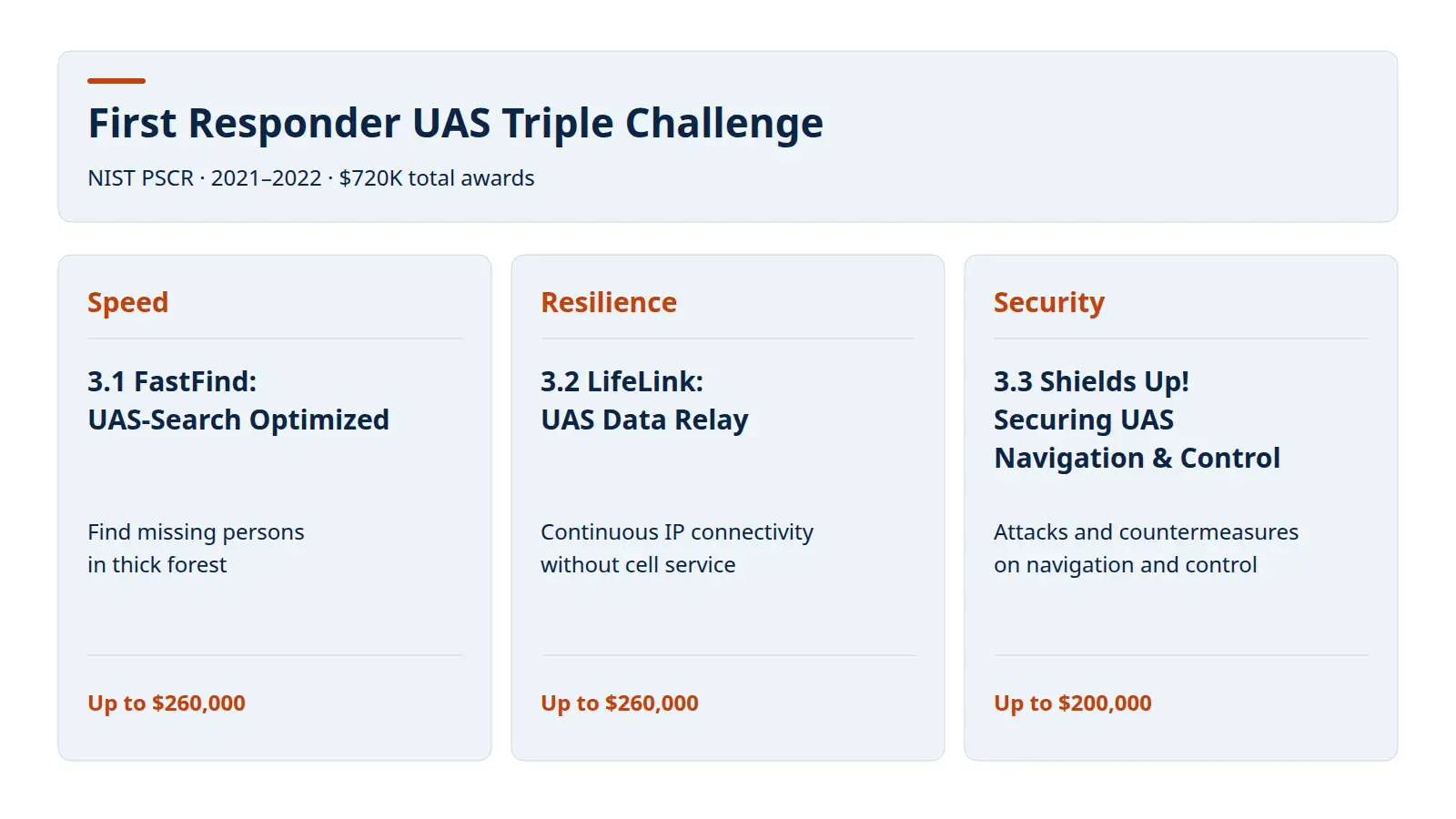
The First Responder UAS Triple Challenge was the third competition in NIST’s UAS challenge series: three parallel challenges with awards totaling $720K. Challenge 3.1 FastFind (up to $260,000) asked for a drone system that helps a search and rescue team find missing people in thick forest faster; 3.2 LifeLink (up to $260,000) for a drone that keeps first responders connected where there is no cell service; 3.3 Shields Up! (up to $200,000) for attacks on, and defenses of, drone navigation and control software. Stage 1 entries ran from 2 August to 30 September 2021, Shields Up! concluded in April 2022, and the FastFind and LifeLink final live events took place in June 2022 near Starkville, Mississippi. NIST PSCR keeps the official results on its own website.
Key points:
- NIST PSCR hosted the challenge with Kansas State University and Mississippi State University. Kansas State University Polytechnic Campus ran the website under contract with NIST PSCR, and the site’s footer said it was “not owned or operated by the Government.”
- Each challenge matched one word of the theme “Speed • Resilience • Security.”
- All three were 3-stage competitions. The archived text does not contain the stage tables, scoring details, full winner lists or individual prize amounts.
- The official rules were hosted on challenge.gov; those three links returned “not found” when we checked on 7 October 2026.
What was the First Responder UAS Triple Challenge?
It was a NIST PSCR prize competition that asked contestants to design and build unmanned aircraft system (UAS) prototypes for first responder missions. It ran from summer 2021 to June 2022 and offered awards totaling $720K across three separate challenges.
| Item | What the archived site says | Archived page (capture) |
|---|---|---|
| Name | First Responder UAS Triple Challenge; site name “UAS Triple Challenge” | Home (7 Jul 2021) |
| Tagline and theme | “Using ingenuity to save lives”; Speed • Resilience • Security | Home (7 Jul 2021) |
| Host | NIST Public Safety Communications Research Division (PSCR), in conjunction with Kansas State University and Mississippi State University | Home (7 Jul 2021); Challenge 3.1 (25 Oct 2021) |
| Website implementer | Kansas State University Polytechnic Campus, under contract with NIST PSCR | About page footer (25 Oct 2021); Contestant Portal (24 Oct 2021) |
| Place in series | Third iteration of the NIST UAS challenge series | Home (7 Jul 2021) |
| Total awards | $720K | Home (7 Jul 2021); Invitation page (21 May 2022) |
| Challenges | 3.1 FastFind, 3.2 LifeLink, 3.3 Shields Up! | Home (7 Jul 2021) |
| Format | Each challenge was a 3-stage competition | Challenge pages (25 Oct 2021) |
| Final live events | 3.1 and 3.2: June 2022, near Starkville, Mississippi | Invitation page (21 May 2022); Live event page (17 Aug 2022) |
| Official rules | One challenge.gov page per challenge | Rules page (24 Oct 2021) |
The home page described PSCR’s Open Innovation team as the group that “engages public safety entities, government, academia, and industry” through prize competitions and challenges. The Triple Challenge was one of those competitions.
The name is easy to confuse with Michigan’s Uncrewed Triple Challenge. That is a separate, state-sponsored competition in which autonomous systems carry a package across water, air and land; its 2025 event was held in Alpena, Michigan. Nothing on this page refers to it.
How did the three challenges differ?
Each challenge took one word of the theme. FastFind was about the speed of a search, LifeLink about the resilience of a network in the field, and Shields Up! about the security of the links that steer and navigate a drone. FastFind and LifeLink were hardware build-and-fly challenges; Shields Up! was a cybersecurity challenge.
| Challenge | Theme | Problem it posed | What contestants had to show | Award pool | First prize in final event |
|---|---|---|---|---|---|
| 3.1 FastFind: UAS-Search Optimized | Speed | Searches where “direct visual contact with a potential subject may be obscured” | A complete UAS that helps a SAR team locate multiple missing persons in thick forest | Up to $260,000 | $40,000 |
| 3.2 LifeLink: UAS Data Relay | Resilience | Responders in remote areas “where access to network connectivity may be denied” | A complete UAS that provides continuous IP connectivity to responders dispersed in thick forest | Up to $260,000 | $40,000 |
| 3.3 Shields Up! Securing UAS Navigation & Control | Security | Security of the command-and-control and navigation communications between drone and ground station | Real-world threats to UAS flight, navigation and control, with countermeasures, demonstrated on a functional UAS | Up to $200,000 | Not stated in the archived text |
Sources for the table: themes and problems from the home page (captured 7 Jul 2021); tasks, award pools and first prizes from each challenge page (captured 25 Oct 2021). All are pages of the original competition website, read through Wayback Machine captures. The three award pools add up to the $720K headline figure. The archived pages give pool sizes and the FastFind and LifeLink first prizes only; how the rest was split between stages is not in the archived text.
Challenge 3.1 FastFind: finding missing people in thick forest
FastFind asked contestants to design, build and fly a complete UAS that helps a search and rescue (SAR) team locate several missing people in a heavily forested area. The intended gains were better image detection and better navigation, so the team could “close the distance” more quickly. The challenge page named law enforcement and other emergency services as the users.
The FAQ (captured 25 October 2021) filled in the search conditions for the final stage:
- The search area would not exceed 1,200 ft × 2,400 ft, near the Mississippi State University campus in Starkville.
- The tallest trees were about 30 ft and the forest was mostly pine.
- Each solution was expected to deploy, search and return the UAS to the launch area within an hour or less.
- Cellular signals (3G, 4G, 5G) could not be used to meet the requirements; teams had to rely on their own RF or microwave equipment.
FastFind offered up to $260,000 in total, with $40,000 for first place in the final event. Stage 1 entries ran from 2 August to 30 September 2021, and walk-on entries for Stage 2 closed on 6 May 2022.
The competition framed this as a speed problem under tree cover. For the general question of how drone searches are planned and sped up in SAR work, see our explainer on UAS search optimization.
Challenge 3.2 LifeLink: a data relay where there is no cell service
LifeLink asked for a complete UAS that gives first responders continuous Internet Protocol (IP) connectivity while they are spread out in thick forest with degraded cellular coverage. The goal, in the site’s words, was “cost-effective, robust, and easily deployable” solutions.
The challenge page described the use case: several teams working beyond cell reception need to share updated map information on their phones. A UAS carrying a wireless transmitter, such as Wi-Fi, could fly over each group and deliver mission information like fireline locations or search clues (“a hiker’s backpack was found here on the map”).
The FAQ added these conditions:
- The final event would have at least three and no more than six user equipment (UE) devices on the ground.
- The coverage area would not exceed a radius of half a mile.
- “Hover” meant staying within a sphere of 30-meter radius centered on a defined position and altitude.
- A location counted as connected when the network could complete an ICMP ping to the device.
- Delay-tolerant networking was accepted, though continuous connectivity with minimum delay was described as the ideal.
- As with FastFind, cellular signals could not be used.
LifeLink offered up to $260,000 in total, with $40,000 for first place in the final event. Walk-on entries for Stage 2 closed on 13 May 2022.
For how a drone works as an airborne communications relay more generally, see our explainer on UAS data relay.
Challenge 3.3 Shields Up!: attacking and defending navigation and control
Shields Up! asked contestants to identify real-world threats to UAS flight, navigation and control, find countermeasures, and demonstrate both on a functional UAS. Attacks had to target open-source software for UAS navigation or control. The challenge page gave two working definitions:
- UAS Navigation: “the ability of the UAS to successfully move between two points within 3D (three dimensional) airspace.”
- UAS Control: “the ability for a pilot-controlled UAS to successfully maintain flight control within a 3D airspace.”
The page explained why this matters for public safety: a drone that flies to the wrong place or arrives late has failed its mission, and a hijacked drone also puts responder equipment at risk. Accepted countermeasures included changes to existing open-source software, new software, new hardware and secure UAS configuration guidance.
From the FAQ:
- Contestants had to write a mission scenario, to show that the attack mattered in a real public safety context. Not every successful attack crashes the aircraft; a deviation of a few feet can be a mission failure in some cases.
- The challenge was designed so that ties could not occur.
- If a contestant found a vulnerability in proprietary software outside their attack, the FAQ said it was ethical to disclose it to the manufacturer.
Shields Up! offered up to $200,000 in total, and no fees or qualifications were needed to enter Stage 1. The invitation page recorded that it “concluded in April 2022.”
The archived challenge text does not name specific attack types. For the wider topic of drone navigation security, including GPS jamming and spoofing, see our explainer on UAS navigation security.
When did each stage happen?
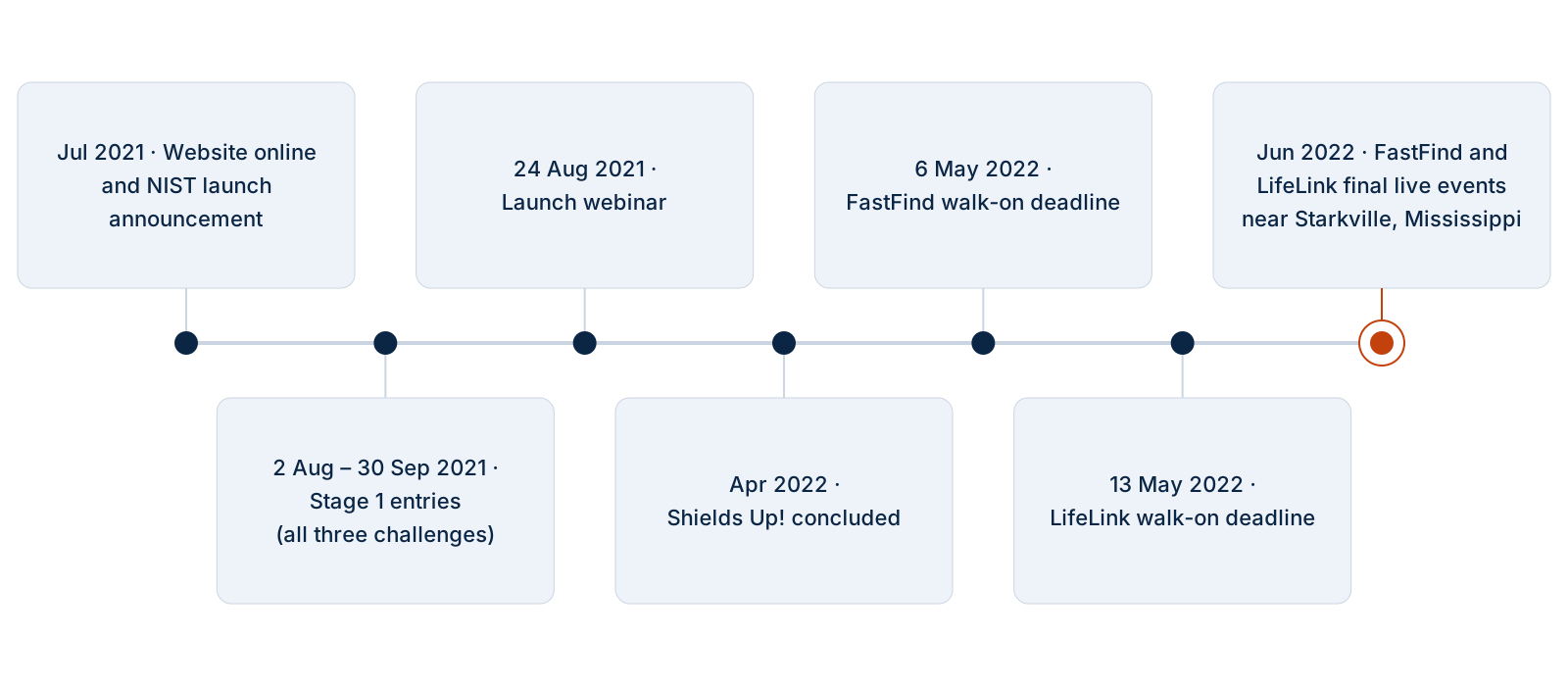
The competition ran for about a year, from the July 2021 launch to the June 2022 live events. The table lists the main dates that can be checked in the archived pages; months without a day are given that way on the source page. A full stage-by-stage schedule is not part of this record.
| Date | Event | Archived page (capture) |
|---|---|---|
| July 2021 | Website online (first capture 7 Jul 2021); NIST launch announcement, linked from the site’s News page | Home (7 Jul 2021); News (30 Nov 2021) |
| 2 Aug – 30 Sep 2021 | Stage 1 entry window, all three challenges | Challenge pages (25 Oct 2021) |
| 24 Aug 2021 | Launch webinar, 10–11 a.m. MT, with PSCR Division Chief Dereck Orr and four panelists from PSCR, Mississippi State University and Kansas State University | Webinar page (1 Dec 2021) |
| April 2022 | Shields Up! concluded | Invitation page (21 May 2022) |
| 6 May 2022 | FastFind walk-on (Stage 2) deadline | Challenge 3.1 (25 Oct 2021); Walk-on page (21 May 2022) |
| 13 May 2022 | LifeLink walk-on (Stage 2) deadline | Challenge 3.2 (25 Oct 2021); Walk-on page (21 May 2022) |
| June 2022 | FastFind and LifeLink final live events near Starkville, Mississippi | Invitation page (21 May 2022); Live event page (17 Aug 2022) |
| August 2022 | Last captures of the competition pages | Live event page (17 Aug 2022) |
We do not give exact days for the June events because the archived pages disagree. The invitation page named the John W. Starr Memorial Forest and one set of June dates, the Get Involved page gave another, and the live event page gave a third, adding that all FastFind events were rescheduled “due to heat advisory” and LifeLink events were moved as well. NIST’s pages are the place to confirm what finally happened.
The same invitation page also announced the next competition in the series, the First Responder UAS Indoor Challenge (UAS 4.0), “launching May 2022” with up to $685,000 in total prizes.
What rules did contestants work under?
The official rules were on challenge.gov and are not part of the archive. What survives is the site’s FAQ, captured on 25 October 2021, where organizers answered contestants’ questions. The table summarizes the general answers and notes where each appeared in the FAQ; more challenge-specific answers are in the sections above. These were this competition’s requirements in 2021; they are not a statement of current FAA rules, which you should check with the FAA directly.
| Topic | What the FAQ said | Where in the FAQ |
|---|---|---|
| Aircraft weight | Aircraft weighing 55 lb or more were not allowed | All Challenges – UAS |
| Weight per aircraft and system | Each UAS in a system had to have a maximum gross takeoff weight under 55 lb, and total system weight had to be under 120 lb | Challenge 3.1 answer |
| System cost | Total system cost under $20,000 | All Challenges – UAS |
| Costing parts | Donated, discounted or already-owned parts listed in the bill of materials at market value; for custom parts, material counted and labor did not | All Challenges – UAS |
| Remote pilot | Every flight flown by an FAA-certified remote pilot under Part 107; hiring a certified pilot was acceptable | All Challenges – UAS |
| Standards | ASTM standards not required unless the FAA requires them | All Challenges – UAS |
| One pilot per aircraft | The FAQ cited 14 CFR 107.35 to rule out one person operating several drones at once, in an answer about drone swarms | Challenge 3.1 answer |
| Line of sight | Beyond visual line of sight (BVLOS) not allowed; direct line of sight at all times | All Challenges – UAS |
| Tethers | Not allowed; systems had to be free flying | All Challenges – UAS |
| Cellular networks | Not allowed for meeting the requirements of challenges 3.1 and 3.2 | Challenge 3.1 and 3.2 answers |
| RTK GPS | Required at the Stage 3 live event; its cost did not count against the cost limit | Challenge 3.1 and 3.2 answers |
| Branding | Team logos allowed; the NIST logo not allowed on the UAS | All Challenges – UAS |
| Prototypes | NIST would not keep contestants’ prototypes | All Challenges – UAS |
| Commercial parts | Existing commercial products could be adapted | All Challenges – UAS |
| Insurance | Liability insurance required before flying for the challenge | All Challenges – UAS |
The FAQ explained the cost cap with survey results: in a NIST survey of first responders, 93% said they would pay $30K or less for a drone that could provide broadband coverage, and in a PSCR survey over 70% of respondents said they needed to limit their budget to $20,000 or less.
Two cautions when reusing this table. FAQ answers were clarifications, and the FAQ itself pointed contestants back to the official rules for full terms. And a requirement written for a 2022 contest flight in Mississippi tells you nothing about what a particular operation needs today.
What results does the archived site show?
Only part of them. The winners pages displayed team rosters as images, which are not in the archived text. What the text does show is the judging criteria and three team names, without a stage, rank or prize amount attached.
| Challenge | Winners page (capture) | Criteria shown | Team names in the archived text | Not in the archived text |
|---|---|---|---|---|
| Overview | 25 Jan 2022 | None; lists the three award pools ($260K, $260K, $200K) | None | All rosters |
| 3.1 FastFind | 3 Nov 2021 | “Clarity, feasibility, plausibility using concept paper, resume and summary slide” | Team UAV MasterLabs; Team Guardian Angel | Stage, rank, amount; other teams |
| 3.2 LifeLink | 21 May 2022 | “Completeness, planned system design, and project logistics”; “Clarity, feasibility, plausibility using concept paper, resume and summary slide” | None | Roster, stage, rank, amount |
| 3.3 Shields Up! | 21 May 2022 | “UAS safety review, demonstrated attacked and counterattack, and UAS/system inspection”; “Completeness, project logistics, feasibility of project, and UAS bill of materials”; “Strategic alignment, technical outcome, and feasibility” | Team Cyber Resilience League | Stage, rank, amount; other teams |
The criteria are quoted as they appear, including the original wording “demonstrated attacked and counterattack.” The archived pages do not say which criterion belongs to which stage.
We have not copied results from other sources into this table, because this record is limited to what the original site’s archived text shows. The full results by challenge and stage are published by NIST PSCR (next section).
Where is the official record now?
NIST PSCR keeps the official pages for this competition, and they carried results by challenge and stage when we checked on 7 October 2026. The original rules pages on challenge.gov no longer load.
- 2021 First Responder UAS Triple Challenge (NIST PSCR overview; the page showed “Updated December 30, 2025”; accessed 7 October 2026)
- NIST PSCR challenge pages: UAS 3.1 FastFind, UAS 3.2 LifeLink, UAS 3.3 Shields Up! (accessed 7 October 2026)
- NIST’s July 2021 launch announcement (accessed 7 October 2026)
- NIST PSCR past prize challenges, which lists this competition and the UAS challenges that followed it (accessed 7 October 2026)
- The three challenge.gov rules pages linked from the original Rules page returned “not found” on 7 October 2026.
If you are citing a result, cite NIST’s page rather than this one. A quick guide to where each kind of fact lives:
| You need | Where to confirm it |
|---|---|
| Winners, ranks and prize amounts by stage | NIST PSCR challenge pages |
| Full official rules | The challenge.gov rules pages (no longer loading); NIST PSCR for current information |
| Exact June 2022 event days | Not settled by the archived pages; check with NIST PSCR |
| Challenge goals, FAQ answers, entry deadlines | This record, with the archived page named for each fact |
How this record was compiled
Method. We read archived copies of the competition website saved by the Internet Archive’s Wayback Machine between July 2021 and August 2022, extracted the page text, and took each fact from the page named next to it. Every source in the list below was accessed on 7 October 2026. This is a compilation of public archived material, not original reporting or testing.
Definitions. “Capture” is the date in the Wayback Machine timestamp (UTC). “Award pool” is the “total award” or “up to” figure stated on the site, not the amount actually paid out.
Limitations. Parts of the original site were drawn by JavaScript or stored as images, including the stage tables on each challenge page, the winner rosters and any logo walls, so they are missing from the archived text. The body of the About page held only website-template placeholder text and is not used; only its footer statement about the implementer is cited. The official rules were never on this site. The Get Involved page asked for volunteers, event support and prizes, and listed no sponsors. Member profile pages and later pages on the domain had nothing to do with the competition and are not used.
Original site page map. Except for the home page, old links to these addresses now redirect here, or to the matching explainer for the three challenge pages.
| Old path | What the page held | Capture used |
|---|---|---|
/ |
Overview, award pools, theme, hosts | 7 Jul 2021 |
/challenges |
Short description of each challenge | 1 Dec 2021 |
/challenge-3-1, /challenge-3-2, /challenge-3-3 |
Goals, background, dates and award pool per challenge | 25 Oct 2021 |
/faq |
Contestant questions and answers | 25 Oct 2021 |
/rules |
Links to the three challenge.gov rules pages | 24 Oct 2021 |
/winners, /3-1winners, /3-2winners, /3-3winners |
Award pools, judging criteria, rosters as images | Nov 2021 – May 2022 |
/walk-on |
Walk-on deadlines for 3.1 and 3.2 | 21 May 2022 |
/invite |
Final live event invitation and UAS 4.0 announcement | 21 May 2022 |
/schedule |
Live event schedule and changes | 17 Aug 2022 |
/copy-of-resources-and-sponsors |
Launch webinar details | 1 Dec 2021 |
/copy-of-webinar |
News links (Commerce Department blog, DroneDJ, NIST) | 30 Nov 2021 |
/sponsors |
Call for volunteers and support | 25 Oct 2021 |
/contestant-portal |
Entry gateway and hosting statement | 24 Oct 2021 |
Version record. 7 October 2026: first published.
If you hold a primary source that corrects anything here, please tell us through the Contact page.