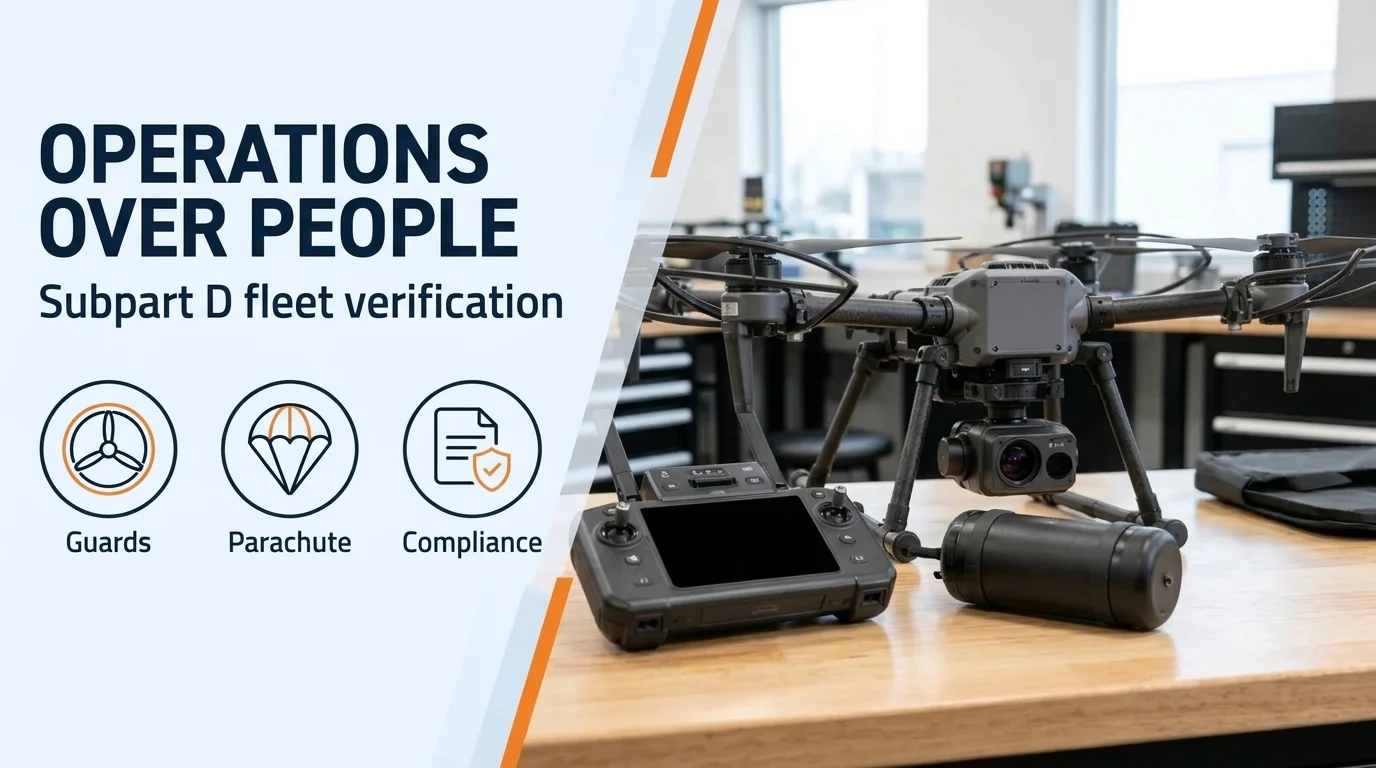
Under § 107.39 (Amendment 107-8, 86 FR 4382, January 15, 2021), no person may operate a small unmanned aircraft over a human being unless that human being is directly participating in the operation, is located under a covered structure or inside a stationary vehicle that can provide reasonable protection from a falling small unmanned aircraft, or the operation meets the requirements of at least one operational category in subpart D rules.
Under § 107.105, except as provided in §§ 107.39(a) and (b) and 107.145, a remote pilot in command may conduct operations over human beings only in accordance with § 107.110 for Category 1 operations, §§ 107.115 and 107.120 for Category 2 operations, §§ 107.125 and 107.130 for Category 3 operations, or § 107.140 for Category 4 operations. Under AC 107-2A, replacing propellers not covered in the remote pilot operating instructions requires submission of a new DOC to conduct Category 2 or Category 3 operations over people (paragraph 8.4.5), any modification that affects Category 2 or Category 3 eligibility requires a new FAA-accepted DOC before operating over people (paragraph 8.12.1), and in the Figure 8-2 sample operating instructions, replacing the camera with anything other than a pre-approved camera listed in the instructions or affixing any other payload not listed there results in the ineligibility of that aircraft to operate over people under Category 2 or Category 3.
Program managers reviewing archival technical resources can browse the UAS Triple Challenge Archive for companion airspace and mission-planning guides.
| Operational Category | Regulatory Section | Core Eligibility Threshold and Verification Mechanism |
|---|---|---|
| Category 1 | § 107.110(a)(1) and (2) | A remote pilot in command must use a small unmanned aircraft that weighs 0.55 pounds or less on takeoff and throughout the duration of each operation under Category 1, including everything that is on board or otherwise attached to the aircraft, and does not contain any exposed rotating parts that would lacerate human skin upon impact with a human being. |
| Category 2 | § 107.120(a)(1)–(3) | To be eligible for use in Category 2 operations, the small unmanned aircraft must be designed, produced, or modified such that it will not cause injury to a human being that is equivalent to or greater than the severity of injury caused by a transfer of 11 foot-pounds of kinetic energy upon impact from a rigid object, does not contain any exposed rotating parts that would lacerate human skin upon impact with a human being, and does not contain any safety defects. |
| Category 3 | § 107.130(a)(1)–(3) and (b)(3)(ii) | To be eligible for use in Category 3 operations, the small unmanned aircraft must be designed, produced, or modified such that it will not cause injury to a human being that is equivalent to or greater than the severity of the injury caused by a transfer of 25 foot-pounds of kinetic energy upon impact from a rigid object, does not contain any exposed rotating parts that would lacerate human skin upon impact with a human being, and does not contain any safety defects, and the applicant must maintain procedures to notify the public and the FAA of any identified safety defect that causes the small unmanned aircraft to exceed a low probability of fatality. |
| Category 4 | § 107.140(a) and (b) | To be eligible to operate over human beings under Category 4, a small unmanned aircraft must have an airworthiness certificate issued under part 21, be operated in accordance with the operating limitations specified in the approved Flight Manual or by the Administrator (which must not prohibit operations over human beings), have maintenance, preventive maintenance, alterations, or inspections performed in accordance with § 107.140(c)(1), and meet § 89.110 or § 89.115(a) for sustained flight over open-air assemblies. |
Baseline Prohibition, Statutory Exceptions, and Trajectory Risk
According to the FAA definition for operations over human beings, “over” refers to the flight of the small unmanned aircraft directly over any part of a person (such as a person’s head, shoulders, extended arms or legs, or a lying person’s torso or toes), regardless of how long the flight is over the person. The Operation of Unmanned Aircraft Systems Over People final rule was published in the Federal Register on January 15, 2021, and corrections published in the Federal Register on March 10, 2021 delayed the effective date from March 16, 2021 to April 21, 2021. In the Operations Over People final rule (printed page 4318), the FAA distinguishes “small unmanned aircraft” (simply the aircraft itself, which flies over people) from “unmanned aircraft system” or “small UAS” (which refers also to the aircraft, the ground control station, communication links, and other components).
To determine if a small unmanned aircraft would go over or strike a non-participant, the remote pilot needs to take into account the aircraft’s course, speed, and trajectory, including the possibility of a catastrophic failure, and ensure the aircraft will pose no undue hazard to other aircraft, people, or property in the event of a loss of control (§ 107.19) and is not operated in a careless or reckless manner (§ 107.23). Under paragraph 8.3.1 of Advisory Circular AC 107-2A, Part 107 does not impose a specific stand-off distance requirement from people when operating a small unmanned aircraft; the remote pilot may elect to observe a minimum stand-off distance considering the aircraft’s course, speed, trajectory, maneuverability, wind, terrain, and probable failures. Under § 107.51, a small unmanned aircraft operating under Part 107 may not exceed a groundspeed of 87 knots (100 miles per hour), cannot fly higher than 400 feet above ground level (unless flown within a 400-foot radius of a structure and no higher than 400 feet above the structure’s immediate uppermost limit), and must maintain flight visibility of at least 3 statute miles as observed from the location of the control station and cloud clearances of at least 500 feet below and 2,000 feet horizontally from clouds. Under the Operations Over People final rule, a remote pilot in command, owner, or person manipulating the flight controls of a small unmanned aircraft system must have in their physical possession and readily accessible their remote pilot certificate with a small UAS rating and identification when exercising remote pilot privileges, and must present them upon request from the FAA, NTSB, TSA, or any Federal, state, or local law enforcement officer.
Operational Category Eligibility, Weight Thresholds, and Flight Limits
Under paragraphs 8.3.4 and 8.3.4.2 of AC 107-2A, Category 1 operations use small unmanned aircraft that weigh 0.55 pounds (250 grams) or less on takeoff and throughout the duration of flight (including everything on board or otherwise attached), and there are no applicant requirements for Category 1. Category 1 eligible small unmanned aircraft require no FAA-accepted Means of Compliance (MOC) or Declaration of Compliance (DOC). Under paragraph 8.11.1 of AC 107-2A, the FAA does not require labeling of small unmanned aircraft eligible for Category 1 operations; before conducting Category 1 operations, the remote pilot is responsible for determining that the aircraft weighs 0.55 pounds or less (including everything on board or attached) and does not contain any exposed rotating parts that would lacerate human skin upon impact.
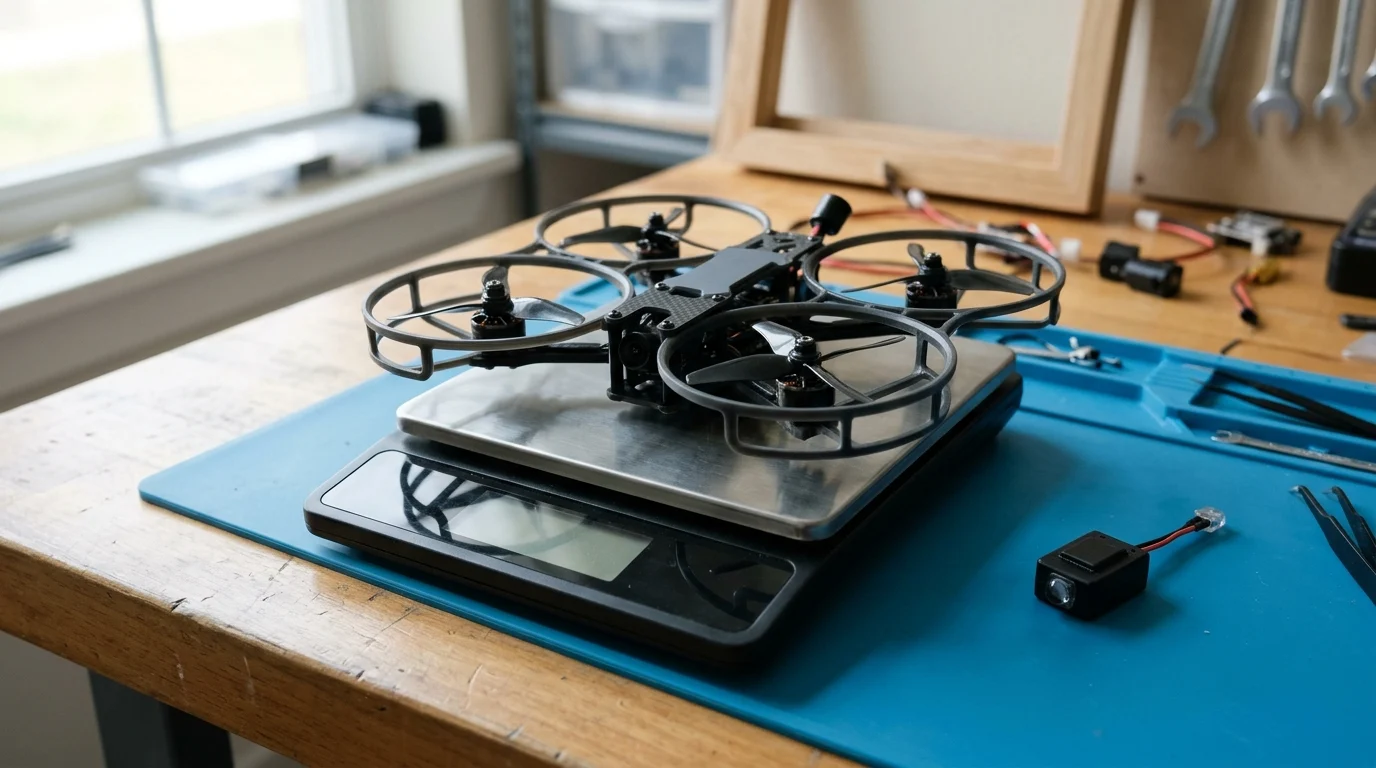
For Category 1 operations, remote pilots may install protective devices made available by the original unmanned aircraft manufacturer, purchased as aftermarket parts, or designed and installed by the owner or operator, provided the remote pilot ensures the small unmanned aircraft does not contain exposed rotating parts that would lacerate human skin and does not exceed the 0.55-pound weight-based limitation of Category 1.
Under paragraph 8.14.1 and Appendix E of AC 107-2A, operating a small unmanned aircraft over human beings at night under part 107 subpart D requires both category eligibility and a functioning anti-collision light that can be seen for at least 3 statute miles (3 sm); in declaring any small unmanned aircraft eligible for Category 2 or 3 operations at night, manufacturers will most likely need to consider the mass of an anti-collision light in declaring the aircraft fulfills §§ 107.120(a) or 107.130(a). Flight crews evaluating how added accessories affect endurance can consult our guide on the drone payload capacity and flight time degradation curve.
Under § 107.115(a) and (b), to conduct Category 2 operations, a remote pilot in command must use a small unmanned aircraft that is eligible under § 107.120(a), is listed on an FAA-accepted declaration of compliance under § 107.160, and is labeled as eligible to conduct Category 2 operations under § 107.120(b)(1), and may not operate in sustained flight over open-air assemblies of human beings unless the operation meets § 89.110 or § 89.115(a). Under § 107.120(b)(1)–(3), a Category 2 declaration of compliance applicant must display a legible, prominent, permanently affixed label in English indicating Category 2 eligibility, provide remote pilot operating instructions upon sale, transfer, or use by another person pursuant to § 107.160, and maintain product support and notification procedures to notify the public and the FAA of any defect or condition causing noncompliance or any identified safety defect that causes the small unmanned aircraft to exceed a low probability of casualty.
Under § 107.125(a)–(c), to conduct Category 3 operations, a remote pilot in command must use an aircraft eligible under § 107.130(a), listed on an FAA-accepted DOC under § 107.160, and labeled under § 107.130(b)(1); must not operate the small unmanned aircraft over open-air assemblies of human beings; and may only operate above any human being if (1) the operation is within or over a closed- or restricted-access site where all human beings are on notice that a small unmanned aircraft may fly over them, or (2) the aircraft does not maintain sustained flight over any human being unless that human being is directly participating in the operation or located under a covered structure or inside a stationary vehicle that can provide reasonable protection from a falling small unmanned aircraft.
Under § 107.135, if a Category 2 or Category 3 label affixed to a small unmanned aircraft is damaged, destroyed, or missing, a remote pilot in command must label the aircraft in English such that the label is legible, prominent, and will remain on the small unmanned aircraft for the duration of the operation before conducting operations over human beings. Under paragraph 8.11.2.1 of AC 107-2A, the FAA does not prescribe a specific font size or location for Category 2 or Category 3 labels; an applicant may use labels such as “Category 2” or “Category 3” painted, etched, or affixed externally to the aircraft by any permanent means. Under § 107.150, a small unmanned aircraft system may be eligible for one or more categories of operation over human beings under Subpart D, as long as a remote pilot in command cannot inadvertently switch between modes or configurations.
Under § 107.140(c)(4) and (5), the owner or operator of a Category 4 small unmanned aircraft must retain records documenting maintenance, preventive maintenance, or alterations for 1 year from when the work is completed (or until repeated or superseded), must retain and transfer with the aircraft upon change in ownership all records documenting the status of life-limited parts, compliance with airworthiness directives, and inspection status, and must ensure all such records are available for inspection upon request from the Administrator or any authorized representative of the National Transportation Safety Board (NTSB). Under paragraph (d) of § 107.140 (Amendment 107-8, 86 FR 4383, January 15, 2021; 86 FR 13633, March 10, 2021), compliance with part 43 and part 91, subpart E, fulfills the requirements in paragraphs (b)(3) and (c) of that section.
Rigid-Object Impact Kinetic Energy vs. Elastic Airframe Deformation and Laceration Rules
Under the FAA-provided Means of Compliance in paragraph 8.6.1.5 of AC 107-2A, maximum impact kinetic energy is calculated as KEimpact = 0.0155 × w × v2 (where KEimpact is in ft-lbs, w is weight in pounds, and v is maximum impact speed in ft/s); a 1.0 pound small unmanned aircraft with a maximum impact speed of 26 ft/s has KEimpact = 0.0155 × 1.0 × (26)2 = 10.5 ft-lbs, and at 40 ft/s has KEimpact = 0.0155 × 1.0 × (40)2 = 24.8 ft-lbs. Under Tables 8-5 and 8-6 of AC 107-2A (FAA-provided MOC without energy-absorbing characteristics), maximum impact speeds for Category 2 (11 ft-lbs) and Category 3 (25 ft-lbs) are: for 1.0 lbs, 26 ft/sec (18 mph) in Category 2 and 40 ft/sec (27 mph) in Category 3; for 1.5 lbs, 22 ft/sec (15 mph) and 33 ft/sec (22 mph); for 2.0 lbs, 19 ft/sec (13 mph) and 28 ft/sec (19 mph); for 2.5 lbs, 17 ft/sec (11 mph) and 25 ft/sec (17 mph); and for 3.0 lbs, 15 ft/sec (10 mph) and 23 ft/sec (16 mph).
| Mass Range | Lower Injury Threshold Speed Profile | Higher Injury Threshold Speed Profile |
|---|---|---|
| 1.0 pound (AC 107-2A paragraph 8.6.1.5) | Maximum impact speed of 26 ft/s yields KEimpact = 0.0155 × 1.0 × (26)2 = 10.5 ft-lbs under the formula KEimpact = 0.0155 × w × v2 | Maximum impact speed of 40 ft/s yields KEimpact = 0.0155 × 1.0 × (40)2 = 24.8 ft-lbs under the formula KEimpact = 0.0155 × w × v2 |
| 1.0 lbs to 3.0 lbs (AC 107-2A Tables 8-5 and 8-6) | Category 2 (11 ft-lbs): 26 ft/sec (18 mph) at 1.0 lbs, 22 ft/sec (15 mph) at 1.5 lbs, 19 ft/sec (13 mph) at 2.0 lbs, 17 ft/sec (11 mph) at 2.5 lbs, and 15 ft/sec (10 mph) at 3.0 lbs | Category 3 (25 ft-lbs): 40 ft/sec (27 mph) at 1.0 lbs, 33 ft/sec (22 mph) at 1.5 lbs, 28 ft/sec (19 mph) at 2.0 lbs, 25 ft/sec (17 mph) at 2.5 lbs, and 23 ft/sec (16 mph) at 3.0 lbs |
Between 2015 and 2019, the FAA-sponsored ASSURE Tasks A4 and A14 (UAS Ground Collision Severity Evaluation) research performed over 512 impact tests and simulations with 16 different fixed-wing and multi-rotor UAS, as well as various objects and payloads with weights ranging from 0.75 pounds to 13.2 pounds; wood blocks assessed the injury resulting from an impact kinetic energy transfer from a rigid object, crash test dummies were used to review and determine thresholds of serious but non-lethal injury utilizing the Abbreviated Injury Scale (AIS), and Post Mortem Human Subjects (PMHS) testing compared those crash test dummy thresholds with injury thresholds yielded from PMHS testing.
Because small unmanned aircraft have greater flexibility and frangibility than rigid objects and transfer only a portion of their pre-impact kinetic energy during impact, FAA analysis of the ASSURE research found that, for a certain impact orientation, a DJI Phantom 3 can impact a person with up to 130 ft-lbs of pre-impact kinetic energy before exceeding the proposed Category 2 injury threshold—up to 11 times more pre-impact kinetic energy than a rigid object (130 ft-lbs vs. 11 ft-lbs) for the same level of injury severity—and FAA analysis of ASSURE’s Anthropomorphic Test Dummy (ATD) Impact Head Injury Criteria (HIC 15) results showed that the Phantom 3 would need to achieve a pre-impact kinetic energy of 130 ft-lbs to cause an equivalent HIC 15 injury level to a rigid object at 11 ft-lbs and 220 ft-lbs to cause an equivalent HIC 15 injury level to a rigid object at 25 ft-lbs. In the final rule, the FAA explained that Category 3’s injury threshold of 25 feet-lbs (about 34 Joules) for impact with a solid object is lower than the European Union Aviation Safety Agency (EASA) Sub-category C1 limit of 80 joules because EASA Sub-category C1 also mandates noise, alerting, structural, navigation, and datalink design requirements that are not included in FAA Category 2 or Category 3 eligibility requirements.
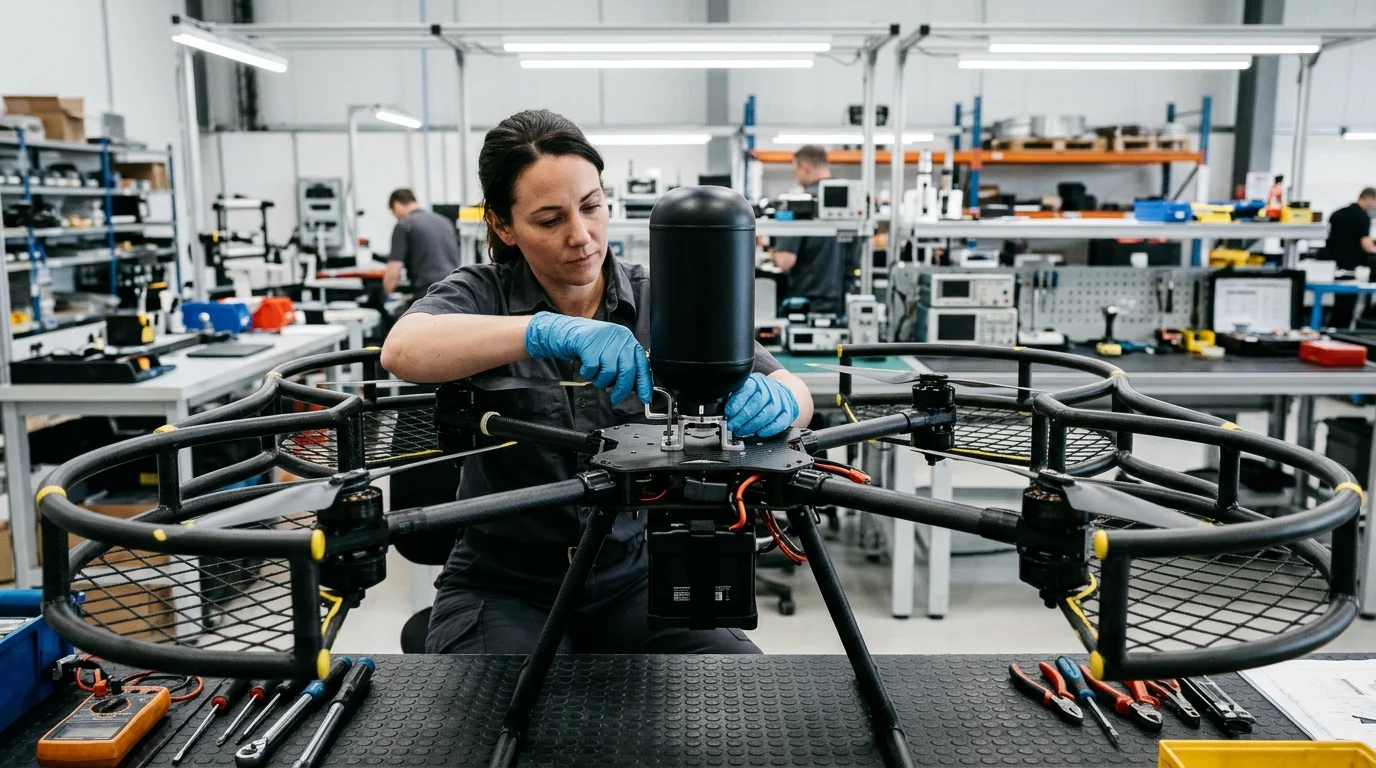
Applicants may choose to demonstrate compliance with Category 2 or Category 3 safety requirements using designs with safety features such as frangible components, propeller cages, propeller guards, parachutes, or padding, provided they use an FAA-accepted means of compliance that incorporates those safety features as a means to comply with the injury severity limitations.
Under paragraphs 8.7.2, 8.7.5, and 8.7.6 of AC 107-2A, the FAA distinguishes a “laceration” (a cut that goes all the way through the skin) from an “abrasion” (a superficial injury to the skin); compliance with the exposed rotating parts prohibition may be achieved using safety features such as propeller guards or technology to stop the exposed rotating part before it would lacerate skin.
Open-Air Assemblies, Broadcast Modules, and Operations Over Moving Vehicles
According to FAA waiver definitions, whether an “open-air assembly” exists is determined on a case-by-case basis: potential examples of open-air assemblies include sporting events, concerts, parades, protests, political rallies, community festivals, or parks and beaches during certain events, whereas individual persons or families exiting a shopping center, athletes participating in friendly sports in an open area without spectators, individuals or small groups taking leisure in a park or on a beach, or individuals walking or riding a bike along a bike path might not be considered open-air assemblies. Sustained flight over an open-air assembly includes hovering above the heads of persons gathered in an open-air assembly, flying back and forth over an open-air assembly, or circling above the assembly in such a way that the small unmanned aircraft remains above some part of the assembly; in a Category 1, 2, or 4 operation, sustained flight does not include a brief, one-time transiting over a portion of the assembled gathering where the transit is merely incidental to a point-to-point operation unrelated to the assembly.
Under § 107.110(b), no remote pilot in command may operate a small unmanned aircraft in sustained flight over open-air assemblies of human beings under Category 1 unless the operation meets the requirements of either § 89.110 or § 89.115(a). Fleet administrators managing serial number records for broadcast modules and standard remote identification aircraft can reference our guide on Remote ID serial number fleet registration.
Under § 107.145, no person may operate a small unmanned aircraft over a human being located inside a moving vehicle unless the operation occurs in accordance with Category 1 (§ 107.110), Category 2 (§ 107.115), Category 3 (§ 107.125), or Category 4 (§ 107.140) requirements; for Category 1, Category 2, or Category 3, throughout the operation the small unmanned aircraft must either (1) remain within or over a closed- or restricted-access site where all human beings located inside a moving vehicle within the site are on notice that a small unmanned aircraft may fly over them, or (2) not maintain sustained flight over moving vehicles; and for a Category 4 operation under § 107.145(c)(1) and (2), the small unmanned aircraft must have an airworthiness certificate issued under part 21 and be operated in accordance with the operating limitations specified in the approved Flight Manual or as otherwise specified by the Administrator, which must not prohibit operations over human beings located inside moving vehicles. Under the operations over moving vehicles rule, the FAA considers a vehicle to be any means of transportation regardless of whether it is motorized, including cars, trucks, buses, trains, motorcycles, scooters, rollercoasters, non-motorized bicycles, and watercraft such as sightseeing vessels, motorboats, and personal watercraft. Public safety agencies drafting SOPs for urban overflight can align these constraints with our drone first responder policy review matrix.
Means of Compliance, Declaration Verification, Hardware Modifications, and Federal Register Rescissions
Under § 107.155(a)–(d), a means of compliance for Category 2 (§ 107.120(a)) or Category 3 (§ 107.130(a)) must consist of test, analysis, or inspection, must be accepted by the FAA before an applicant relies on it, and is subject to ongoing review by the Administrator, who may rescind acceptance of a means of compliance by publishing a notice of rescission in the Federal Register.
On December 16, 2021 (Federal Register Document 2021-27188, Docket No. FAA-2021-1158), the FAA formally accepted the Virginia Tech Mid-Atlantic Aviation Partnership (VT MAAP) Operation of Small UAS Over People Means of Compliance (MOC) Version 1.0 (published October 20, 2021) as an acceptable means of demonstrating compliance with § 107.120(a) for Category 2 and § 107.130(a) for Category 3 operations over people.
Effective December 30, 2024 (Federal Register Document 2024-31234, Docket No. FAA-2024-2403), the FAA formally accepted VT MAAP’s “Operation of Small Unmanned Aircraft Systems Over People,” version 2.1, dated August 9, 2024, as an acceptable means of compliance with §§ 107.120(a) and 107.130(a) for Category 2 and Category 3 operations over human beings, noting that future revisions to version 2.1 will not be automatically accepted.
Under § 107.160(a), to declare a small unmanned aircraft compliant for Category 2 or Category 3 operations, an applicant must submit a declaration of compliance for acceptance by the FAA that includes: the applicant’s name, physical address, and email address; the small unmanned aircraft make and model name, and series, if applicable; the serial number or range of serial numbers that are the subject of the declaration; whether the declaration of compliance is an initial declaration or an amended declaration, and, if amended, the reason for the re-submittal; the accepted means of compliance used to fulfill § 107.120(a) or § 107.130(a) or both; a declaration that the applicant has demonstrated that the small unmanned aircraft, or specific configurations of that aircraft, satisfies § 107.120(a) or § 107.130(a) or both through the accepted means of compliance, has verified that the unmanned aircraft does not contain any safety defects, has satisfied § 107.120(b)(3) or § 107.130(b)(3) or both, and will, upon request, allow the Administrator to inspect its facilities, technical data, and any manufactured small unmanned aircraft and witness any tests necessary to determine compliance with Subpart D; and other information as required by the Administrator. Under § 107.165(a) and (b), a person who submits a declaration of compliance and produces a small unmanned aircraft must retain all supporting compliance information for two years after the cessation of production, a person who designs or modifies a small unmanned aircraft must retain the supporting information for two years after submitting the declaration of compliance, and a person who submits a means of compliance must retain its detailed description and justification for as long as the means of compliance remains accepted. Under paragraphs 8.3.5.1 and 8.3.6.1 of AC 107-2A, it is the remote pilot’s responsibility to ensure that the small unmanned aircraft is listed on an FAA-accepted DOC and labeled for Category 2 or Category 3 operations by checking online at uasdoc.faa.gov to see if the DOC is valid and by visually inspecting the aircraft to ensure the category label is affixed.
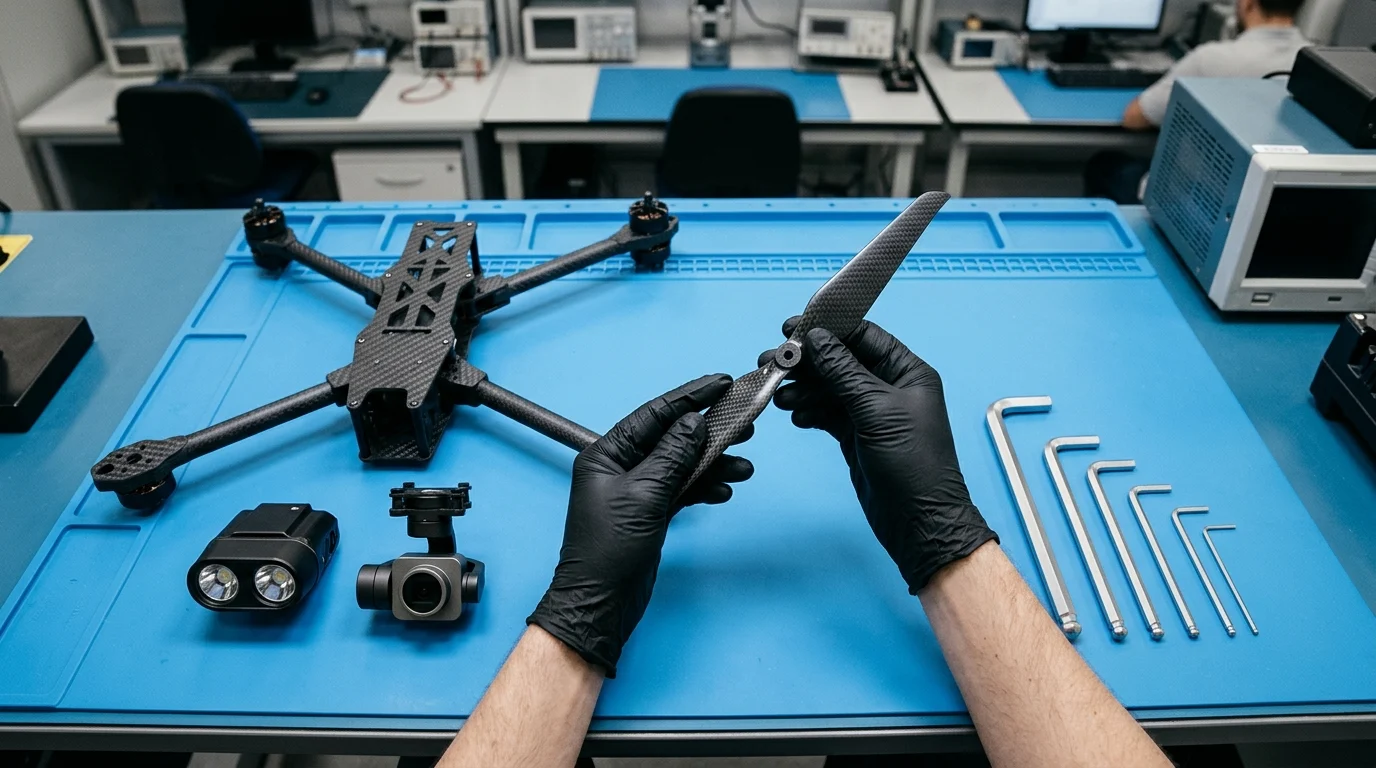
Under paragraph 8.12.1 and Figure 8-2 of AC 107-2A, remote pilot operating instructions for Category 2 or Category 3 aircraft must clearly identify any specific component that must be attached (such as a separately provided parachute system, or the Category-specific rotor blades and guards in Figure 8-2) and, if modifications are allowed, provide a complete description of allowable modifications and any payload that may be included on the aircraft; any modification that affects Category 2 or Category 3 eligibility requires a new DOC for FAA acceptance before the aircraft is eligible to operate over people, and in the Figure 8-2 sample, replacing the camera with anything other than a pre-approved camera listed in the remote pilot operating instructions, or affixing any other payload that is not listed there, results in ineligibility to operate over people in accordance with Category 2 or Category 3.
Under paragraphs 8.4.3–8.4.5 of AC 107-2A, any person who makes a modification not permissible by the remote pilot operating instructions to a small unmanned aircraft eligible for Category 2 or Category 3 operations over people—such as altering its declared configuration or replacing propellers not covered in the remote pilot operating instructions—renders that small unmanned aircraft ineligible for operations over people unless that person takes on the responsibilities of an applicant, verifies compliance using an FAA-accepted MOC, and submits a new DOC. Under § 107.160(d) and (e), no person may operate a small unmanned aircraft identified on a rescinded declaration of compliance while it is rescinded; for non-emergency unresolved safety issues, the FAA issues a notice proposing to rescind the DOC and provides the holder 30 calendar days to submit evidentiary or compliance information (with 60 days after rescission issuance to petition for reconsideration), whereas if an emergency exists related to safety, the FAA may issue an immediate order rescinding the DOC under 49 USC 46105(c).
Effective September 18, 2025 (Federal Register Document 2025-18099, Docket No. FAA-2025-2926), the FAA rescinded Operations Over People declaration of compliance tracking number OOP000000176 for the Skydio X10 with Aerial Vehicle Safety Solutions (AVSS) Parachute Recovery System (PRS-X10)—originally accepted by the FAA on August 26, 2024—after AVSS voluntarily requested rescission on April 2, 2025 because it is no longer supporting this unmanned aircraft configuration and no production units were sold.
Effective October 18, 2025 (Federal Register Document 2025-18100, Docket No. FAA-2025-2927), the FAA rescinded Operations Over People declaration of compliance tracking number OOP000000178 for the DJI Mavic 3 Multispectral (M3M) with Aerial Vehicle Safety Solutions (AVSS) Parachute Recovery System (PRS-M3E)—originally accepted by the FAA on August 29, 2024—after AVSS voluntarily requested rescission on April 2, 2025 because it is no longer supporting the configuration and the AVSS Parachute Recovery System (PRS-M3E) is not compatible with the DJI Mavic 3 Multispectral unmanned aircraft series.
| Declaration Tracking Number | Covered Aircraft and Parachute System | Rescission Effective Date and Federal Register Docket |
|---|---|---|
| OOP000000176 | Skydio X10 with Aerial Vehicle Safety Solutions (AVSS) Parachute Recovery System (PRS-X10), originally accepted August 26, 2024 | Rescinded effective September 18, 2025 (Federal Register Document 2025-18099, Docket No. FAA-2025-2926) following AVSS’s April 2, 2025 voluntary rescission request because it is no longer supporting this configuration and no production units were sold |
| OOP000000178 | DJI Mavic 3 Multispectral (M3M) with Aerial Vehicle Safety Solutions (AVSS) Parachute Recovery System (PRS-M3E), originally accepted August 29, 2024 | Rescinded effective October 18, 2025 (Federal Register Document 2025-18100, Docket No. FAA-2025-2927) following AVSS’s April 2, 2025 voluntary rescission request after identifying that the PRS-M3E is not compatible with the DJI Mavic 3 Multispectral series |
To fly over a person or over moving vehicles with a small UAS that does not meet the conditions of operational Categories 1, 2, 3, or 4, an operator must apply for a Part 107 operational waiver from § 107.39 (Operation over human beings) or § 107.145 (Operations Over Moving Vehicles) through the FAA’s Aviation Integrated Safety (AIS) Services system; the FAA reviews waiver requests with a target of within 90 days of submission, and if the applicant does not respond to an FAA request for information within 30 days, the application is canceled.
Operators preparing airspace waiver packages or emergency responder filings can consult our guides on the airspace and operational waiver application process and the emergency drone authorization SGI checklist.
Pre-Flight Operations Over People Verification Checklist
| Pre-Flight Audit Step | Regulatory Reference | Field Verification Requirement |
|---|---|---|
| Verify human participation or cover protection | § 107.39 (Amendment 107-8, 86 FR 4382, January 15, 2021) | Confirm that no person operates a small unmanned aircraft over a human being unless that human being is directly participating in the operation, is located under a covered structure or inside a stationary vehicle that can provide reasonable protection from a falling small unmanned aircraft, or the operation meets at least one operational category in subpart D. |
| Weigh Category 1 aircraft with all attached accessories | § 107.110(a)(1) and (2) | Confirm that the small unmanned aircraft weighs 0.55 pounds or less on takeoff and throughout the duration of each operation under Category 1, including everything on board or otherwise attached, and does not contain any exposed rotating parts that would lacerate human skin upon impact with a human being. |
| Confirm active DOC status at uasdoc.faa.gov and inspect exterior label | AC 107-2A paragraphs 8.3.5.1 and 8.3.6.1 | Ensure that the small unmanned aircraft is listed on an FAA-accepted DOC and labeled for Category 2 or Category 3 operations by checking online at uasdoc.faa.gov to see if the DOC is valid and by visually inspecting the aircraft to ensure the category label is affixed. |
| Audit attached payloads, cameras, and rotor blades against the RPOI | AC 107-2A paragraph 8.12.1 and Figure 8-2 | Verify that any required component (such as a separately provided parachute system, or the Category-specific rotor blades and guards in Figure 8-2) is attached and, per the Figure 8-2 sample, that no camera other than a pre-approved camera listed in the remote pilot operating instructions, and no other payload that is not listed there, is affixed to the Category 2 or Category 3 aircraft. |
| Verify Remote ID compliance before sustained flight over open-air assemblies | § 107.110(b) and § 89.110 or § 89.115(a) | Confirm that no remote pilot in command operates a small unmanned aircraft in sustained flight over open-air assemblies of human beings under Category 1 unless the operation meets the requirements of either § 89.110 or § 89.115(a). |
| Verify physical possession of remote pilot certificate and identification | Operations Over People Final Rule | Ensure the remote pilot in command, owner, or person manipulating the flight controls has in physical possession and readily accessible their remote pilot certificate with a small UAS rating and identification when exercising remote pilot privileges, and is prepared to present them upon request from the FAA, NTSB, TSA, or any Federal, state, or local law enforcement officer. |
Frequently Asked Questions
Can a remote pilot install aftermarket propeller guards to qualify a small quadcopter for flights over people?
When conducting Category 1 operations, remote pilots may install protective devices made available by the original unmanned aircraft manufacturer, purchased as aftermarket parts, or designed and installed by the owner or operator, provided the remote pilot ensures the small unmanned aircraft does not contain exposed rotating parts that would lacerate human skin and does not exceed the 0.55-pound weight-based limitation of Category 1.
Does briefly flying across the edge of a crowd count as sustained flight over an open-air assembly?
In a Category 1, 2, or 4 operation, sustained flight over an open-air assembly does not include a brief, one-time transiting over a portion of the assembled gathering where the transit is merely incidental to a point-to-point operation unrelated to the assembly, whereas hovering above the heads of persons gathered, flying back and forth, or circling above the assembly in such a way that the small unmanned aircraft remains above some part of the assembly constitutes sustained flight.
What happens if an exterior category label becomes illegible or if an unlisted payload is attached?
When a Category 2 or Category 3 label affixed to a small unmanned aircraft is damaged, destroyed, or missing, § 107.135 requires a remote pilot in command to label the aircraft in English such that the label is legible, prominent, and will remain on the small unmanned aircraft for the duration of the operation before conducting operations over human beings. Furthermore, under paragraph 8.12.1 and the Figure 8-2 sample remote pilot operating instructions in AC 107-2A, replacing the camera with a camera that is not a pre-approved camera listed in the remote pilot operating instructions, or affixing any other payload that is not listed there, makes that configuration ineligible for Category 2 or Category 3 operations over people.
Are the Skydio and Mavic Multispectral parachute declarations still valid for operations over people?
Following Aerial Vehicle Safety Solutions (AVSS) voluntary rescission requests on April 2, 2025, the FAA rescinded Operations Over People declaration of compliance tracking number OOP000000176 for the Skydio X10 with the AVSS Parachute Recovery System (PRS-X10) effective September 18, 2025 (Federal Register Document 2025-18099, Docket No. FAA-2025-2926, originally accepted August 26, 2024) because AVSS is no longer supporting this unmanned aircraft configuration and no production units were sold. Similarly, the FAA rescinded declaration of compliance tracking number OOP000000178 for the DJI Mavic 3 Multispectral (M3M) with the AVSS Parachute Recovery System (PRS-M3E) effective October 18, 2025 (Federal Register Document 2025-18100, Docket No. FAA-2025-2927, originally accepted August 29, 2024) because AVSS is no longer supporting the configuration and the PRS-M3E is not compatible with the DJI Mavic 3 Multispectral unmanned aircraft series.
Sources
- Electronic Code of Federal Regulations — Title Fourteen Aeronautics and Space, Small Unmanned Aircraft Systems, Subpart B Operating Rules and Subpart D Operations Over Human Beings
- Federal Aviation Administration — Advisory Circular for Small Unmanned Aircraft Systems
- Federal Aviation Administration — Operations Over People General Overview and Executive Summary
- Federal Aviation Administration — Small Unmanned Aircraft System Waivers Guidance
- Federal Register — Operation of Small Unmanned Aircraft Systems Over People Final Rule and Official Notices