This site is an independent publication named after the domain once used by the First Responder UAS Triple Challenge. It is not that competition’s organizer and is not affiliated with NIST or the universities involved; this explainer covers the problem behind the competition’s LifeLink challenge.
Search teams, wildfire crews and disaster responders often work where cell service is weak or gone. A drone can carry a radio above them and restore some connectivity, but “a drone relay” covers several quite different systems. This page separates them and explains what each depends on, using FirstNet, FCC and NIST material, IETF standards and published research.
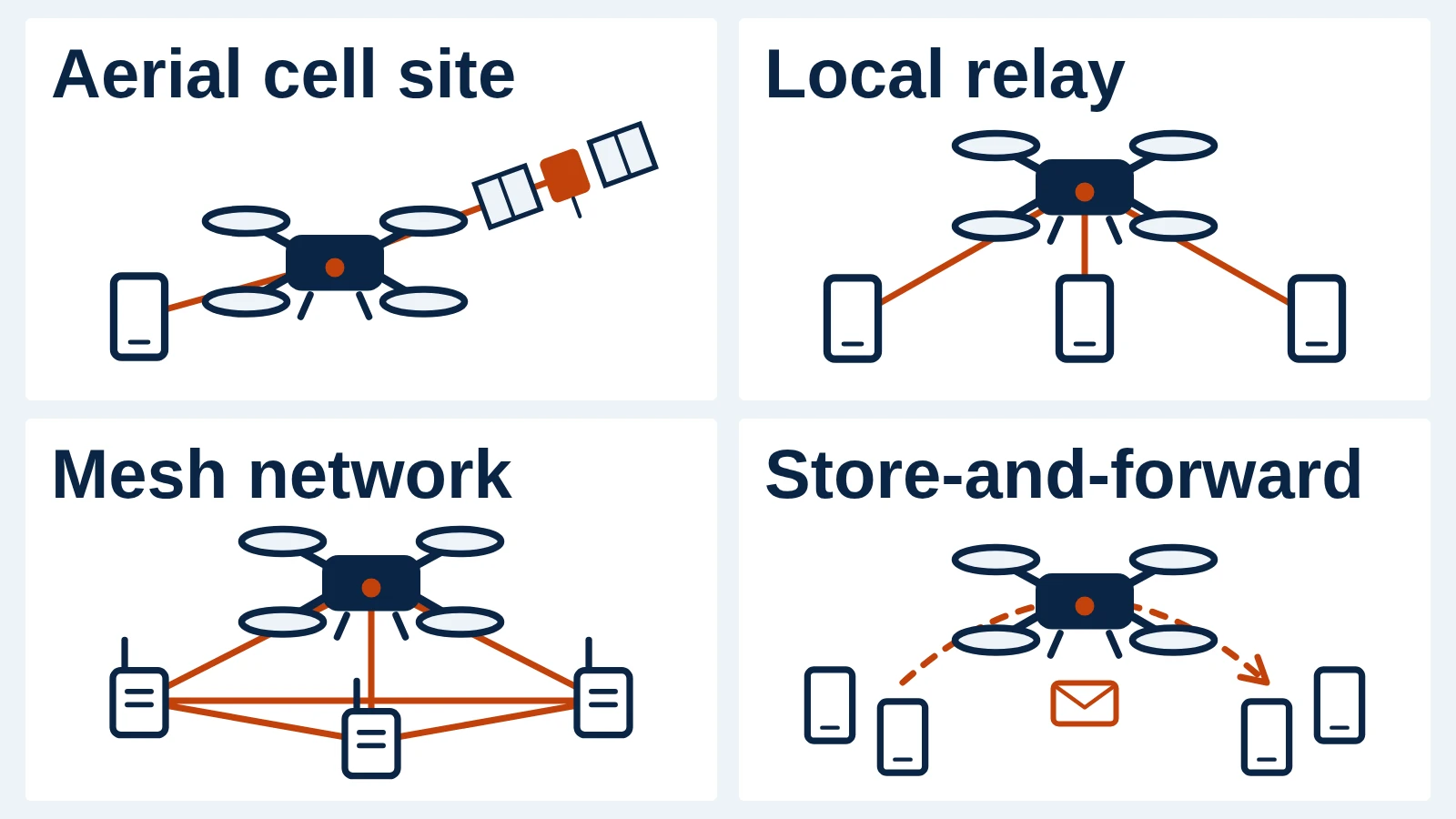
A drone communications relay is a radio carried aloft so that devices on the ground can reach each other, or reach the wider network, where terrain or missing infrastructure blocks a direct link. There are four broad designs: an aerial cell site that connects back to the network through backhaul, such as the satellite links FirstNet describes for its deployables; a local relay that links devices at the scene; a mesh network of moving nodes; and store-and-forward, where the drone carries data between groups and accepts delay. Which one fits depends on whether responders need a connection out of the scene and whether they can wait for data. Every design is limited by power and flight time, by terrain and trees between the drone and the users, and by the spectrum and aviation rules it operates under.
Key points:
- Without a link out of the scene, a drone relay connects only the devices within its own network; reaching a dispatch center or agency outside that network needs a separate link, which need not be the public internet.
- FirstNet’s Flying Cell on Wings is a tethered aerial cell site; a free-flying relay trades that persistence for mobility.
- The dedicated UAS spectrum the FCC opened in 2024 is for flying the aircraft, not for carrying users’ traffic.
- “Connected” can mean anything from a reply to a ping to usable video; ask which one a system was measured against.
What does a drone communications relay do?
It puts a radio where it can see the users when they cannot see each other or a tower. Zeng, Zhang and Lim’s 2016 overview in IEEE Communications Magazine describes three typical uses of drones in wireless communications, and a drone relay for responders can play any of them.
| Role | What the drone does | Example given in the source |
|---|---|---|
| Coverage | Assists the existing infrastructure, where there is any, to provide seamless coverage over an area | Rapid service recovery after infrastructure damage in a natural disaster |
| Relaying | Connects two or more distant users or user groups that have no reliable direct link | Linking the frontline and the command center in an emergency response |
| Dissemination and collection | Flies to distributed ground devices to deliver or collect data that can tolerate delay | Collecting data from wireless sensors, for example in precision agriculture |
The same overview notes that low-altitude drone systems are generally faster to deploy and easier to reconfigure than terrestrial infrastructure or high-altitude platforms, and are likely to have better radio channels because of short line-of-sight links. It also notes the cost: drones are highly mobile and energy-constrained, which creates new design problems. A later tutorial by Mozaffari and colleagues frames the drone either as an aerial base station that improves coverage and capacity or as a flying terminal that itself connects to a cellular network.
Why do first responders need one?
Because many missions happen where there is no cellular broadband, and responders say they would use it if it were there. In NIST PSCR’s 2019 survey of 183 first responders (published in 2020 as NISTIR 8305), over 69% said they had been on missions without cellular broadband, and over 94% of those said they would have wanted it during those missions.
The report gives PSCR’s reasoning: disasters can knock out power, backhaul and cell towers, so one research direction is to let responders operate without macro cellular coverage “by bringing the coverage with them,” using drones that carry wireless networks. The relay problem is therefore a continuity problem: keeping maps, messages, video and position reports moving between teams who are spread out and moving.
Which relay architecture fits which job?
If responders must reach people or systems outside the scene, start with an aerial cell site or another design with backhaul. If they mainly need to reach each other, a local relay or mesh network is enough. If the data can wait, store-and-forward is an option. The table below is our summary of the four designs, with the source for each mechanism.
| Architecture | How data moves | Needs a connection out of the scene? | Main constraint | Basis |
|---|---|---|---|---|
| Aerial cell site with backhaul | Drone carries a cell site; traffic goes back to the operator’s network over backhaul | Yes, that is its purpose | Backhaul capacity (FirstNet’s deployables rely on satellite); compatible devices | FirstNet fact sheet; Zeng et al. |
| Local relay (for example Wi-Fi) | Drone links devices at the scene to each other or to a command post | No, unless a gateway is added | Range and line of sight to every user | LifeLink use case; Zeng et al. |
| Mesh (mobile ad hoc) network | Drone and ground radios forward traffic for each other; nodes move freely | No; can run in isolation or through a gateway | Changing topology as nodes move | RFC 2501 |
| Store-and-forward (delay-tolerant) | Drone receives data, carries it, delivers it when in range of the next group | No | Delay; only suits data that can wait | RFC 4838; Zeng et al. |
Aerial cell site. FirstNet’s deployable program fact sheet (2020) describes AT&T’s Flying Cell on Wings (COW), offered to agencies that subscribe to FirstNet, as a system of tethered drones on a trailer, aimed at situations such as wildfires or mountain rescue where terrain makes connectivity hard. The same sheet warns that FirstNet’s deployables depend on satellite connectivity, that satellite bandwidth is “a very limited resource” compared with fiber, and that they are meant for FirstNet devices, not consumer traffic. A drone cell site restores coverage, but the backhaul sets how much traffic it can carry out.
Local relay and mesh. If responders mainly need to share data with each other, the drone does not need a path out at all. The IETF’s MANET document describes a mobile ad hoc network as an autonomous system of freely moving nodes that may operate in isolation or connect to a fixed network through gateways. A drone can be one high node in such a network.
Store-and-forward. IETF RFC 4838 describes delay-tolerant networking, which uses store-and-forward with persistent storage to get messages across disrupted links. Zeng and colleagues describe the drone version: for delay-tolerant data, a single drone can fly over ground nodes and communicate with them in turn, or fly back and forth between source and destination to shorten each link. In our reading, non-urgent map updates or status reports could travel this way when the mission allows the wait and the information is still useful on arrival; real-time voice cannot, and urgent alerts may not tolerate the delay either.
Tethered or free-flying?
A tether trades mobility for persistence. When NIST PSCR asked responders which would be more useful for a drone providing broadband coverage, their explanations pointed both ways:
| Tethered | Free-flying | |
|---|---|---|
| Reasons respondents gave | Additional flying time; long-term communications support; no need for another operator and observer | More flexibility; area-wide observation; a more versatile platform |
| What it suits (our reading) | Holding coverage over a fixed point, such as a staging area, for a long time | Following teams that move, or reaching places a vehicle cannot |
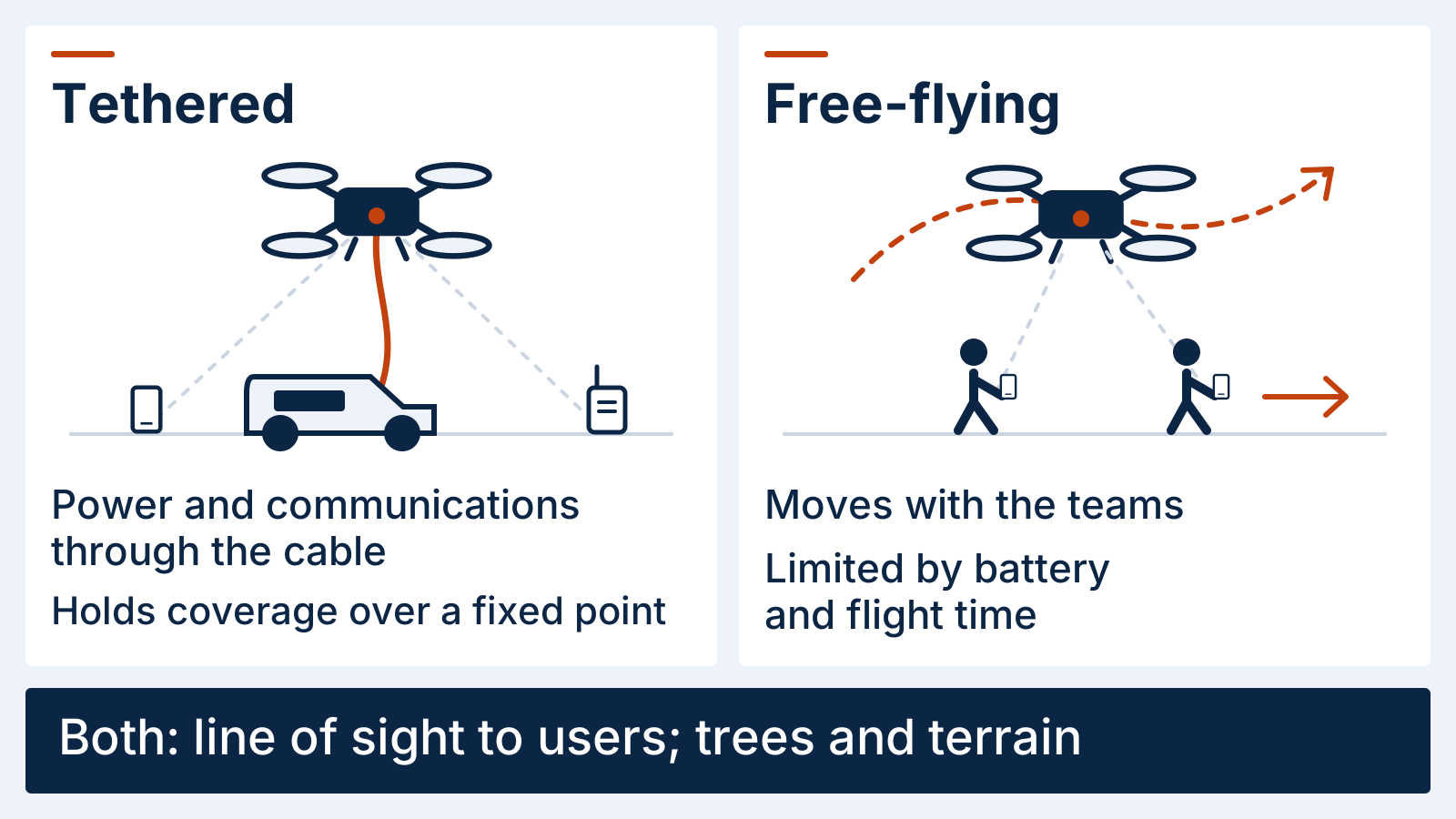
Other comments in the same set of answers: “Power is always an issue,” flying time and payload capacity, and a concern about flying a drone in areas with trees. Zeng and colleagues list size, weight and power limits as a core constraint on what a drone can carry and how long it can stay up. In the survey question, a tether supplied continuous power and communications between the ground station and the drone; it does not help with mobility.
What limits a relay drone?
Backhaul, power, movement, terrain, spectrum and aviation rules. Which one to check first depends on the design: backhaul for anything that must reach outside the scene, delay for store-and-forward, flight time for free-flying relays.
- Backhaul. An aerial cell site is only as useful outward as its link back to the network. FirstNet’s fact sheet asks users to save satellite bandwidth for mission-critical applications. Satellite communications for long-range drone flights are also a research topic: one of the FAA’s October 2026 drone research awards tests them.
- Power and flight time. Energy limits are a basic constraint for drones in communications (Zeng et al.), and responders named power as an issue in the NIST survey.
- A changing network. Moving drones create network topologies that are often sparse and intermittently connected (Zeng et al.). Systems need to keep working, or degrade gracefully, when links drop.
- Terrain and trees. The drone’s advantage is line of sight from above; anything between it and a handset (ridges, canopy, buildings) erodes that advantage.
- Spectrum. The FCC’s 2024 order (FCC 24-91) created rules in part 88 for drone use of the 5030–5091 MHz band, but limited that band to control-and-non-payload communications: transmissions between the aircraft and its ground station that support the safety or regularity of the flight. It did not permit payload communications there at this time, and it defines payload as information sent to achieve mission objectives. A relay’s user traffic is payload in those terms, so it runs on whatever radio and band the relay uses, under that band’s rules.
- Aviation rules. The relay is still an aircraft, and the authorization it flies under has to be checked for each mission. For flights under Part 107, 14 CFR 107.31 requires the crew to keep the aircraft in visual line of sight, and 14 CFR 107.205 lists that rule among those that can be waived. The FAA’s emergency Special Governmental Interest process can add authority to an existing certificate of authorization or remote pilot certificate for responders in emergencies; if a request is denied, operators should not fly outside their existing authorization. Our drone search and rescue explainer covers these rules in more detail.
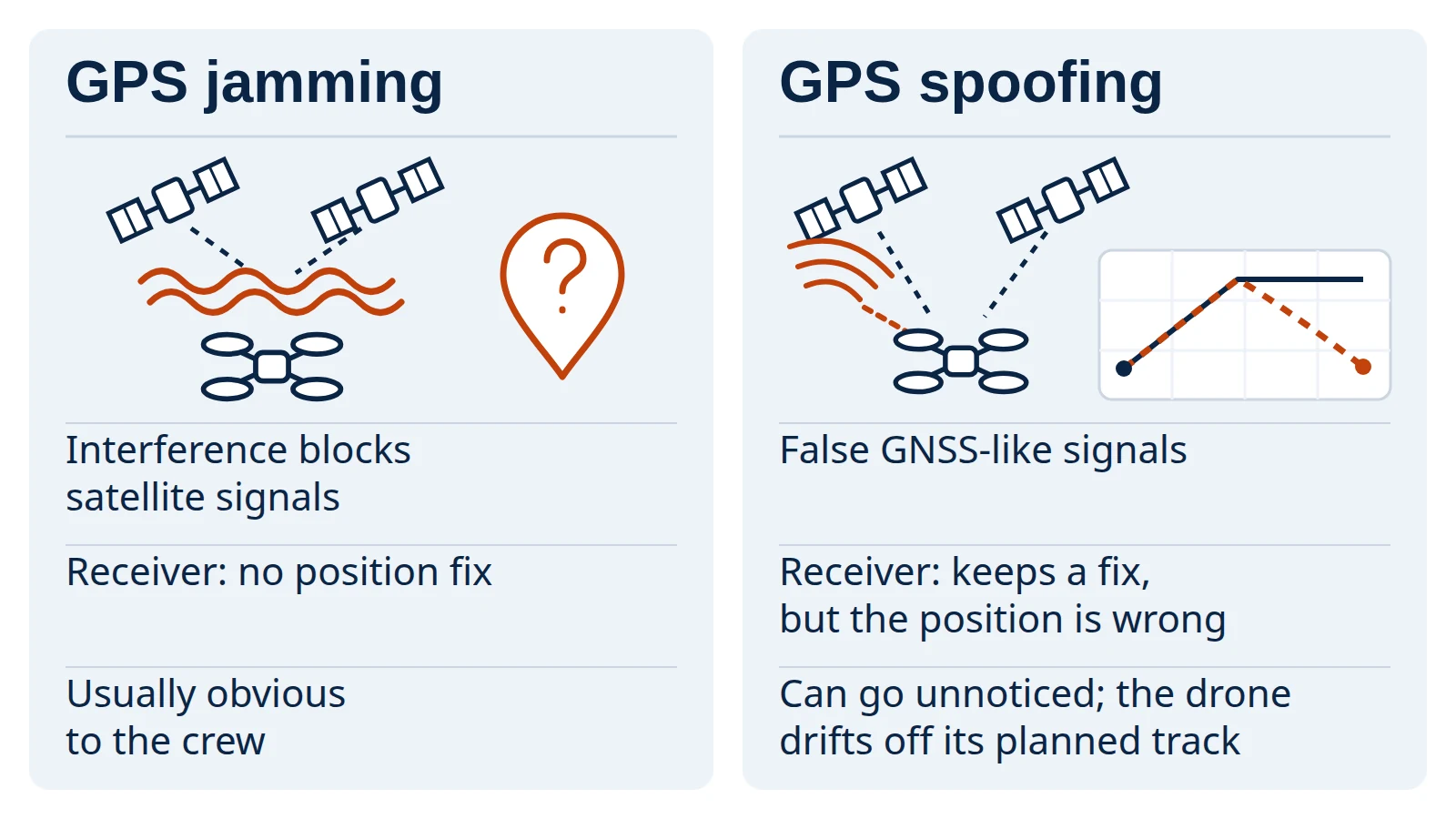
- The relay’s own navigation and control. A relay is only useful while it holds its position and stays under control; GPS jamming or spoofing can disturb both, as our explainer on GPS spoofing, jamming and drones describes.
A relay also only helps if someone has something to send: in a search, a clue’s location found by one team has to reach the others.
What did the 2021 LifeLink challenge ask for?
LifeLink, challenge 3.2 of NIST PSCR’s First Responder UAS Triple Challenge, asked contestants to design, build and fly a complete UAS that provides continuous IP connectivity to first responders dispersed in a thick forested area with degraded cellular coverage. The archived challenge page described several teams beyond cell reception who need to share updated map information on their phones, with a drone carrying a wireless transmitter, such as Wi-Fi, flying over each group.
The challenge FAQ (captured 25 October 2021) set conditions that line up with the trade-offs above: three to six user devices on the ground within a half-mile radius; a location counted as connected when the network could complete a ping to the device; delay-tolerant networking accepted, although continuous connectivity with minimum delay was described as the ideal; no use of cellular networks; and no tethers. The UAS Triple Challenge archive summarizes what the archived competition pages can confirm and links to NIST’s official results.
Questions to ask before relying on a relay
Check device compatibility, the link out of the scene, what “connected” means, capacity, terrain, delay, endurance, tethering, spectrum and aviation authorization. Ask these questions of a vendor, a mutual-aid partner or your own team:
- Which devices can connect: FirstNet or other cellular handsets, Wi-Fi devices, dedicated radios?
- Does it provide a connection out of the scene? If so, over what backhaul, and how much of that capacity is shared?
- What does “connected” mean in its test: a ping reply, a minimum data rate, or a working application such as video?
- How many users at once, spread over what kind of area?
- Was it tested with trees, ridges or buildings between the drone and the users?
- Real time or store-and-forward? Which of your applications can tolerate delay?
- How long does coverage last, and what happens at a battery change: a gap, or a hand-over to another aircraft?
- Tethered or free-flying, and who has to stay with it?
- Which radio bands does it use, and what authorization do they require?
- Which aviation authorization does the flight need where you will use it?
If an answer is missing, write it down as an open condition rather than assuming the best case.
Method and sources
This page is compiled from public sources, not from our own testing. The relay roles and constraints come from two IEEE review articles, read in their arXiv versions; network mechanisms come from IETF RFCs 2501 and 4838; the FirstNet description comes from the First Responder Network Authority’s 2020 deployables fact sheet, so asset counts and details may have changed since; survey figures come from NISTIR 8305; spectrum rules come from the FCC’s Report and Order FCC 24-91; aviation rules come from eCFR and the FAA’s emergency operations page. All were accessed on 7 October 2026. Competition details come from archived copies of the challenge website. Nothing here is a recommendation of a product or a spectrum or aviation compliance opinion.
Last updated: 7 October 2026.