An FAA Certificate of Waiver or Authorization (COA) allows qualifying government entities under 49 USC 40102(a)(41) and 49 USC 40125 to fly unmanned aircraft as Public Aircraft Operations under 14 CFR Part 91 while self-certifying their pilots and aircraft for statutory governmental functions. A single city can cover multiple departments under one COA when its designated Responsible Person maintains active oversight and operational control over every flight.
Government agencies, law enforcement departments, and public safety entities operating drones under 55 pounds have two distinct regulatory pathways under FAA public safety program guidance: civil small unmanned aircraft operations under 14 CFR Part 107, or Public Aircraft Operations (PAO) under 14 CFR Part 91 using a COA. Understanding where statutory eligibility begins, what the 2026 Part 91.113 Certificate of Waiver and Authorization (CoW/A) changes, and how municipal oversight prevents non-governmental flight contamination determines whether a public safety fleet stays audit-ready.
When should public safety agencies apply for an FAA COA instead of flying under Part 107?
Public safety agencies pursue an FAA COA when they qualify as a statutory governmental entity, fly owned or exclusively leased aircraft on qualifying governmental functions, and want agency-level pilot and aircraft self-certification or Part 91 BVLOS relief rather than civil Part 107 limits.
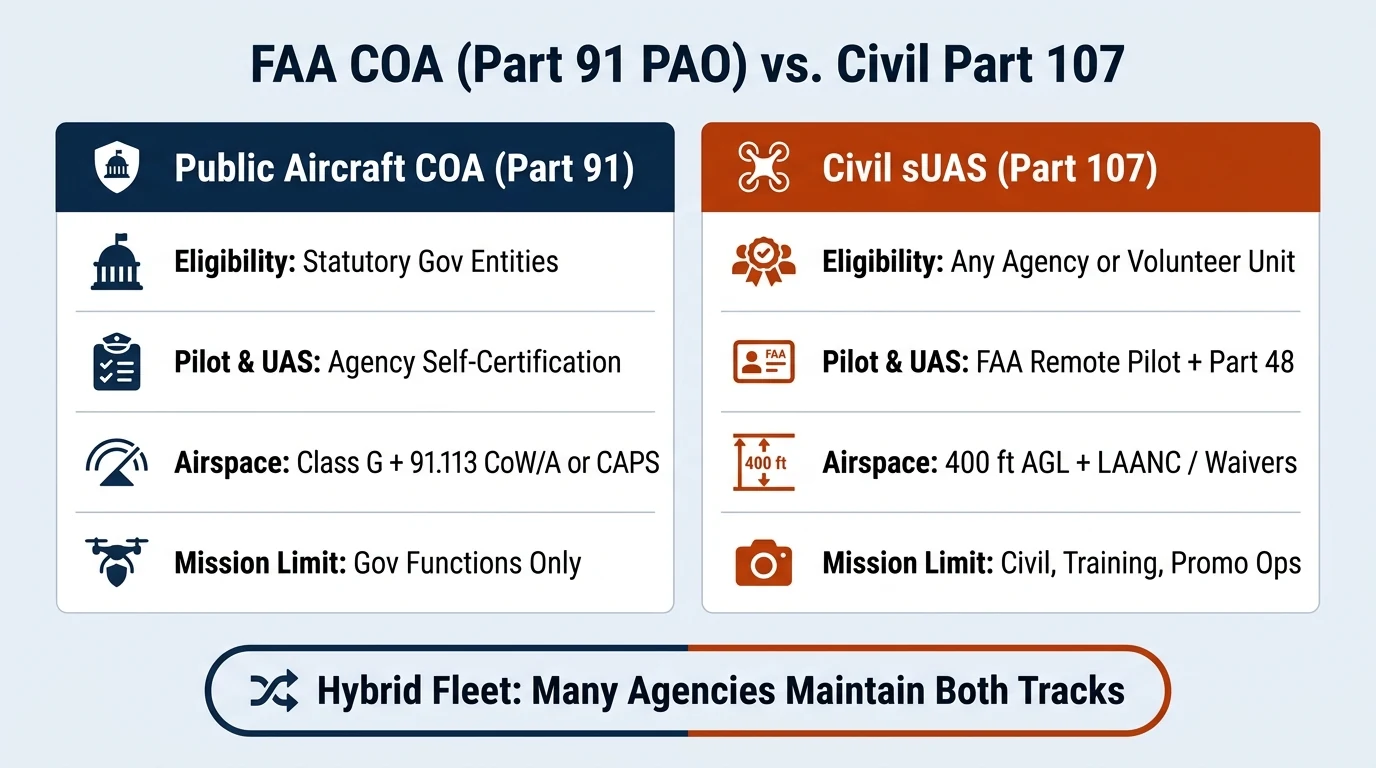
Eligibility for a Certificate of Waiver or Authorization is governed by federal statute, not by community benefit. Under FAA Aeronautical Information Manual Chapter 11, Section 4, a flight qualifies as a public aircraft operation only when two conditions hold simultaneously: the operator is a qualifying governmental entity under 49 USC 40102(a)(41), and the mission satisfies the governmental function criteria of 49 USC 40125.
Aircraft ownership or lease tenure also matters. Public aircraft are aircraft owned and operated by a state, the District of Columbia, a United States territory or possession, or a political subdivision of one of those governments, or aircraft exclusively leased by that governmental body for at least 90 continuous days, subject to 49 USC 40125(b).
Qualifying governmental functions listed by the FAA include:
- Law enforcement, including prisoner and detainee transport support
- Firefighting and wildfire support
- Search and rescue
- National defense and intelligence missions
- Aeronautical research
- Biological or geopolitical resource management
Any flight outside those statutory boundaries reverts automatically to civil aircraft status. The FAA explicitly warns that an operation for the public good does not automatically qualify as a public aircraft operation: most volunteer fire departments, volunteer search and rescue units, and tax-exempt nonprofit organizations are not statutorily eligible for PAO status and must fly under 14 CFR Part 107. Likewise, an aircraft described under 49 USC 40102(a)(41) loses public aircraft qualification when used for commercial purposes or non-governmental tasks, such as a police drone filming department promotional footage even without remuneration.
| Regulatory Dimension | FAA COA / Part 91 Public Aircraft Operation | Civil sUAS under 14 CFR Part 107 |
|---|---|---|
| Statutory & Regulatory Basis | 49 USC 40102(a)(41), 49 USC 40125, and 14 CFR Part 91 | 14 CFR Part 107 civil small UAS rule |
| Eligible Operators | Federal, state, tribal, territorial, and political subdivision entities performing governmental functions | Any civil operator, government agency, volunteer fire department, or nonprofit rescue unit |
| Aircraft Ownership / Weight | Owned or exclusively leased for at least 90 continuous days; up to 55 pounds under expedited 91.113 CoW/A, with 55 pounds or more reviewed case-by-case | Under 55 pounds including all attached equipment or payload |
| Pilot Qualification | Agency trains and self-certifies pilots as competent per AC 00-1.1 | FAA Remote Pilot Certificate (at least 16 years of age, English proficiency, recurrent training within 24 months) |
| Aircraft Airworthiness & Registration | Agency determines airworthiness across aircraft, crew, control station, and command and control links; 55 pounds or more requires 14 CFR Part 47 | Pilot verifies safe condition preflight; 14 CFR Part 48 registration under 55 pounds |
| Baseline Airspace Access | Blanket Class G across the continental United States including night with required lighting and training; controlled airspace via 91.113 CoW/A or CAPS Standard COA | Class G up to 400 feet AGL (or within 400 feet of a structure) for VLOS; controlled airspace via LAANC or FAADroneZone |
| Non-Governmental & Promotional Flights | Prohibited under public aircraft statute | Permitted when complying with Part 107 conditions |
Why does an agency need a Public Declaration Letter before requesting an FAA COA?
Non-federal agencies must submit a Public Declaration Letter first so FAA General Counsel can formally verify statutory governmental entity status under federal law before granting access to COA filing systems.
Under AIM Chapter 11, Section 4, the Public Declaration Letter (PDL) is the prerequisite gate for any state, tribal, county, or municipal PAO COA program. A city attorney, county counsel, or state attorney usually issues the letter certifying that the requesting organization meets the statutory definition of a governmental entity under 49 USC 40102(a)(41). Federal agencies are deemed governmental entities automatically and do not submit a PDL.
Once FAA General Counsel verifies the agency’s status, the FAA issues credentials for the COA Application Process System (CAPS) or DroneZone so the agency can file its COA request. According to the FAA’s Drones in Public Safety starting guide, completing legal declaration verification and initial COA onboarding can take up to 60 days.
A second statutory distinction now shapes what relief a qualified PAO receives. Under the 2024 FAA Reauthorization Act (Public Law 118-63, section 926(e), codified in 49 USC 44806(e)), a Public Safety Organization (PSO) is an entity primarily engaged in activities related to the safety and well-being of the general public, including law enforcement, fire departments, and emergency medical services. Agencies that qualify as both a PAO and a PSO (PAO-PSO) receive full public safety CoW/A provisions, including the narrow life-safety emergency overflight exception. Statutory public aircraft entities that are not PSOs—such as parks, building code enforcement, or wildlife agencies—can still obtain a Part 91.113 CoW/A, but they do not receive relief from mitigations for operations over people or moving vehicles.
What airspace, aircraft, and safety requirements go into a COA or Part 91.113 CoW/A package?
A public safety COA or Part 91.113 CoW/A submission defines the agency’s airspace ceiling, collision-avoidance mitigation, aircraft equipage, lost-link behavior, and crew duties, with most agencies applying either under a 200-foot obstruction-shielded profile or a 400-foot DAA profile.
Required submission documents and filing channels
Under the FAA Part 91 PAO CoW/A Frequently Asked Questions v11, current as of 12 Nov 2026, agencies seeking combined VLOS and BVLOS authority under Part 91.113 select either the 200-foot obstruction-shielded checklist or the 400-foot Detect and Avoid (DAA) checklist from the FAA Public Safety Toolkit. The applicant submits four items together by email to 9-AVS-AFS-750-91.113Waivers@faa.gov:
- The completed 200-foot shielded or 400-foot DAA checklist
- A qualification letter stating statutory PAO-PSO or non-PSO PAO eligibility
- A brief Concept of Operations (CONOP) justifying the waiver, signed by the Responsible Person
- A completed FAA Form 7711-2
By contrast, agencies requesting VLOS-only Blanket or Jurisdictional COAs, aircraft weighing 55 pounds or more (reviewed case-by-case), or tailored airspace above standard ceilings continue filing through CAPS.
Airspace caps, obstruction shielding, and required safety equipage
FAA data in the 12 Nov 2026 CoW/A FAQ shows that approximately 87% of Part 91.113 applicants rely on obstruction shielding as their primary BVLOS collision-avoidance mitigation, while approximately 13% invest in electronic DAA systems that are FCC-approved for aviation use and compliant with ASTM and/or RTCA standards to detect non-cooperative aircraft not broadcasting ADS-B Out. Active DAA systems such as radar may require an FCC Station License under 47 CFR Part 87, Subpart B before aviation service use, whereas passive sensors may not.
| Operational Parameter | 200-Foot Obstruction Shielded Track | 400-Foot DAA Track |
|---|---|---|
| Class G BVLOS Ceiling | At or below 200 feet AGL, or within 100 feet above an obstruction inside a 100-foot radius (not exceeding 400 feet AGL) | Up to 400 feet AGL within the DAA system’s approved detection volume |
| Class B, C, D, or E Surface Area Ceiling | At or below 200 feet AGL or below the UAS Facility Map (UASFM) grid height, whichever is lower | Up to UASFM grid height or 200 feet AGL under baseline CoW/A; higher tailored altitudes require a second-step CAPS ATO COA |
| Primary Collision-Avoidance Mitigation | Obstruction shielding plus ADS-B In and anti-collision lighting | FCC-approved aviation DAA (47 CFR Part 87, ASTM and/or RTCA compliant) plus ADS-B In and anti-collision lighting |
| FAA Applicant Share & FCC Licensing | Approximately 87% of applicants; uses obstruction shielding rather than active radar | Approximately 13% of applicants; active radar systems may require an FCC Station License under 47 CFR Part 87, Subpart B |
Both Part 91.113 CoW/A tracks share the following baseline aircraft and operational requirements:
- Maximum aircraft weight: Up to 55 pounds including the unmanned aircraft and all attachments; aircraft weighing 55 pounds or more are reviewed case-by-case and may be directed to CAPS.
- Anti-collision lighting: Conspicuity to 3 statute miles for civil twilight and night operations, kept active whenever airborne day or night, with lights-out flight prohibited.
- Remote ID for BVLOS: Standard Remote ID under 14 CFR Part 89 is required for BVLOS operations unless otherwise authorized in writing by the FAA.
- Operations over people equipage: Requires a Part 107 Subpart D category-compliant drone, prop guards for non-compliant aircraft weighing 0.88 lbs or less, or a parachute recovery system conforming to ASTM F3322-18 or newer above 0.88 lbs, with a narrow life-safety emergency exception reserved for PAO-PSO CoW/As only.
For details on validating serial numbers and fleet Remote ID compliance before BVLOS deployment, see Remote ID serial number fleet registration, and for category compliance thresholds on non-emergency flights over people, review drone operations over people under Part 107 categories.
ATC coordination, observers, and Lost Link contingencies
Part 91 air traffic procedures documented in FAA Facility Operation and Administration Chapter 5, Section 5 establish hard operational boundaries between UAS flight crews and air traffic control. Under traditional Part 91 COAs, flights below Flight Level 180 require a dedicated ground-based or chase-plane observer unless a waiver to 14 CFR 91.113 is held, and a pilot may not perform concurrent pilot and observer duties. Both Part 91 COAs and the expedited Part 91.113 CoW/A default to one Remote Pilot in Command per unmanned aircraft; one-to-many operations require case-by-case review under Part 91 or a waiver to 14 CFR 107.35 under Part 107.
Every COA must document aircraft-specific Lost Link Procedures so ATC supervisors and controllers know how the aircraft behaves on link loss and how to reach the pilot in command. In Class B, Class C, and Class D airspace, Part 91 UAS operate under a Standard COA or an agency-FAA Memorandum of Agreement or Understanding, with ATC services following FAA Order JO 7110.65. When an Air Traffic Manager requires local procedural detail—such as graphical boundary maps, flight termination points, flyaway procedures, lost-sight protocols, or weather minima—the facility executes a Letter of Agreement (LOA) alongside the COA. An LOA supplements a COA; it never replaces one.
How does one municipality oversee multiple departments under a single FAA COA?
An entire city or county can operate police, fire, sheriff, and emergency management fleets under one municipal COA, but the COA holder assumes full accountability for every aircraft and pilot, and its Responsible Person must actively control training, airworthiness, and flight release across all departments.
The FAA FAQ on single-entity government COAs states the rule plainly: one city can hold a single COA covering multiple departments, yet anyone or any aircraft flying under that COA remains the direct responsibility of the COA holder, and the designated Responsible Person must exercise proper oversight and control over all personnel operating under it.
The most common failure mode in multi-department municipal programs is administrative fragmentation—issuing one city-wide COA while letting police, fire, and emergency management maintain incompatible pilot qualification rosters, incomplete maintenance records, or informal dispatch rules that blur governmental missions with community-relations flights. Remember also that public safety drones do not receive right-of-way or priority over other aircraft in the shared National Airspace System.
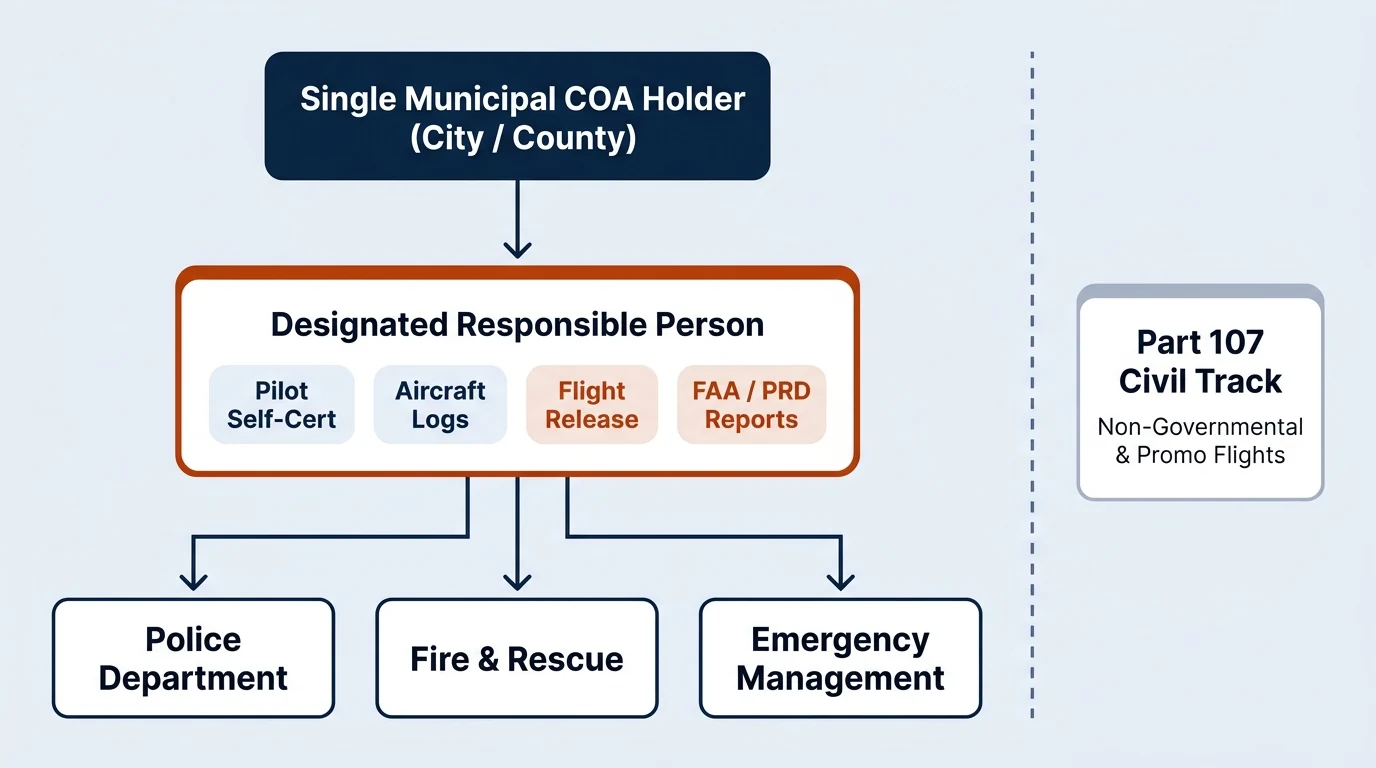
To maintain enforceable cross-department control under one COA, the Responsible Person should anchor four auditable governance controls across every participating bureau:
| Oversight Control Domain | Required Regulatory Basis | Central Record Maintained Under Responsible Person |
|---|---|---|
| Pilot Training & Self-Certification | AIM Chapter 11, Section 5 and AC 00-1.1 require agencies to train and self-certify PAO pilots as competent | Unified municipal pilot roster tracking initial currency, night-flight qualification, and bureau authorization |
| Whole-UAS Airworthiness Control | AIM Chapter 11, Section 3 extends PAO airworthiness determination to aircraft, crew, control station, and command and control links | Shared maintenance, firmware, anti-collision lighting (3 statute miles), and ASTM F3322-18 PRS inspection logs |
| Mission Eligibility Preflight Gate | 49 USC 40125 restricts PAO flights strictly to governmental functions | Standardized dispatch classification routing non-governmental, promotional, or volunteer flights to Part 107 |
| Incident, NTSB & PRD Reporting | 49 CFR 830.2 (NTSB), FAA incident reporting, on-request flight logs, and 14 CFR Part 111 Subpart C / AC 120-68 (PRD) | Standardized post-incident notification workflow and Pilot Records Database trigger log across all bureaus |
Agencies formalizing local dispatch authority, evidence custody, and internal policy sign-off alongside their COA manual can pair this structure with the drone-as-first-responder policy review matrix.
How do FAA COA validity periods, renewals, and tailored airspace updates work?
Expedited Part 91.113 CoW/As remain valid for 48 months without NOTAM or monthly reporting obligations, legacy TBVLOS and FR-BVLOS COAs are no longer renewed upon expiration, and routine operations above standard ceilings require a second-step CAPS airspace request.
Tracking renewal rules prevents silent authorization lapses as FAA public safety instruments consolidate. Based on FAA Part 91 CoW/A guidance current as of 12 Nov 2026:
- Combined Part 91.113 CoW/A (Form 7711-1): Issued with a 48-month validity period covering VLOS, BVLOS, and eligible operations over people or moving vehicles. It does not require NOTAMs or routine monthly flight reports, though agencies must still submit FAA incident reports, comply with NTSB 49 CFR 830.2 reporting, produce flight logs if requested by the FAA, and fulfill 14 CFR Part 111 Subpart C Pilot Records Database obligations.
- Legacy TBVLOS and FR-BVLOS COAs: Existing Tactical BVLOS and First Responder BVLOS COAs are not cancelled immediately and remain valid until they expire or are cancelled, along with their original reporting conditions. However, the FAA no longer accepts new applications or renewals for TBVLOS or FR-BVLOS COAs; expiring holders transition to the Part 91.113 CoW/A.
- VLOS-Only Blanket and Jurisdictional COAs: Agencies choosing to remain strictly VLOS can still apply for and renew Blanket and Jurisdictional COAs through CAPS. Those legacy VLOS COAs continue to carry NOTAM filing and monthly reporting obligations.
- Tailored Airspace and Class E3/E4 Operations: Whenever a Part 91.113 CoW/A holder needs routine operations above published UASFM altitudes in controlled airspace, above 400 feet AGL or more than 100 feet from an object in Class G, or at any altitude in Class E3 or E4 airspace, the agency completes a second step by applying for a separate Air Traffic Organization COA in CAPS after receiving the 91.113 waiver and attaching the approved waiver as supporting documentation.
- Temporary Flight Restrictions (TFRs) and Emergency Relief: TFRs always take precedence over an existing airspace authorization. Agencies must verify the governing regulation behind a TFR before flying under their CoW/A TFR special provisions. When an active disaster or life-safety emergency requires temporary relief beyond existing COA or Part 107 limits, crews use the Special Governmental Interest path detailed in the emergency drone authorization SGI checklist.
Should a public safety drone unit run Part 107, a Part 91 COA, or both in parallel?
Most municipal police, fire, and emergency management programs operate both Part 107 and a Part 91 COA in parallel so governmental emergency missions leverage COA authority while community outreach, promotional media, and routine civil flights remain strictly compliant under Part 107.
FAA AIM Chapter 11, Section 4 explicitly notes that public safety organizations often operate under both 14 CFR Part 107 and public aircraft operations. Running a single track rarely fits every municipal need: pure Part 107 fleets cannot self-certify non-Part 107 pilots or aircraft for governmental operations above 55 pounds, whereas a pure PAO COA fleet cannot legally launch for non-governmental filming, public relations events, or partner flights involving non-qualifying volunteer organizations.
| Agency Profile | Recommended Operating Track | Primary Operational Reason |
|---|---|---|
| Volunteer fire department, volunteer SAR, or nonprofit rescue unit | 14 CFR Part 107 only (including Part 107 PSO shielded-ops waivers) | Typically ineligible for statutory public aircraft status under 49 USC 40102(a)(41) |
| Small municipal unit conducting routine VLOS flights under 55 pounds | 14 CFR Part 107 baseline with LAANC and targeted waivers | Part 107 pilot qualification (at least 16 years of age and 24-month recurrent currency) without PDL legal review or agency airworthiness administration |
| County or city agency running 24/7 DFR BVLOS or multi-bureau response | Dual-track: Part 91.113 CoW/A plus Part 107 civil track | Combines 48-month PAO-PSO BVLOS authority and agency self-certification with a compliant civil lane for non-governmental tasks |
| Large UAS fleet (55 pounds or more) performing statutory governmental missions | Part 91 PAO COA (case-by-case / CAPS) with 14 CFR Part 47 registration | Exceeds the 55-pound weight limit for both Part 107 and expedited Part 91.113 CoW/A processing |
Before choosing a filing portal for routine civil waivers or controlled-airspace grid access alongside a municipal COA program, compare approval boundaries in FAA Part 107 waiver vs. SGI vs. LAANC and review controlled-airspace grid preparation in the zero-grid drone authorization checklist.