A waiver is unnecessary when complying with all part 107 regulations.
LAANC provides airspace authorizations only.
First responders and other organizations responding to natural disasters or emergencies may be eligible for expedited Special Governmental Interest approval.
Start with the mission: identify the operating rule, the airspace, and the emergency circumstances. Use the comparison below to choose which application instructions to open.
Choose the approval path
| Question to resolve | Approval boundary | Application channel |
|---|---|---|
| Need relief from an operating rule? | The Administrator may issue a waiver for a regulation specified in § 107.205 if the proposed operation can safely be conducted under its terms. | The Part 107 Waiver Application process has transitioned to Aviation Safety Hub. |
| Need controlled-airspace access? | LAANC provides airspace authorizations only. | Part 107 Airspace Authorization applications remain in FAADroneZone until further notice. |
| Responding to an emergency? | If approved, FAA amends the existing COA or Remote Pilot Certificate for the specified operation under certain conditions. | The SGI waiver submission route is the TSA/FAA Waiver & Airspace Access Program. |
What does an operational waiver permit?
A waiver holder may deviate only to the extent specified in the certificate.
A waiver holder must comply with the certificate’s conditions and limitations.
Match the requested relief to the listed provision. Selected examples:
- Visual line of sight aircraft operation is listed as subject to waiver under Section 107.31.
- Operation of multiple small unmanned aircraft systems is listed as subject to waiver under Section 107.35.
- Operation over people is listed as subject to waiver under Section 107.39.
- Anti-collision light requirements for night and civil twilight is listed as subject to waiver under Section 107.29(a)(2) and (b).
Operation in certain airspace is listed as subject to waiver under Section 107.41.
14 CFR part 107.41 waiver applications can only be submitted through DroneZone.
Prepare the safety explanation
A waiver request must contain a complete operation description and justification that it can safely be conducted under the waiver.
- The waiver safety explanation should describe the proposed operation.
- The waiver safety explanation should describe possible operational risks and methods to mitigate them.
- Address each Waiver Safety Explanation Guideline in detail.
- FAA suggests providing latitude/longitude and a detailed map of the planned flight area.

Where does FAADroneZone fit now?
The Part 107 Waiver Application process has transitioned to Aviation Safety Hub.
Previously submitted waivers will be processed in FAADroneZone; no action is required.
Part 107 Airspace Authorization applications remain in FAADroneZone until further notice.
FAA aims to review and approve or disapprove waiver requests within 90 days of submission.
Processing times vary with request complexity and the completeness of the initial application.
Failure to respond to an information request within 30 days causes cancellation and requires resubmission.
What applies to a zero-grid flight?
Prior ATC authorization is required for small unmanned aircraft in Class B, Class C, Class D, or within the lateral boundaries of airport-designated Class E surface airspace.
Facility maps show maximum altitudes where FAA may authorize part 107 operations around airports without additional safety analysis.
Facility maps do not authorize operations at depicted altitudes; they are informational.
Part 107 remote pilots may request LAANC further coordination above grid altitudes up to 400’, including 0’ grids, excluding on-airport submissions.
Further coordination requires review by the Air Traffic Manager responsible for the airspace.
Further coordination requests must be submitted at least 72 hours before the requested operation start.
FAADroneZone provides authorizations for airports that are not LAANC-enabled.
FAADroneZone can process requests at LAANC-enabled facilities but does not provide near-real-time authorizations.

LAANC authorization may not satisfy all requirements; operators must also meet governing NOTAM or TFR requirements.
For the location-specific planning checklist, continue to zero-grid drone authorization.
When does emergency approval apply?
First responders and other organizations responding to natural disasters or emergencies may be eligible for expedited Special Governmental Interest approval.
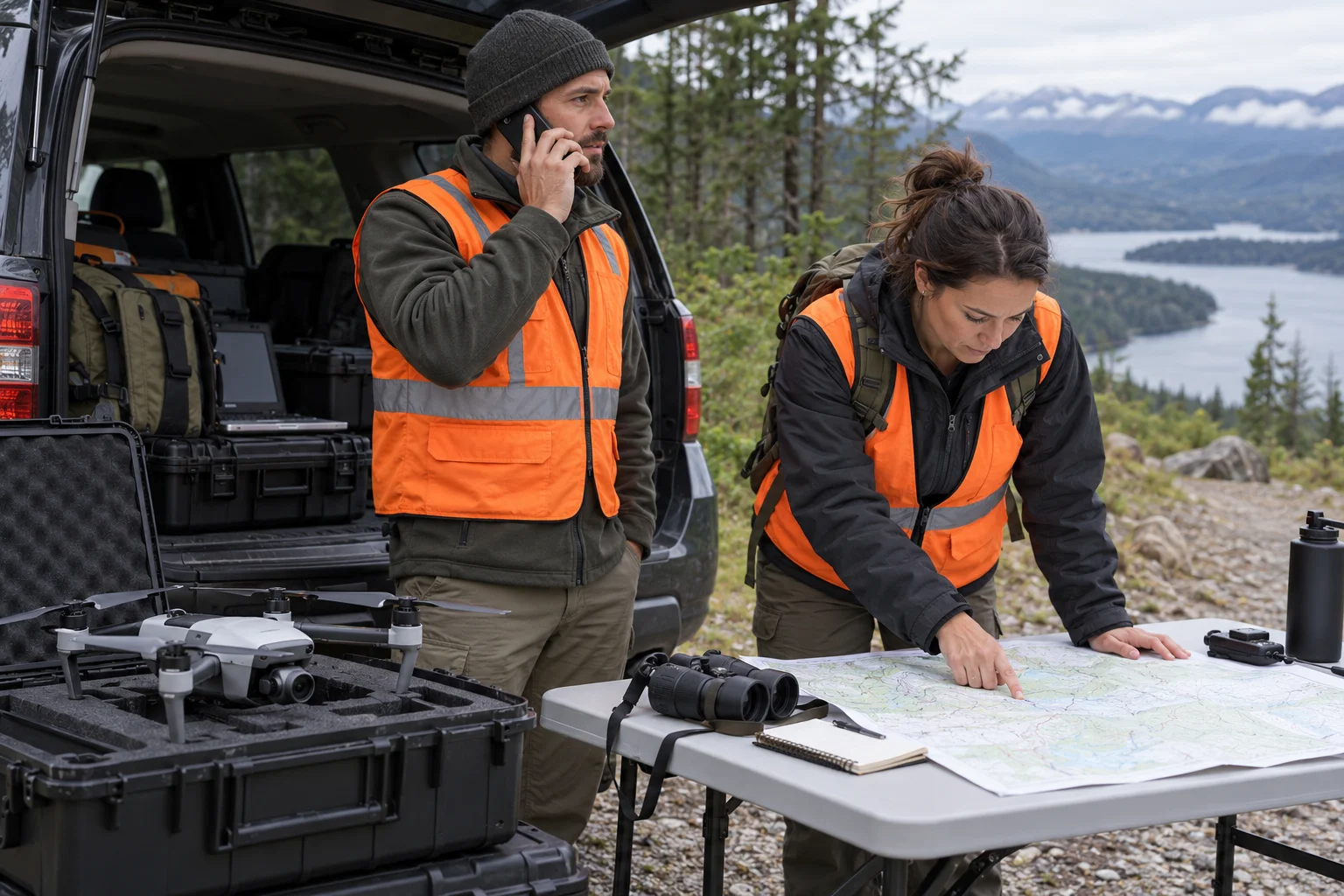
Search and Rescue is an operation that may be considered for SGI.
Utility or Other Critical Infrastructure Restoration may be considered for SGI.
The SGI waiver submission route is the TSA/FAA Waiver & Airspace Access Program.
Select “Part 107 Special Government Interest” in the portal drop down.
For time-sensitive operations, call the System Operations Support Center (SOSC) for real-time authorization at 202-267-8276.
If denied, operators should not fly outside their existing COA or part 107 provisions.
BVLOS approval issued through SOSC will typically require a TFR.
Standard emergency SGI approvals may be issued in minutes for visual-line-of-sight operations.
Emergency BVLOS applicants should expect longer processing than standard emergency SGI approvals.
Use the emergency drone authorization checklist for the next planning step.
Public safety: which operating framework?
Government agencies, law enforcement and public safety entities have two operating options for drones under 55 pounds.
Flying under 14 CFR part 107 is an option for public safety drone operations.
Public-aircraft operations use a COA to self-certify UAS and operators for flights performing governmental functions.
An operation for the public good does not necessarily qualify as a public operation.
Public safety organizations often operate under both 14 CFR part 107 and public aircraft operations.
The CADZ service is currently available only to Department of Defense users meeting FAA requirements.
Before choosing a portal, identify your operating framework and the permission you are requesting. Keep the proposed operation and the conditions of any existing approval together when preparing the application.
For related first-responder reading, explore the UAS Triple Challenge archive.
Sources
- eCFR — Waiver policy and requirements
- eCFR — List of regulations subject to waiver
- eCFR — Operation in certain airspace
- FAA — Part 107 Waivers
- FAA — Part 107 Airspace Authorizations
- FAA — UAS Data Exchange (LAANC)
- FAA — UAS Facility Maps
- FAA — Emergency Situations
- FAA — Operate a Drone, Start a Drone Program
- FAA — AIM, Airspace Access for UAS
- FAA — COA Application FAADroneZone (CADZ)
- FAA — Part 107 sUAS Operations, air traffic order