A policy line with no owner fails the next audit. Record the control, the person who owns it, and the document that would prove it.
The answer is a blank matrix, filled from the policy the reviewer opened. On the Montgomery County Police Department drone-as-first-responder page, read on 11 October 2026, a launch is for a 911 call or a police-generated call, and the page says the program does not patrol and does not fly random surveillance. The same page says the aircraft flies at or below 400 feet above the ground, the camera stays toward the horizon until the aircraft is on the call, and video follows the same retention and access rules as body-worn and in-car video. That page does not print a number of days. The CJTTEC brief opened with it says there is no national retention standard. A cell with no opened source stays blank.
Key points:
- Write your entry from the policy you opened. The county column is an example, and it is not your rule.
- Retention on that county page points at the current body-worn and in-car policy. It does not give a day count.
- The county policy PDF named on that page was not text-read here. An unread scan does not fill a cell.
- The CJTTEC brief discusses warrant statutes and example retention periods. Those statutes and schedules were not opened, so they do not fill a cell.
- An FAA amendment is a different record. The emergency SGI request checklist covers that path.
Independent explainer: this site is named after the domain once used by the First Responder UAS Triple Challenge and is not its organizer, NIST, or a university. Nothing here is a department policy, an FAA approval, or a legal opinion.
Which controls belong on the sheet?
The job is to see whether a launch, a recording, or a later question can be traced to a person and a file. The CJTTEC brief, in the policy section of the copy opened on 11 October 2026, says a program policy defines when the drone will and will not be used, which regulations the agency says it follows, the privacy safeguards, and how the program lines up with community expectations. The same section says policies typically name when drones are deployed, who is authorized to operate them, how data are managed, and how operations are documented and reviewed.
The brief’s workflow section adds that the calls appropriate for a response vary by agency policy. It lists four go or no-go factors: weather, the type of call, whether the call is inside the area the aircraft can reach, and which call wins when several qualify. It does not publish one national call list. The dispatch row below stays empty until the local policy names the calls.

A headset and a paper cup beside a monitor that shows a blank dark screen.
| Control | Your entry | Example from the Montgomery County FAQ, read 11 October 2026 | Leave your cell blank when |
|---|---|---|---|
| Dispatch trigger | A 911 call or a police-generated call, or an officer asking for support. Not patrol. Not random surveillance. Not an occurred-earlier call with no suspect on scene and no safety concern. The page says the call must meet program specifications and does not list those codes. | Your policy does not list the calls. Do not copy the example into your cell. | |
| Recording scope | The camera stays toward the horizon until the aircraft is on the call. Video and photos go into the same system, and in the same manner, as body-worn and in-car video. The page says the drone does not use facial recognition and does not record audio. It does not say when the recording starts and stops. | Your policy is silent on aim, start, stop, audio, or face matching. | |
| Access | Same access rules as the existing body-worn and in-car video policy, and official use only. | Your policy does not name who can open the file. | |
| Retention reference | Same retention as the current body-worn and in-car video policy. | Your policy, or the camera policy it points to, does not state the period. This page has no day count to lend you. | |
| Exception | The FAQ prints a limit on intentional recording or transmission where a person would have a reasonable expectation of privacy, such as inside a private building, except a warrant or an emergency. | Your policy does not state the exception or who approves it. | |
| Complaints and questions | The page prints MCPDUAS@montgomerycountymd.gov and 240-773-6500, and says the email is checked periodically. It does not describe a complaint form. | Your policy does not name where a question or a complaint goes. | |
| Review cadence | A lieutenant who is the program manager periodically audits for training issues. Violations follow existing procedures. Each deployment is approved, tracked, and reviewed. Flights are published after every flight, and deployments are in the annual report. The page does not define periodically as a number of days. | Your policy does not name the auditor or the interval. |
The empty column is the audit. An example sentence is not a substitute for the document your agency actually uses.
What does the county page state, and what does it leave out?
The Montgomery County page is the operational example opened for this matrix. It is one department’s FAQ. The NCJRS abstract, read the same day, describes drone-as-first-responder programs as prepositioned drones sent to certain calls, often before officers arrive. The county page is narrower than that definition: it says this program responds to 911 calls and to incidents where officers on the ground request support.
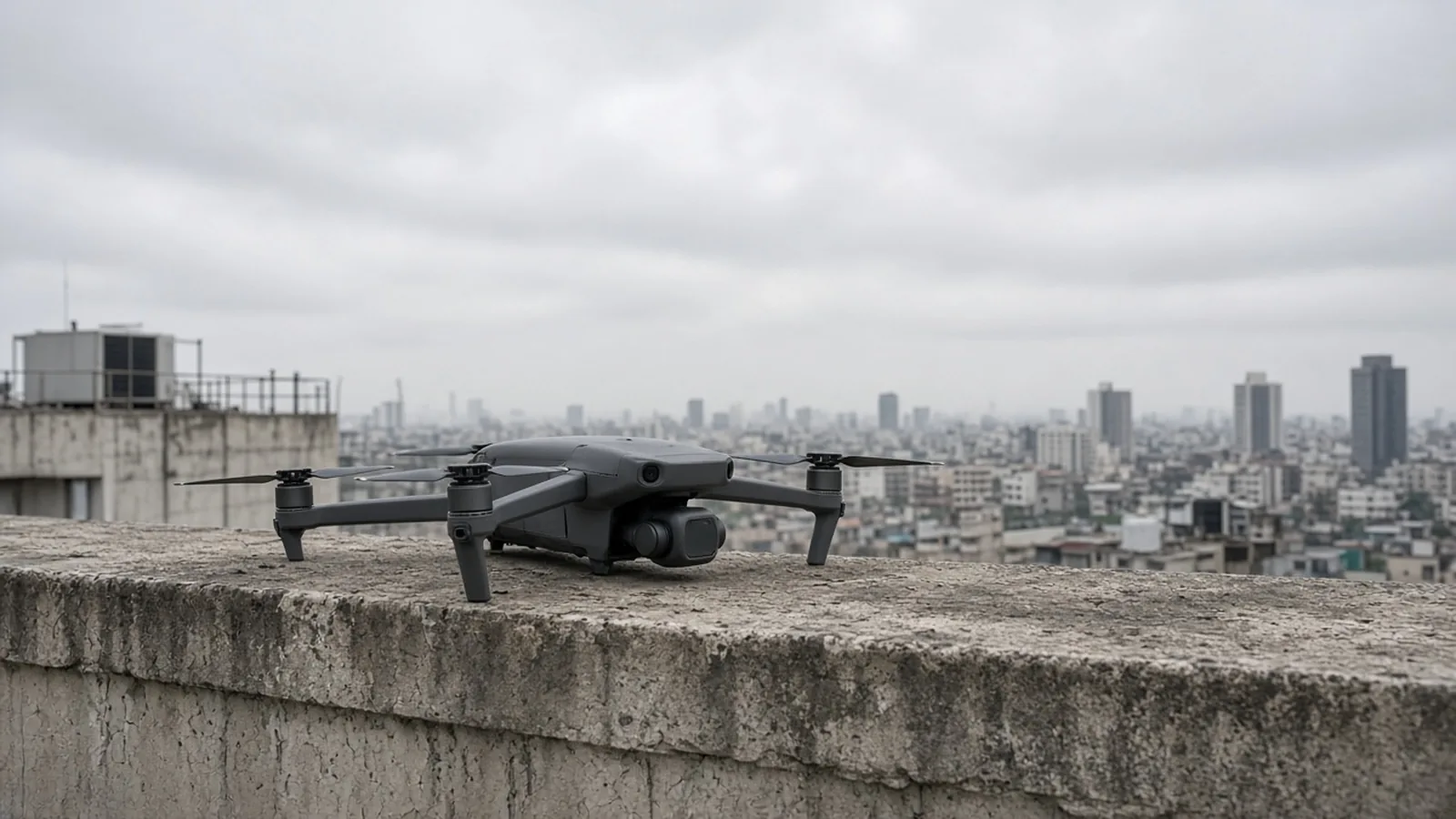
A gray quadcopter on a concrete parapet with the camera aimed at a distant skyline.
The FAQ says staff listen to Live911, which it describes as a program that lets officers hear 911 calls in real time, and launch when a call in the service area meets program specifications. The goal it states is overhead before, or together with, officers on the ground. It also says there are times when the aircraft result lets the department discontinue a ground response. It does not define the specifications, and it does not say how often a ground response stops.
On altitude, the FAQ says the aircraft flies at or below 400 feet above the ground. It names the aircraft as a Skydio X10, call sign RAVEN, and it prints a flight-time and speed card. Those card figures are not repeated here. They are not a test, and they are not a score for any other aircraft.
On privacy, the FAQ says the department respects the United States Constitution, including the First and Fourth Amendments, during operations. The policy text printed on that page says unmanned-aircraft data will not be used to identify people taking part in lawful First Amendment activity, and will not be based solely on race, ethnicity, national origin, sexual orientation, gender identity, religion, or age. The same printed text says the department obtains the FAA authorizations, permits, or certificates that apply before it operates, and keeps them current. Which document covered a given flight is a separate record. When the flight needs an emergency amendment to a certificate the crew already holds, use the SGI request and handoff checklist.
The FAQ names FC 0460 as the official unmanned-aircraft policy and links a PDF. The copy of that PDF in the research set for this page has no extracted text. This article does not quote FC 0460. If a sentence is only in that PDF, the cell stays blank until someone reads the PDF.
The FAQ says department personnel hold a Part 107 certificate before they operate a drone on duty. It describes a 40-hour Maryland Police and Correctional Training Commission approved course, practice on the National Institute of Standards and Technology bucket course, and, for drone-as-first-responder pilots, a 20-hour teleoperator course, field training, and monthly training. It does not attach those sentences to a named pilot. A training cell is blank until the file for that person is the file on the desk. This page does not list a headcount.
The FAQ dates the department’s official launch at 20 November 2023, after a community process in 2023, and it says drone-as-first-responder flying as the department knows it began in Chula Vista in October 2018. Both dates are that page’s account. The FAQ also says policies are subject to collective bargaining and that the department cannot go around that process with the unmanned-aircraft policy.
The transparency address printed on the FAQ is https://remote.dronesense.com/dashboard/MCPDDFR. The page says that view shows the flight path, the date and time, the call-for-service event number, and a short reason. The CJTTEC brief says this dashboard, and the dashboards it names for Chula Vista and Brookhaven, are updated daily. The FAQ’s own wording for Montgomery County is after every flight. Use the FAQ for that department’s fields.
What belongs in the evidence column?
The person who signs the review writes the record, not a conclusion about whether the program is sound.

An open notebook with blank pages, a pen, and a closed gray binder on a wooden table.
| Field | Write this | Leave it blank until |
|---|---|---|
| Policy file | Title, version or directive number, and the date you read it | You have the file, not a summary of it |
| Owner | Name and role of the person accountable for that control | The policy or the assignment record names someone |
| Dispatch record | The call number and the rule that made it eligible or ineligible | A real call is on the sheet |
| Recording record | Where the file is stored, and whether audio or face matching was off if the policy requires that | The evidence system shows the file |
| Access record | Who opened it, under the rule your policy names | An access log, or the policy’s named custodian, is in hand |
| Retention record | The period your camera or evidence policy states, and the date the clock started | That policy states a period. Do not invent days. |
| Exception record | Warrant identifier, or the emergency facts the policy requires | The exception was actually used |
| Question record | Where the question went, and the date | The path in your policy was used |
| Review record | Auditor, date, and whether a violation was found | The audit for that period exists |
| Public entry | The flight date and the event number, if your policy says flights are published | You can open that entry |
A lieutenant’s periodic audit, on the Montgomery County page, is an example of a review row with no interval. Write “interval not stated” only in the example notes. In your column, blank means you still do not have the interval.
What does the CJTTEC brief add?
The brief is the second source, not a second policy. The NCJRS abstract page displays Date Published January 2025, length 25 pages, NCJ 311130, with the National Institute of Justice as the sponsoring agency and the Criminal Justice Technology Testing and Evaluation Center as the corporate author. The PDF copy opened the same day prints “Published: January 2026” beside the references. This page does not choose a first-publication date.
The brief says the exact number of agencies operating a drone-as-first-responder program is unknown. This page does not add a count.
On retention, the brief says there is no national standard, and that agencies use general evidence rules or write their own. It says limits are generally stricter for video and photos that identify a person, that flight logs and telemetry often do not identify a person, and that most of these operations do not collect audio. It then gives example durations for named departments, including Montgomery County. The records schedules those sentences cite were not opened. The Montgomery County FAQ does not print those durations. The durations are not copied into the matrix.
The brief says the published policies of Montgomery County, Brookhaven, and Chula Vista are similar, and that all three prohibit intentional recording where a person would have a reasonable expectation of privacy, prohibit random surveillance and harassing, intimidating, or discriminating use, and state that the drone will not be weaponized. That is the brief’s comparison. This page opened the Montgomery County FAQ, not those three policy PDFs. The FAQ page does not print the weaponization sentence. That cell stays blank until the policy file is read.
The brief’s legal section names state statutes, warrant rules, and exceptions. This page did not open those statutes. The jurisdiction cell stays blank until counsel writes the rule that applies to the agency. The brief’s own warning is the one this sheet keeps: use has to fit an exception the applicable law recognizes or rest on a warrant, and the agency has to align the protocol with that law and keep the documentation.
On community review, the brief calls it best practice to involve stakeholders before launch. It says Brookhaven asked the local district attorney and the American Civil Liberties Union to read a draft. It says Montgomery County’s process raised facial recognition, and it quotes a policy line that the aircraft shall not be used for facial recognition or for audio collection. The FAQ’s operational sentence is the one in the table above: the drone does not use facial recognition and does not record audio.
The brief also asks about budget, software integration, staffing type, and a training plan. Those questions are not this matrix. This page does not price a program, does not test a dispatch interface, and does not rank a vendor. The brief says the products it names are illustrations, not a recommendation or a validation by the Department of Justice, the National Institute of Justice, RTI International, or the center that wrote the brief.
When this sheet does not decide the flight
This matrix does not authorize a flight, score a policy, or set a retention period. A blank cell is the record that the fact is still unknown.
If the local policy requires an FAA authorization and the flight needs relief the current certificate does not give, the emergency SGI checklist linked above is the handoff for that request. It does not fill the local owner column.
Which Remote ID serial belongs on an inventory is a different worksheet. The Remote ID serial audit is that record. It is not a substitute for the dispatch, access, or retention rows above.
Method and sources
This page is compiled from three public documents saved on 11 October 2026. No department was contacted, and no policy was scored.
The Montgomery County column comes from that department’s drone-as-first-responder FAQ. The 400-foot sentence, the horizon-camera sentence, the body-worn and in-car retention and access sentences, the call limits, the Live911 sentence, the Part 107 and training sentences, the 20 November 2023 launch date, the Chula Vista origin sentence, the lieutenant audit, the dashboard fields, the email, and the phone number are from that FAQ. The flight-time and speed card on the FAQ is not reused. The FC 0460 PDF was not text-read.
The policy-purpose description, the “no national standard” retention sentence, the three-policy comparison, the state-law discussion, the community examples, the daily-dashboard sentence, and the product-disclaimer sentence are from the CJTTEC brief. Example day counts in that brief were not copied, because the schedules behind them were not opened and the county FAQ does not print them. The January 2025 date is what the NCJRS abstract page displays. The January 2026 date is what the PDF copy prints. Neither is treated as a settled first-publication date.
The photographs show a blank grid, an unmarked quadcopter on a parapet, an open blank notebook, and a headset beside a dark screen. They are not a department office, a named aircraft, or a live dashboard.
Last updated: 14 October 2026.