Independent explainer: this site is named after the domain once used by the First Responder UAS Triple Challenge and is not its organizer or affiliated with NIST or the universities involved. Nothing here is an FAA approval, a legal opinion, or a safety guarantee.
Launching a drone outside the authorization the crew already holds is the failure this checklist is meant to prevent. For a U.S. natural disaster or other emergency, the FAA’s Special Governmental Interest (SGI) process is the expedited route for asking that an existing certificate be amended for one specified operation.
On the FAA Emergency Situations page, last updated 16 June 2026 and read on 11 October 2026, first responders and other organizations responding to a natural disaster or other emergency may be eligible for expedited Special Governmental Interest approval. The submission path is the TSA/FAA Waiver and Airspace Access Program in Firefox or Chrome, choosing “Part 107 Special Government Interest.” A time-sensitive operation also calls the System Operations Support Center at 202-267-8276. An approval is an amendment to an existing COA or Remote Pilot Certificate and covers only the conditions written for that operation. A denial leaves the crew inside the existing authorization. Visual-line-of-sight emergency approvals may be issued in minutes; a beyond-visual-line-of-sight approval through the support center typically needs a temporary flight restriction and takes longer. That is not a promise that a given request will be granted.
Key points:
- If the current Part 107 certificate or COA already allows the flight, SGI is the wrong next step. Fly that authorization.
- The emergency page names a web portal and a phone number. It does not publish an email address for this process.
- Copy the decision, the document that was amended, and every condition onto a handoff record before the aircraft leaves the ground.
- Visual-line-of-sight and beyond-visual-line-of-sight requests are different timing cases. The FAA does not give them the same processing description.
- This page does not start a standing public-aircraft program, map a live temporary flight restriction, or approve autonomous flight.
When does this flight need an SGI request?
Use SGI when the emergency flight needs something the crew’s current authorization does not already allow. If Part 107 or the existing COA already covers the aircraft, the area, the altitude, and visual line of sight, the emergency page is not the path that makes the flight legal. The crew flies under the authorization they hold.
The FAA’s public-safety program page, last updated 2 June 2022, describes two baselines for government drones under 55 pounds: Part 107, which that page summarizes as visual-line-of-sight operations at or below 400 feet above ground level, or a public-aircraft operation under a COA for a governmental function. An SGI approval does not replace either baseline. The emergency page says the FAA adds an amendment to the existing COA or Remote Pilot Certificate.
Eligibility on the emergency page is conditional. First responders and other organizations responding to natural disasters or other emergency situations may be eligible. The operations that page says may be considered are:
- Firefighting, including wildfire suppression and Red Flag Warning area monitoring
- Search and rescue
- Law enforcement
- Utility or other critical infrastructure restoration
- Damage assessments supporting disaster recovery related insurance claims
- Media coverage providing crucial information to the public
“May be considered” is the FAA’s limit. A mission that fits one of those labels still needs the amendment, or an authorization that already covers it, before anyone treats the flight as approved. Search planning after a flight is allowed is a separate job. How a drone search is optimized under forest canopy covers detection and track spacing, not the authorization.
A standing waiver is also a different job. The Public Safety Toolkit, last updated 23 March 2026, points routine Part 107 operational waivers and public-aircraft waiver packages to their own forms and inboxes. The emergency page does not. Use the toolkit routes for a standing waiver. Use the portal and the support-center number below for an SGI request.
Which route matches the mission?
Read this table against the Emergency Situations page as it stood on 11 October 2026. The “what you still do not have” column is the point of the record: an SGI request is not itself permission to fly.
| Situation | Where the FAA page sends you | Timing the page actually states | What you still do not have |
|---|---|---|---|
| The current Part 107 certificate or COA already allows this flight | Stay with that authorization | SGI is not the step | An SGI amendment, and you do not need one for this flight |
| The emergency needs relief the current authorization does not give, and the aircraft will stay in visual line of sight | TSA/FAA Waiver and Airspace Access Program. Select “Part 107 Special Government Interest.” If the operation is time sensitive, also call the System Operations Support Center at 202-267-8276 | Standard emergency SGI approvals may be issued in minutes for visual-line-of-sight operations | A guarantee. Approval is still an amendment with conditions |
| The emergency needs flight beyond visual line of sight | The same SGI path. The page discusses beyond-visual-line-of-sight approval issued through the support center | That approval will typically require a temporary flight restriction, and applicants should expect longer processing than a standard visual-line-of-sight emergency approval | A routine beyond-visual-line-of-sight permission, and a known clock time |
| The request is denied | Do not fly outside the existing COA or Part 107. The page says operators may amend the request | No automatic second approval | Permission to fly the profile that was denied |
The portal steps, in the page’s order, are: open the program in Mozilla Firefox or Google Chrome, create a username and password, request a new waiver, select “Part 107 Special Government Interest,” complete the required fields, move through the sections with the tabs, and submit. This checklist does not invent the field labels behind the login. We did not submit a test request. Whatever the form marks required, copy it onto the handoff record below.
The emergency page says the SGI amendment process is outlined in JO 7210.3EE. That statement is all this article takes from the order. The order’s own paragraphs were not used as a second procedure.
One account people reach for is the wrong door for this task. The FAADroneZone CADZ page, last updated 24 October 2023, says CADZ account creation is currently only for Department of Defense users who meet FAA requirements, and it points other government agencies to a guide for starting operations. That page is about applying for a COA. An incident SGI request, on the June 2026 emergency page, goes through the waiver program above and amends a certificate the organization already has.
Older write-ups tell crews to email a form. The emergency page read on 11 October 2026 describes the portal and the support-center phone. It does not list an email address for SGI. Check that page before relying on an email step from an older summary. This article does not claim that every earlier email channel has been closed.
What do you prepare before you submit or call?
Have these items in one place before the portal session or the call. Leave a blank where the crew does not yet know the answer. A blank is a better handoff than a guessed airspace class or a guessed altitude.
| Item | What to write | Stop if you cannot say |
|---|---|---|
| Incident or mission name | The name dispatch and the crew will both recognize | Which operation the request is for |
| Time the need was identified | Local date and time, and UTC if the form asks | When the emergency request started |
| Authority already held | Part 107 remote pilot certificate, or the existing COA identifier | Which document an amendment would attach to |
| Aircraft identifier | The registration or other identifier the form asks for | Which aircraft the request names |
| Location | Address or coordinates. Airspace class if known; otherwise write “unknown” | Where the specified operation is |
| Profile | Visual line of sight or beyond visual line of sight, the area, and altitude if the form asks | Which of the two timing rows above applies |
| Purpose, if one fits the published list | One of the six operations quoted above, or “not on the published list” | Why this is being offered as an emergency SGI request |
| Already covered? | Yes or no. If yes, stop and fly the existing authorization | Whether SGI is even the right route |
| Path used | Portal, support-center call, or both | How the request actually left the crew |
| Reference | Portal confirmation or the time of the call, once you have it | How a later shift finds the request |
The phone number 202-267-8276 is the support-center number printed on the emergency page for time-sensitive, real-time authorization. Put the number on the crew’s card from that page, and re-read the page when the card is reprinted. This article is not a second official listing.
How should a crew treat VLOS and BVLOS timing?
Split the request before anyone quotes “a few minutes” in a briefing.
For operations within visual line of sight, the emergency page says standard emergency SGI approvals may be issued in minutes. “May” is the FAA’s word. The page does not publish a service level, a queue position, or a time after which the crew may launch anyway.
For beyond visual line of sight, the same page says any such approval issued through the System Operations Support Center will typically require a temporary flight restriction, and applicants should expect extended processing compared with those visual-line-of-sight emergency approvals. Plan the briefing around a longer wait and around a restriction that may have to be established. Do not brief the visual-line-of-sight sentence as the beyond-visual-line-of-sight plan.
An FAA public-safety FAQ retrieved earlier on 11 October 2026 said public-safety crews must comply with Part 107 or their COA, that beyond-visual-line-of-sight flight is not allowed for routine operations without a Part 107 waiver or a specific COA provision, and that an actual emergency follows the SGI process: a temporary emergency waiver to 14 CFR 107.31 when flying under Part 107, or a temporary emergency amendment to the existing COA when flying as a public aircraft. A later request to that FAQ address on the same day returned 404, so that paragraph is a dated reading of the morning copy and is not linked here. The live emergency page remains the procedure for the portal, the phone number, the temporary-flight-restriction note, and the denial rule.
No response time in this section is a commitment. The only clock that matters for launch is the one written on an approval the crew has actually received.
What belongs on the handoff record?
The person who receives the FAA’s answer fills this in and gives it to the person who will fly. Keep the portal text or the call notes with it. Version the record if the request is amended: v1 submitted, v2 approved with conditions, or v2 denied.
| Field | Write this when the answer arrives | Leave blank until |
|---|---|---|
| Decision | Pending, approved, denied, or amended | The FAA responds |
| Document amended | Existing COA or Remote Pilot Certificate, and its identifier | An approval names it |
| Conditions | Area, time window, altitude, visual or beyond visual, any temporary flight restriction identifier, and every other limit written on the amendment | Before launch |
| Who has the conditions | Name and role of the person who will fly, and of the person who briefed them | Before launch |
| If denied | A line that the crew will stay inside the existing COA or Part 107, and whether an amended request was sent | The denial is known |
| Source check | “Emergency Situations page, last updated 16 June 2026, read on [date]” | The card is copied for another incident |
An approval authorizes flight under certain conditions for the specified operation. Those conditions are the ones on the amendment, not the examples on this page. If the amendment’s area, time, or altitude is narrower than the request, the narrower text is the one the crew flies.
What changes if the FAA denies the request?
The emergency page is direct: if the request is denied, operators should not fly outside the provisions of their existing COA or Part 107. They may amend the request. Amending means a new submission with the gap fixed, and another line on the handoff record. It does not mean launching while the amended request is pending.
A denial of a beyond-visual-line-of-sight profile does not, by itself, forbid a flight that the existing certificate already allows inside visual line of sight. It forbids the profile that was denied. The crew writes that distinction on the record so the next shift does not treat “denied” as “the aircraft cannot fly at all” or as “fly it anyway.”
Method and sources
This page is compiled from public FAA pages, not from a submitted request, a timed test, or a legal review. The procedure, the eligible-operation examples, the portal steps, the support-center number, the approval and denial sentences, and the visual versus beyond-visual timing sentences come from the Emergency Situations page, last updated 16 June 2026, retrieved on 11 October 2026. The two operating baselines come from the public-safety program page, last updated 2 June 2022. The note that CADZ account creation is limited to qualifying Department of Defense users comes from the CADZ page, last updated 24 October 2023. The distinction between this checklist and routine waiver packages comes from the Public Safety Toolkit, last updated 23 March 2026. The emergency page’s pointer to JO 7210.3EE was followed only as far as the document information page; the order text was not used. The beyond-visual-line-of-sight FAQ wording is from a copy retrieved earlier on 11 October 2026; that address later returned 404, so it is not offered as a live link.
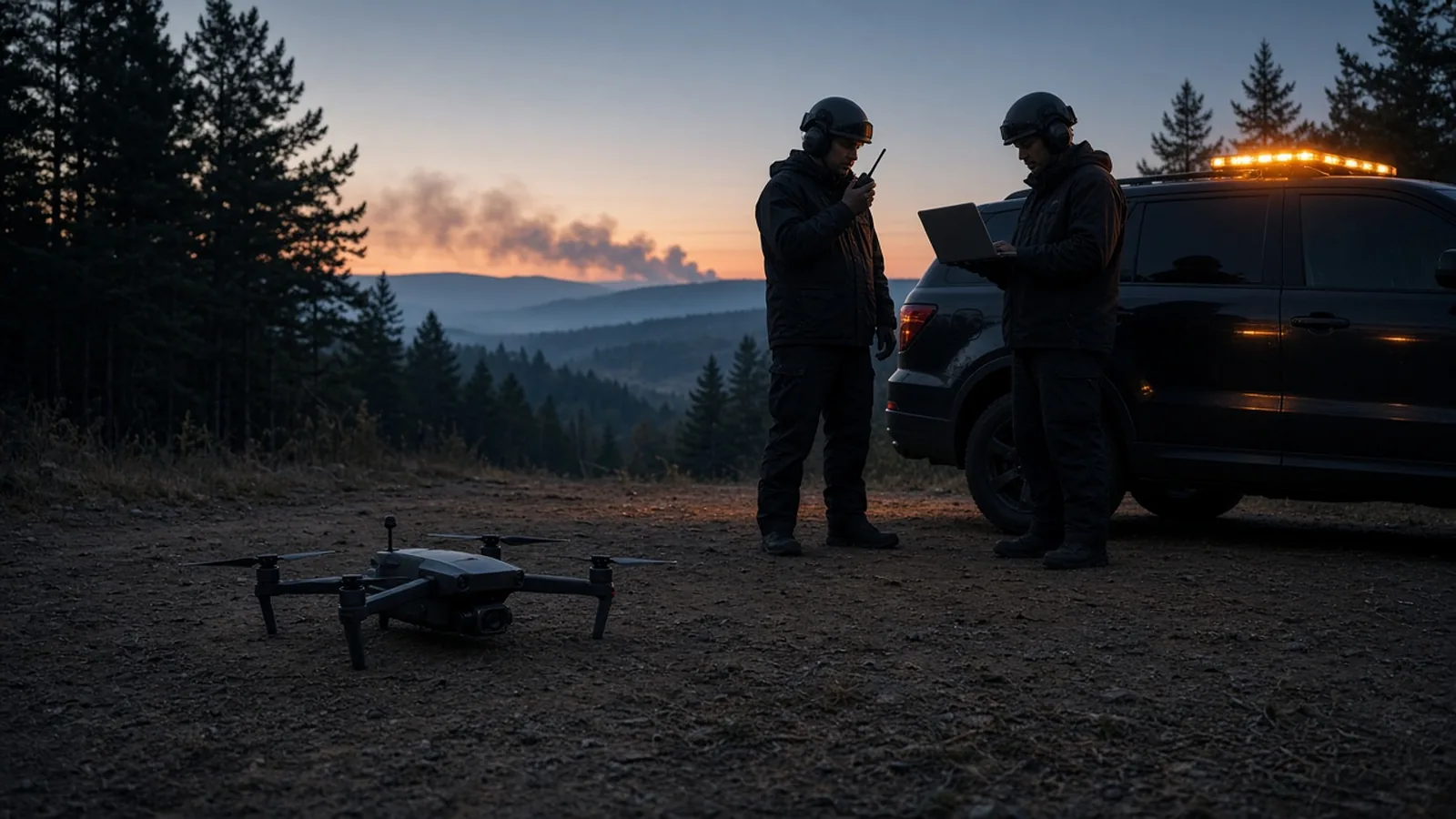
The photograph is an illustration of a crew preparing a request with the aircraft still on the ground. It is not a documented operation, a customer site, or a specific aircraft model.
Last updated: 11 October 2026.