A global shutter exposes every pixel together, so one frame has one camera position. A rolling shutter reads row by row, and forward speed during that readout moves the camera before the last row is stored. The published Phantom 2 case shifted the frame by about 10 pixels at 8 meters per second and 70 meters above the ground.
What is the difference between a global shutter and a rolling shutter?
Wikipedia defines rolling shutter as image capture that scans rapidly across a scene rather than taking a snapshot of the entire scene at a single instant, contrasting it with a global shutter in which the entire frame is captured at the same instant. Rolling shutters can be mechanical or electronic; while some CMOS sensors use a global shutter, the majority in the consumer market use an electronic rolling shutter that continues gathering photons during acquisition to increase sensitivity. CCD-based cameras often use global shutters representing a relative single instant, and a frame-transfer CCD or global-shutter CMOS sensor captures the entire image at once into a frame store rather than scanning row by row within approximately 1/60 or 1/50 of a second.
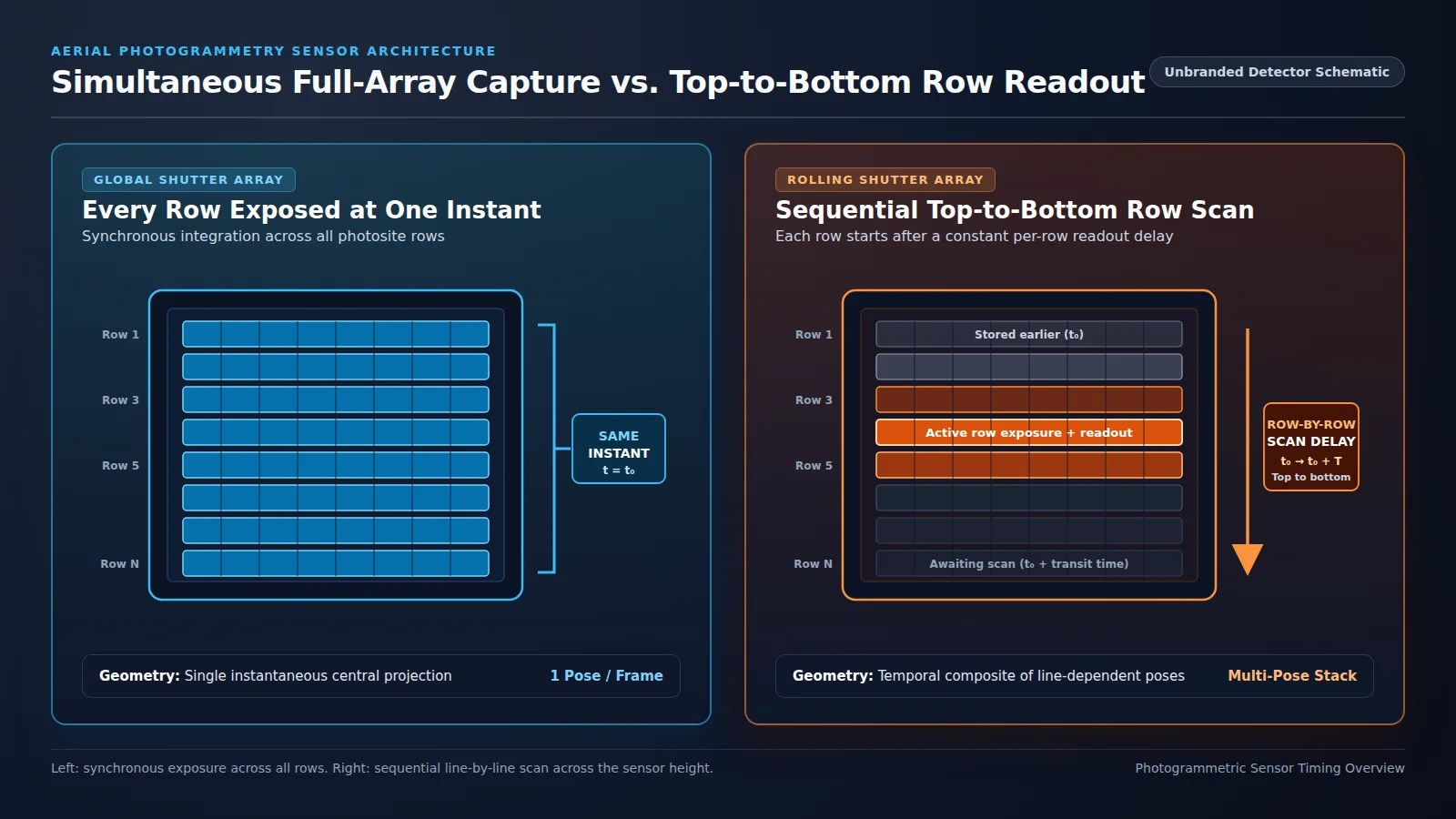
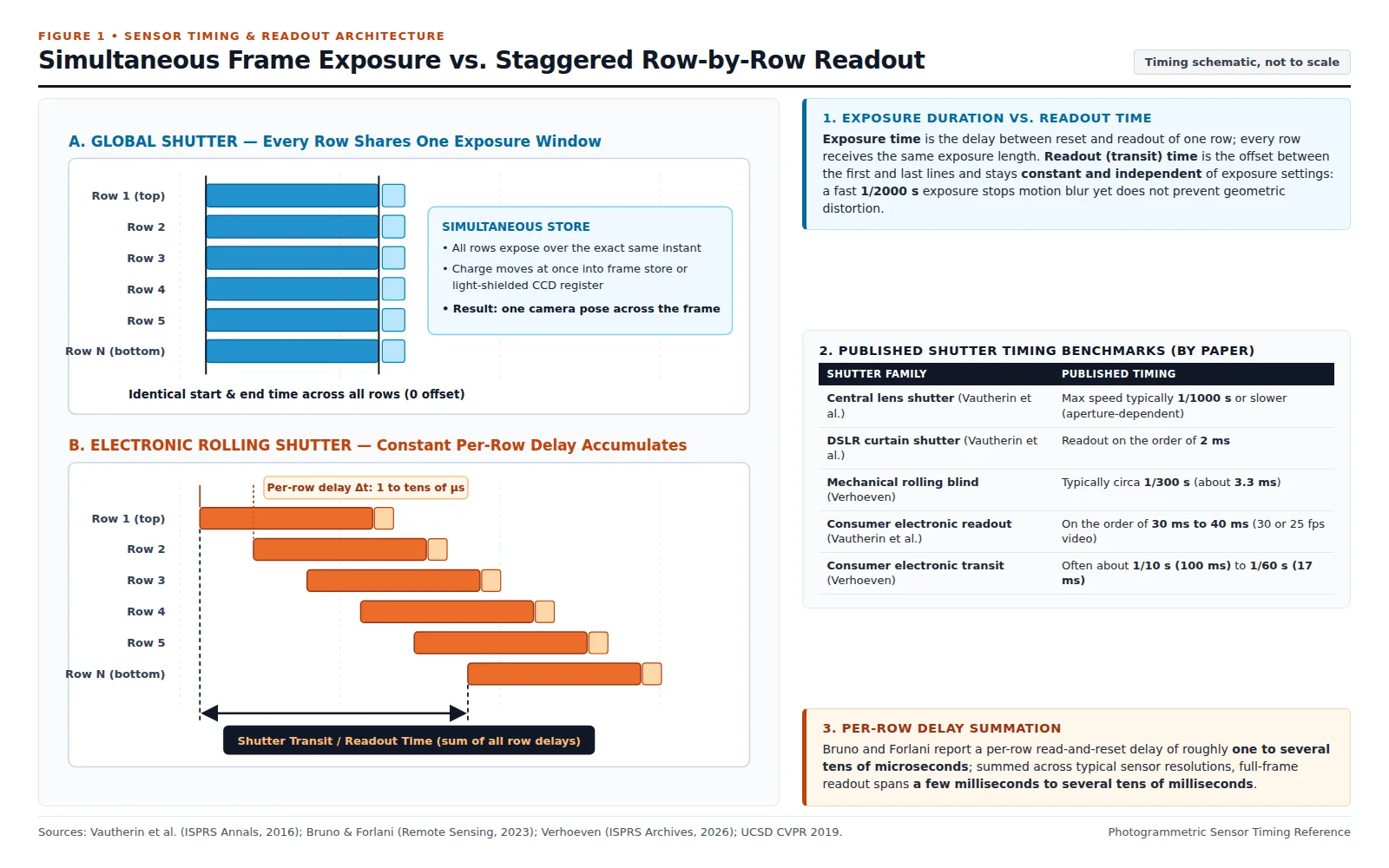
Computer-vision and photogrammetry studies state the same boundary in row geometry. A UCSD camera-model paper notes that a global shutter exposes all rows of the sensor array at the same time, whereas a rolling shutter exposes rows from top to bottom with a constant time delay between consecutive rows, causing camera motion during capture to deviate from the pinhole camera model. Vautherin and coauthors state that a rolling shutter exposes and reads the sensor line by line, and Bruno and Forlani define rolling-shutter cameras as cameras whose image rows are exposed at slightly different times, noting that film global shutters and CCD electronic global shutters best approximate one projection center while most CMOS electronic shutters mirror a mechanical focal-plane shutter. Verhoeven adds that the resulting photo is a temporal composite of line-dependent camera poses rather than one instantaneous central projection.
A global shutter exposes every row over the same instant, whereas a rolling shutter staggers row exposure across the frame readout interval.
When does rolling-shutter skew break a photogrammetric model?
Vautherin and coauthors write that consumer UAVs used for mapping are usually equipped with rolling shutter cameras, calling this a significant obstacle when extracting high-accuracy measurements with available photogrammetry software packages. Mapping drones need to fly as fast as possible, typically up to 10 m/s at altitudes of 50 m above ground. At such speeds and without appropriate modeling, distortions due to the rolling shutter limit the accuracy of the photogrammetric reconstruction.
Bruno and Forlani explain how that distortion enters bundle block adjustment. If the camera moves during exposure, each image row is captured with a slightly different set of exterior orientation parameters compared to adjacent rows. Applying the collinearity principle in bundle block adjustment as if the frame had one projection center generates inconsistencies in homologous ray intersections. When sensor rows are aligned to UAV motion, the rolling-shutter effect is a skew deformation of the image; when sensor rows are orthogonal to UAV motion, the effect is an image scaling.
Platform vibration compounds forward translation. Vautherin and coauthors note that line-by-line readout leads to additional distortions when imaging fast-moving objects or using a fast-moving or vibrating camera. At the U.S. Geological Survey, Kirk, Shepherd, and Sides likewise describe geometric distortions caused by platform motion, called jitter, as two-dimensional image sensors are exposed and read out line by line.
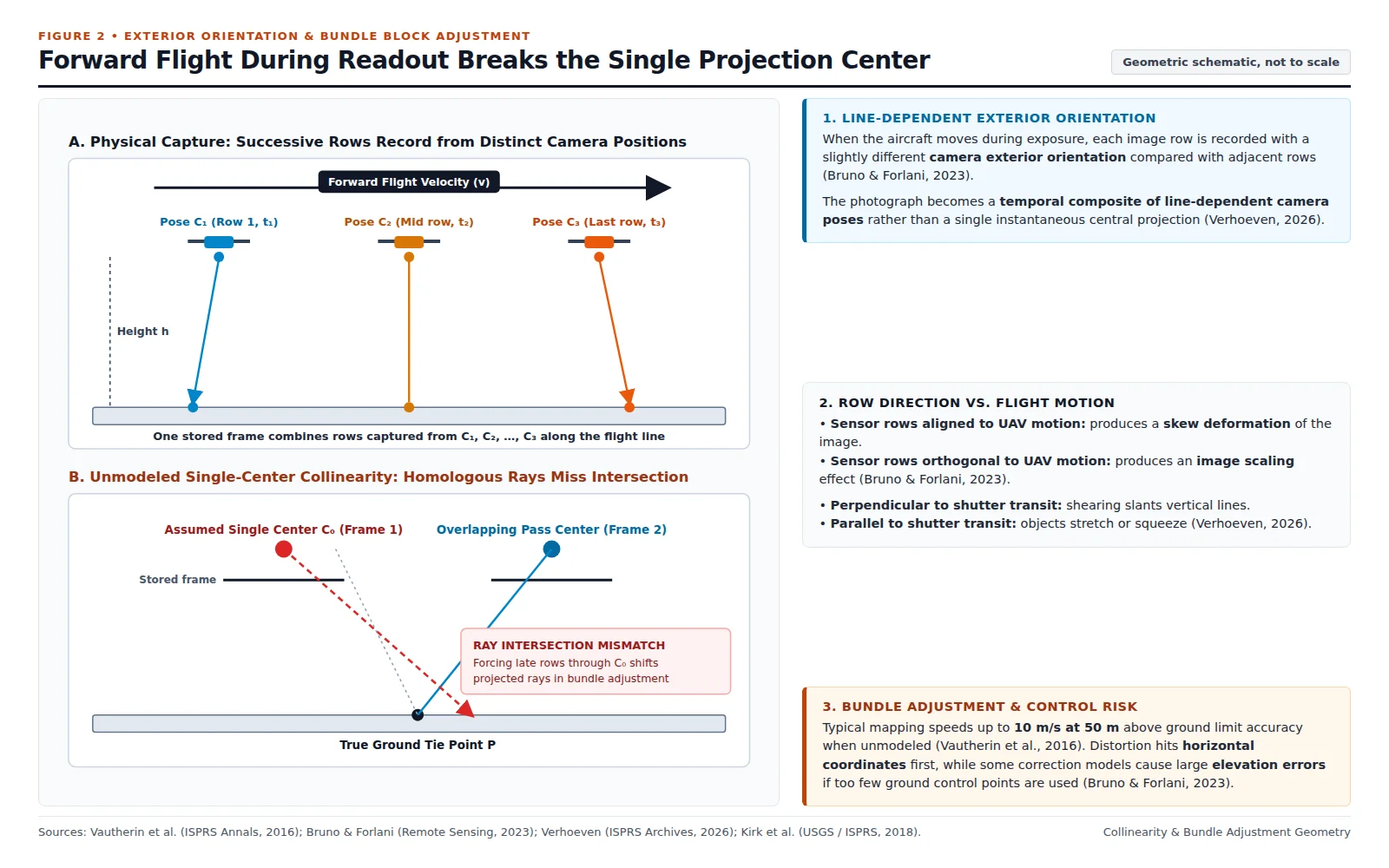
Forward aircraft motion during row-by-row readout assigns successive rows different exterior orientations, breaking single-center collinearity.
What pixel shift did the published flights record?
Vautherin and coauthors state that frame readout time is constant and independent of exposure parameters, whereas exposure time is set by the delay between reset and readout of each line. They express vertical pixel displacement during readout in prose-equivalent terms as approximately drone velocity in meters per second times readout time times vertical image size in pixels, divided by vertical camera field of view in radians times flight height above ground in meters, where vertical field of view equals vertical sensor size divided by focal length.
In their grid-flight experiments with a DJI Phantom 2 Vision+, a DJI Inspire 1, and a 3DR Solo, Vautherin and coauthors estimated a median readout time of 74 ms for the Phantom 2 (DJI confirmed 73 ms) and listed the DJI Phantom 2 Vision+ FC200 as a rolling-shutter camera with a 74 ms readout. For a DJI Phantom 2 flying at 8 m/s and 70 m above ground, the rolling shutter caused a displacement of about 10 pixels. For the DJI Inspire 1, estimated readout time was 30 ms (DJI confirmed 33 ms), and the displacement dropped to only about 4 pixels largely because of that much shorter readout time. On the senseFly eBee Canon S110 global-shutter reference dataset, the rolling shutter model produced random vectors of nearly zero length and identical results with or without the rolling-shutter model because the model is not applicable to a global shutter.
Bruno and Forlani assume a linear correlation between speed and image deformation, stating that flying at 4 m/s at 40 m should experience an effect proportional to a more common setup of 10 m/s at 100 m above ground level. Because distortion effects fall primarily on horizontal coordinates, scale with platform speed, and vary with sensor readout time, knowing sensor readout time in advance helps plan survey speed; without a readout time on the camera sheet, Vautherin’s displacement relation cannot be completed.
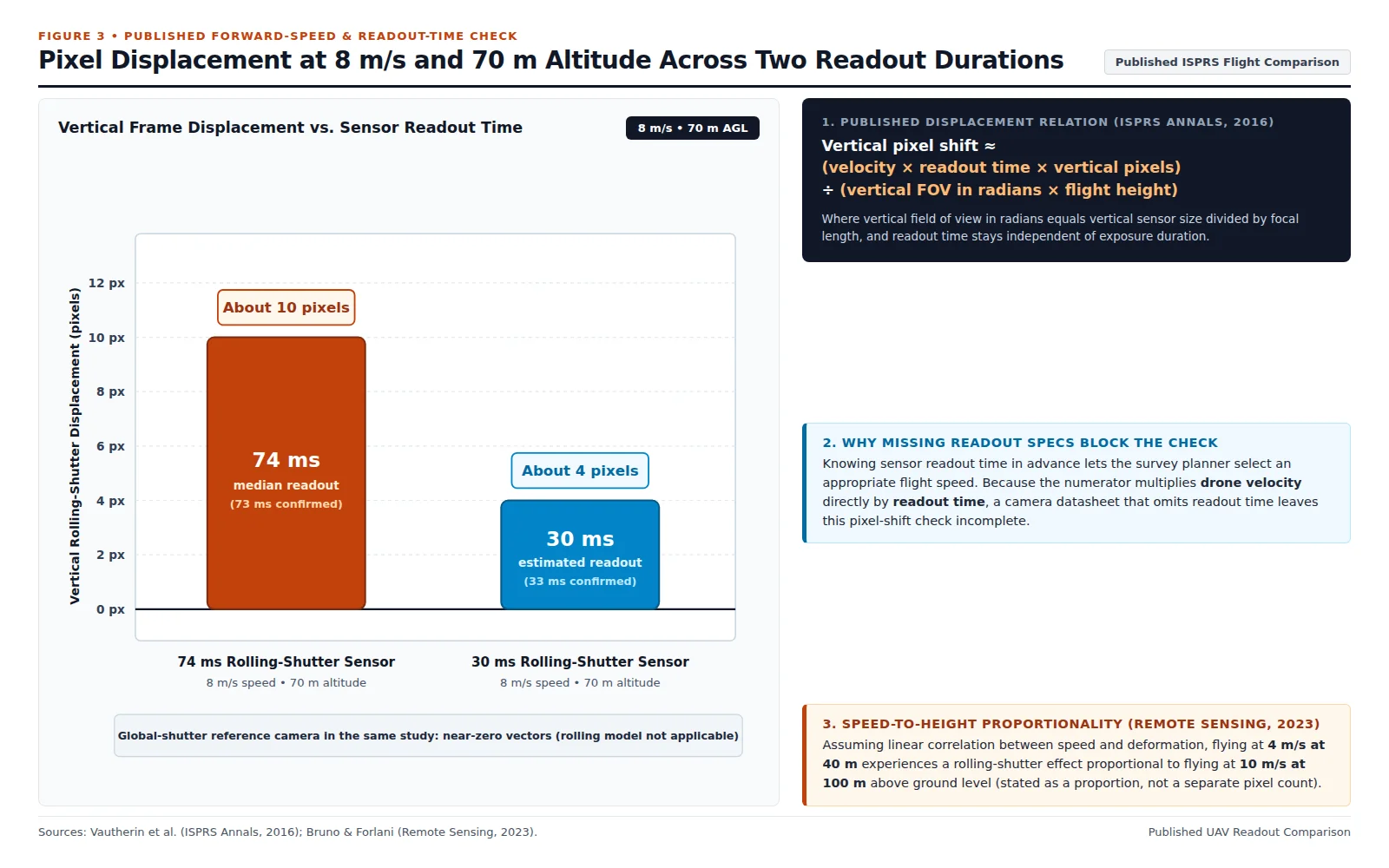
At 8 m/s and 70 m above ground, the published 74 ms readout shifts by about 10 pixels while the 30 ms readout shifts by about 4 pixels.
How do mechanical, electronic global, and electronic rolling shutters differ?
Published photogrammetric papers report distinct timing ranges for lens shutters, mechanical focal-plane curtains, and consumer CMOS readouts:
| Shutter family | Published timing or transit figure |
|---|---|
| Central shutter inside the lens | Maximum shutter speed typically 1/1000 s or slower, depending on aperture (Vautherin et al.) |
| DSLR mechanical curtain | Readout time on the order of 2 ms, more than an order of magnitude shorter than most electronic rolling shutters (Vautherin et al.) |
| Mechanical rolling-blind shutter | Typically circa 1/300 s, or about 3.3 ms, to transit the sensor (Verhoeven) |
| Consumer electronic rolling readout | On the order of 30 ms to 40 ms, the longest readout allowing 30 or 25 fps video (Vautherin et al.) |
| Consumer camera electronic transit | Often from about 1/10 s (100 ms) to 1/60 s (17 ms) (Verhoeven) |
Vautherin and coauthors describe mechanical global shutters as central shutters inside the lens, whereas common DSLR systems use mechanical rolling curtains that move simultaneously at very fast shutter speeds to expose a small fraction of the image at any moment. In an interline-transfer CCD, charge transfer into light-shielded vertical and horizontal registers happens simultaneously across the entire sensor without extra complexity. Standard CMOS sensors do not store charge independently of the photodiode, so mobile phones, action cameras, and many consumer drones use electronic rolling readout instead of a mechanical shutter, which can cause artifacts on moving UAVs.
Bruno and Forlani note that every row in an electronic rolling shutter has the same exposure length, starting after a per-row read-and-reset delay of roughly one to several tens of microseconds whose sum over all rows ranges from a few milliseconds to several tens of milliseconds. Verhoeven defines shutter transit time as the temporal offset between the first and last lines of photosites and notes that a fast exposure such as 1/2000 s can prevent motion blur without necessarily preventing geometric distortion, making readout architecture decisive for 3D reconstruction fidelity.
Which sensors in the published tests capture the frame at one instant?
Wikipedia’s active-pixel sensor overview notes that 5T and 6T CMOS pixel designs add extra transistors beyond standard 3T and 4T cells, making functions such as global shutter possible instead of the more common rolling shutter. Active circuitry inside a CMOS pixel occupies surface area that is not light-sensitive, reducing photon-detection efficiency, although microlenses and back-illuminated sensors can mitigate that loss. A primary manufacturing advantage of a CMOS sensor is that it is typically less expensive to produce than a CCD sensor because image capturing and sensing elements combine onto the same integrated circuit.
In aerial mapping literature, Vautherin and coauthors note that electronic global shutters have been implemented for CMOS sensors but are much less widely used because each pixel requires more complex circuitry. At the time of their study, CMOS electronic global shutter sensors were manufactured only with moderate pixel counts and densities, mostly for cameras operating at very high frame rates. Their global-shutter reference aircraft was a senseFly eBee carrying a Canon S110 global-shutter camera.
Why do vibration and a spinning propeller show up?
Wikipedia identifies wobble, also known as the jello effect, as unnatural image wobble appearing when a rolling-shutter camera vibrates on a moving vehicle or handheld mount. Skew is a related manifestation in which the image bends diagonally as the camera or subject moves from side to side, exposing different parts of the frame at different times. Verhoeven separates these linear deformations by transit axis: relative motion perpendicular to the shutter transit direction produces shearing that makes vertical lines appear slanted, while motion parallel to the shutter transit stretches or squeezes objects.
Rapid periodic motion and pulsed illumination create two additional artifacts. Wikipedia gives a quickly rotating propeller as an example of spatial aliasing in which vertically adjacent pixels are sampled in violation of the sampling theorem because blade rotation nears the camera readout speed. Temporal aliasing produces partial exposure when a camera flash, strobe, fluorescent lamp, or lightning bolt illuminates only the rows being sequenced during the burst.
Does a rolling-shutter model erase the global-shutter advantage?
Using a beta version of Pix4Dmapper 2.1, Vautherin and coauthors compared traditional camera models against a rolling-shutter model and found a significant accuracy improvement on validation ground control points for flights at 8 m/s, with higher flight speed and slower readout time yielding greater improvement and allowing drone speed and direction to be estimated from the rolling-shutter effect alone. Even with that rolling-shutter model applied, they concluded that while competitive accuracies can be obtained, global shutter cameras are still superior.
Bruno and Forlani flew one plan at 1 m/s, 2 m/s, and 4 m/s—selecting 1 m/s for small or perhaps negligible deformations—and reviewed correction models in Pix4D and MicMac. They found that rolling shutter affects primarily horizontal coordinates and varies notably across platforms, that in most of their cases the extended Fraser camera calibration adequately modeled the affine deformation on the terrain they flew, and that some rolling-shutter models may cause large elevation errors if too few ground control points are used. Kirk and coauthors note that their USGS jitter correction applies where a rolling-shutter camera can read selected check lines at chosen times during frame readout, while Verhoeven reports that bundle adjustments in Agisoft Metashape Professional show even imperceptible rolling-shutter artefacts can significantly degrade exterior orientation and 3D surface quality.
What should the payload sheet record before a fast survey?
Before flying a mapping or inspection pass, record five items on the payload sheet: shutter family, frame readout or transit time, planned airspeed, airframe vibration isolation, and whether the photogrammetric bundle adjustment assumes one camera pose per frame. Because Vautherin’s pixel-displacement check multiplies airspeed by readout time and Bruno and Forlani note that prior knowledge of readout time helps plan survey speed, a camera sheet that omits readout time leaves the pre-flight skew check incomplete.
Pixel spacing on the ground follows a separate optical relation covered in our ground sample distance guide, while added camera and gimbal weight is analyzed on the drone payload capacity and flight-time degradation curve. Agency airframe selection appears in the public safety drone guide, multi-sensor gimbal checks are on the Prism ISR integration checklist, and historical competition trials are documented in the UAS Triple Challenge archive.