NDAA-compliant drones are complete unmanned aircraft systems that avoid restricted foreign manufacturers and covered telecommunications or video surveillance components under Section 889 (FAR 52.204-25), the American Security Drone Act (FAR 52.240-1), and Section 848. The Defense Department Blue UAS Cleared List is a pre-vetted procurement shortlist, not the only compliant pathway for federal or grant-funded work.
What does NDAA compliance restrict on federal drone contracts?
NDAA drone compliance is not a single certificate; it combines component-level telecommunications bans under Fiscal Year 2019 NDAA Section 889 with system-level unmanned aircraft prohibitions under the FY2024 NDAA American Security Drone Act (ASDA), FY2020 NDAA Section 848, and subsequent FCC Covered List actions tied to FY2025 NDAA Section 1709.
Each federal statute targets a distinct layer of the supply chain and attaches through a specific acquisition or grant rule. Procurement teams and contractors need to check all applicable clauses before proposing hardware or aerial services.
| Federal authority | Effective trigger | Restricted entities and hardware | Contracting or grant mechanism |
|---|---|---|---|
| Fiscal Year 2019 NDAA Section 889 (Pub. L. 115-232) | August 13, 2019 (delivery); August 13, 2020 (contractor use) | Huawei and ZTE telecom; Hytera, Hikvision, and Dahua video surveillance or telecom for public safety, government facilities, critical infrastructure, or national security | FAR 52.204-25 for contracts; 2 CFR 200.216 for federal grants and loans |
| FY2020 NDAA Section 848 (Pub. L. 116-92) | FY2020 defense baseline; expanded under EO 14307 (June 6, 2025) | Unmanned aircraft and critical drone components subject to Defense Department supply chain restrictions | Aligned with the Defense Innovation Unit Blue UAS List under Executive Order 14307 |
| FY2024 NDAA ASDA (Pub. L. 118-31, sections 1821–1833) | November 12, 2024 (FAR delivery rule); December 22, 2025 (operation and federal funds); expires December 22, 2028 | Unmanned aircraft systems manufactured or assembled by an ASDA-covered foreign entity on the FASC list in SAM.gov | FAR Subpart 40.2 and FAR 52.240-1 across all acquisitions and subcontracts |
| FY2025 NDAA Section 1709 and FCC Covered List | December 22, 2025 Covered List addition | All foreign-produced UAS and UAS critical components plus Section 1709 communications and video surveillance equipment and services | FCC Public Safety and Homeland Security Bureau Covered List action documented in FCC Public Notice DA 26-742 |
Section 889 component and contractor-use bans (FAR 52.204-25)
Section 889 of the John S. McCain National Defense Authorization Act for Fiscal Year 2019 (Pub. L. 115-232) operates in two parts implemented through FAR 52.204-25. Under Section 889(a)(1)(A), effective August 13, 2019, executive agencies and contractors are prohibited from procuring or providing any equipment, system, or service that uses covered telecommunications equipment or services as a substantial or essential component or as critical technology unless an exception or FAR 4.2104 waiver applies.
Section 889(a)(1)(B) goes further. Effective August 13, 2020, executive agencies are prohibited from entering into, extending, or renewing a contract with an entity that uses covered telecommunications equipment or services as a substantial or essential component or critical technology, regardless of whether that use occurs in performance of work under a federal contract. FAR 52.204-25 defines covered foreign country as The People’s Republic of China and names telecommunications equipment from Huawei Technologies Company or ZTE Corporation, plus video surveillance and telecommunications equipment from Hytera Communications Corporation, Hangzhou Hikvision Digital Technology Company, or Dahua Technology Company (and their subsidiaries or affiliates) when used for public safety, security of government facilities, physical security surveillance of critical infrastructure, or other national security purposes.
American Security Drone Act phased prohibitions (FAR 52.240-1)
The American Security Drone Act of 2023 (subtitle B, title XVIII of the FY2024 NDAA, Pub. L. 118-31), enacted December 22, 2023, expanded drone-specific restrictions government-wide. Through the interim rule in 89 FR 89464, contracting officers must include FAR 52.240-1 in solicitations issued and contracts awarded on or after November 12, 2024.
FAR 52.240-1 defines an American Security Drone Act-covered foreign entity as an entity on the list developed and maintained by the Federal Acquisition Security Council (FASC) and published in the System for Award Management (SAM) under section 1822 of Pub. L. 118-31, which Executive Order 14307 directed the FASC to publish within 30 days of June 6, 2025. Under FAR 52.240-1(b), contractors are barred from delivering any FASC-prohibited unmanned aircraft system under sections 1823 and 1826, and on or after December 22, 2025, are barred from operating a FASC-prohibited unmanned aircraft system in contract performance under section 1824 or using federal funds to procure or operate one under section 1825. Under section 1833 of Pub. L. 118-31, the authorities in FAR 40.202 expire on December 22, 2028.
December 2025 FCC Covered List additions
Supply chain screening also intersects with Federal Communications Commission equipment authorizations. On December 22, 2025, the FCC Public Safety and Homeland Security Bureau (PSHSB) added all UAS and UAS critical components produced in a foreign country, along with all communications and video surveillance equipment and services listed in section 1709 of the FY2025 NDAA, to the FCC Covered List.
In its July 2026 Public Notice (DA 26-742, 91 FR 48108), the FCC proposed restricting continued importation and marketing of certain previously authorized foreign-produced and white-labeled systems while clarifying that the proposal would not affect continued use or operation of already-purchased equipment and would not apply to platforms on the DCMA Blue UAS Cleared List, domestic end products under the Buy American Standard, or devices granted Conditional Approval by the Department of War or Department of Homeland Security. Agency buyers must still treat FCC equipment authorization and federal procurement eligibility as separate gates because legal commercial operation does not override FAR 52.240-1 or 2 CFR 200.216 on federally funded projects.
How does NDAA compliance differ from the Blue UAS Cleared List?
A drone does not have to appear on the Blue UAS or Green UAS lists to be NDAA compliant. NDAA compliance is a statutory supply chain requirement verified across the full aircraft system, whereas the Blue UAS Cleared List is a Defense Department pre-vetted shortlist that streamlines buying and military installation approval.
Conflating the two standards causes costly procurement errors. Writing a solicitation that demands Blue UAS when the mission only requires statutory NDAA compliance narrows competition unnecessarily, while assuming an unlisted vendor declaration satisfies a DoD installation mandate can ground a newly purchased fleet.
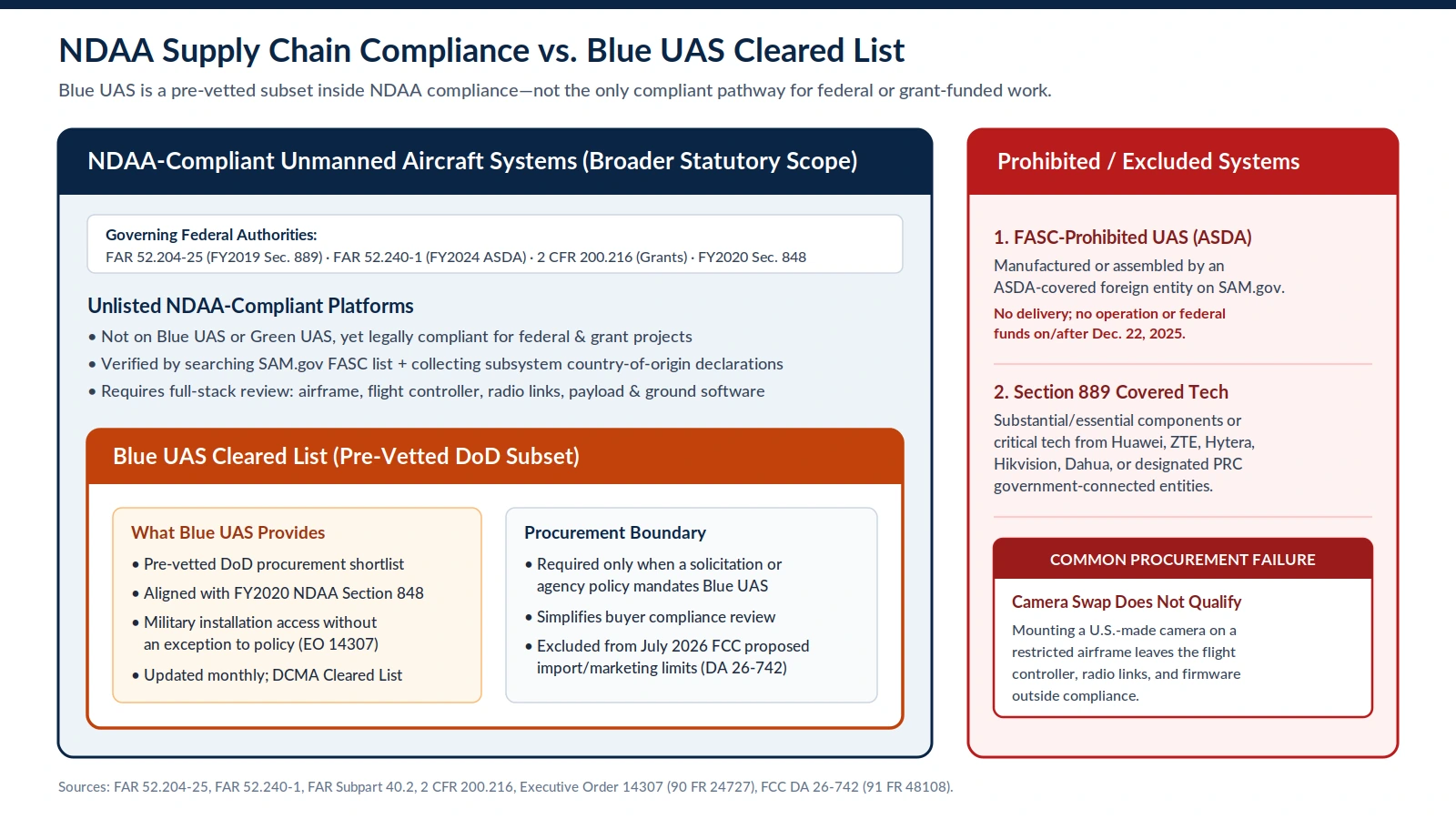
Blue UAS sits inside the broader pool of NDAA-compliant unmanned aircraft systems as a DoD-vetted procurement shortlist; prohibited systems remain excluded regardless of payload swaps.
Under Executive Order 14307 of June 6, 2025, the Secretary of Defense was directed to ensure all platforms on the Defense Innovation Unit (DIU) Blue UAS List can operate on all military installations or ranges without requiring an exception to policy. The same order directed the Secretary of Defense within 90 days to expand DIU’s Blue UAS List to include drones and critical drone components compliant with section 848 of the FY2020 NDAA (Pub. L. 116-92) to the fullest extent practicable, and to update the Blue UAS List on a monthly basis.
| Evaluation criterion | General NDAA compliance | Blue UAS Cleared List |
|---|---|---|
| Statutory or program role | Mandatory federal supply chain baseline under FAR 52.204-25, FAR 52.240-1, 2 CFR 200.216, and Section 848 | DoD pre-vetted procurement shortlist (DIU / DCMA Blue UAS Cleared List) used to streamline agency acquisition |
| Required for every federal or grant project | Yes, whenever applicable FAR or grant clauses govern the funding and no statutory exception or waiver applies | No; required only when the solicitation, agency policy, or military base rule specifically mandates Blue UAS |
| Military installation flight access | May require separate agency review or exception to policy on DoD ranges | Executive Order 14307 directs operation on military installations or ranges without an exception to policy |
| Registry maintenance | Contractors must search the FASC-maintained list in SAM.gov and perform a Section 889 reasonable inquiry | Updated monthly per Executive Order 14307; expressly carved out in FCC Public Notice DA 26-742 |
| Buyer verification burden | Buyer reviews vendor country-of-origin declarations, data-flow documentation, security audits, and legislative statements | Pre-vetted listing reduces repetitive compliance screening for government buyers |
Remember that procurement vetting does not replace operational hardening once hardware arrives. Even after selecting a compliant or Blue UAS airframe for an agency fleet, pair procurement checks with our drone cybersecurity audit guide covering default credentials, firmware signature checks, and flight log retention, and review the broader fleet framework in our public safety drone guide.
Why does swapping a camera not make a restricted drone compliant?
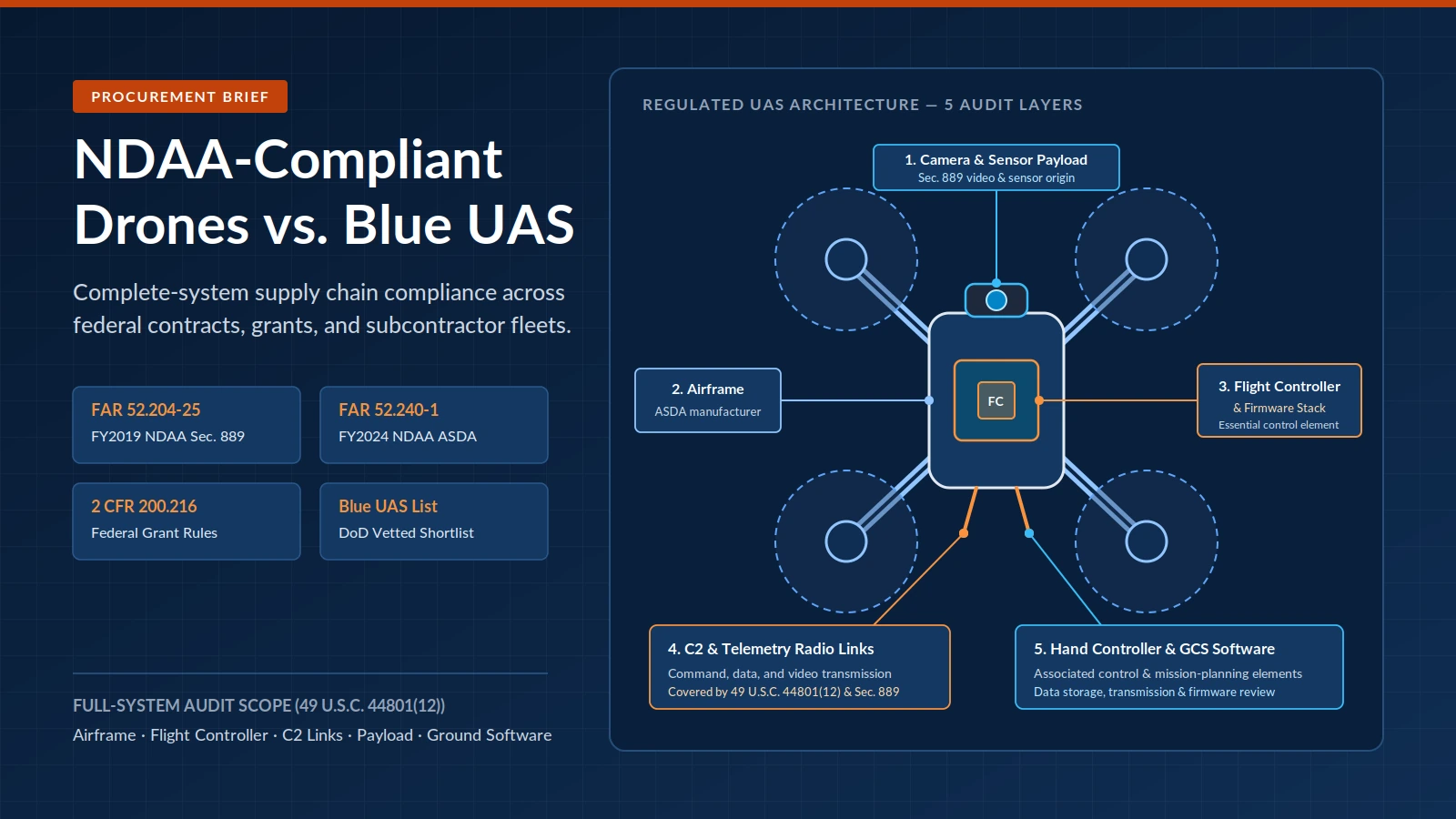
Mounting a U.S.-made camera on a restricted drone airframe does not produce an NDAA-compliant system. Federal rules evaluate the entire unmanned aircraft system—airframe, flight controller, radio telemetry links, sensors, and ground control software—so swapping one payload leaves prohibited flight control and communications architecture intact.
The legal text leaves no ambiguity about full-system scope. Both FAR 52.240-1 and FAR Subpart 40.2 incorporate the statutory definition in 49 U.S.C. 44801(12), which defines an unmanned aircraft system as an unmanned aircraft and associated elements—including communication links and the components that control the unmanned aircraft—required for safe and efficient operation in the national airspace system.
Why flight controllers, radio links, and ground stations fall inside review
Under FAR 52.204-25, a substantial or essential component means any component necessary for the proper function or performance of a piece of equipment, system, or service. Flight controllers, command-and-control transceivers, video downlinks, hand controllers, and ground control station software are essential to flying the aircraft and handling mission telemetry or imagery.
FAR 52.204-25(c)(2) exempts only telecommunications equipment that cannot route or redirect user data traffic or permit visibility into any user data or packets that it transmits or handles. Because drone command links, video transmitters, and ground control links actively carry control packets, telemetry, or imagery, they cannot hide behind that narrow non-routing exception.
| UAS subsystem layer | Why it triggers NDAA procurement review | Compliance check before award |
|---|---|---|
| Airframe and structural assembly | Directly covered by ASDA when manufactured or assembled by a FASC-covered foreign entity under FAR 52.240-1 | Verify airframe manufacturer and assembler against the SAM.gov FASC list |
| Flight controller and firmware | Controls aircraft stability and navigation as an essential control element under 49 U.S.C. 44801(12) and FAR 52.204-25 | Collect hardware country-of-origin and firmware provenance statements |
| Command, telemetry, and video radio links | Explicit associated elements under 49 U.S.C. 44801(12); handle live packets outside the FAR 52.204-25(c)(2) carve-out | Confirm radio modules contain no Huawei, ZTE, Hytera, Hikvision, or Dahua components |
| Camera, LiDAR, and sensor payloads | Video surveillance components from Hytera, Hikvision, or Dahua fall under Section 889 for public safety and critical infrastructure | Document payload OEM, sensor chip origin, and video processing chain |
| Hand controller and ground control software | Associated control components governing telemetry storage, mission planning, and external data transmission | Review vendor data storage and transmission architecture plus independent security audits |
The ASDA sub-component assembly nuance
Procurement officers should also track one subtle statutory boundary explained in the 89 FR 89464 preamble. While ASDA clearly prohibits a covered foreign entity from manufacturing or assembling a UAS or associated element, the FAR Council noted that ASDA does not necessarily prevent a covered foreign entity from supplying a sub-component part used by another entity to assemble or manufacture the UAS or associated element.
Rather than treating that sub-assembly gap as a free pass, the FAR Council encouraged agencies to consult agency-specific guidelines and emerging government-wide UAS procurement policies under section 1829 of Pub. L. 118-31. In practice, sub-components can still trigger Section 889 (if they are covered telecom or video surveillance components), FY2020 NDAA Section 848 (for critical components on defense platforms), or agency-level security policies, so buyers need bill-of-materials visibility below the airframe brand label.
How do local agency budgets differ from federal grants and contracts?
Most state and local government operations paid solely from local budgets operate without federal NDAA procurement restrictions unless a state law or private client agreement imposes them. Accepting federal grant or loan money immediately changes the rules by activating 2 CFR 200.216 and ASDA federal-funds restrictions.
Police departments, sheriff offices, fire districts, and municipal public-works teams frequently mix local capital budgets with federal preparedness, infrastructure, or transportation grants. Tracking the funding source on every purchase order and service invoice is essential before issuing a request for proposals.
Under 2 CFR 200.216, recipients and subrecipients are prohibited from obligating or expending federal loan or grant funds to procure, obtain, extend, renew, or enter into a contract for Section 889 covered telecommunications or video surveillance equipment or services, including systems that use covered equipment as a substantial or essential component or critical technology. When a local agency accepts a federal loan or grant, 2 CFR 200.216(e) treats that acceptance—along with every payment request and financial report—as an active certification of compliance. Parallel federal-funds restrictions in FAR 52.240-1(b)(3) prohibit using federal funds on or after December 22, 2025, for the procurement or operation of any FASC-prohibited UAS under section 1825 of Pub. L. 118-31.
Statutory exemptions, exceptions, and waivers under FAR Subpart 40.2
FAR Subpart 40.2 establishes narrow statutory carve-outs that agencies must document explicitly in the solicitation and contract file before relying on them:
- National-interest agency exemptions (FAR 40.202-4): Narrow exemptions apply to the Department of Homeland Security, Department of Defense, Department of State, and Department of Justice for specified national-interest missions—including systems modified before operational use so they can no longer transfer data to or download data from an ASDA-covered foreign entity and pose no national security cybersecurity risks as determined by the exempting official—along with defined exemptions for the Department of Transportation, NTSB safety investigations, and NOAA science or operational missions.
- Wildfire, search and rescue, and Tribal exceptions (FAR 40.202-5): Under section 1832 of Pub. L. 118-31, prohibitions in FAR 40.202 do not apply to an appropriate federal agency supporting wildfire management or search and rescue operations, or to Tribal law enforcement or Tribal emergency service agencies supporting law enforcement or search and rescue on Indian lands, when an authorized agency official makes the determination in consultation with the Secretary of Homeland Security.
- Case-by-case waivers (FAR 40.202-6): An agency head may waive FAR 40.202 prohibitions case by case only with approval from the Director of the Office of Management and Budget after consulting the FASC and notifying the appropriate congressional oversight committees.
No contractor or local subrecipient can self-grant an exemption, exception, or waiver. Under FAR 52.240-1(c), any effort or expenditure involving a FASC-prohibited UAS must match an exemption, exception, or waiver determination expressly stated in the contract. When budgeting compliant hardware alongside retained staffing and policy governance, pair this funding analysis with our DFR cost quote worksheet and DFR policy review matrix.
How do you verify an unlisted NDAA-compliant drone before bidding?
Because no single statutory registry lists every NDAA-compliant drone, buyers verify an unlisted platform in four steps: identify the governing funding clauses, search SAM.gov for the FASC-covered foreign entity list, perform a Section 889 reasonable inquiry across all five UAS subsystems, and archive written vendor origin and security declarations before award.
FAR 52.240-1(c) makes the registry lookup mandatory: before proposing or using any unmanned aircraft system in contract performance, the contractor must search SAM at sam.gov for the FASC-maintained list of ASDA-covered foreign entities. Under FAR 52.204-25, the companion standard is a reasonable inquiry—an inquiry designed to uncover information in the entity’s possession about the producer or provider of covered telecommunications equipment or services without requiring a formal internal or third-party audit.
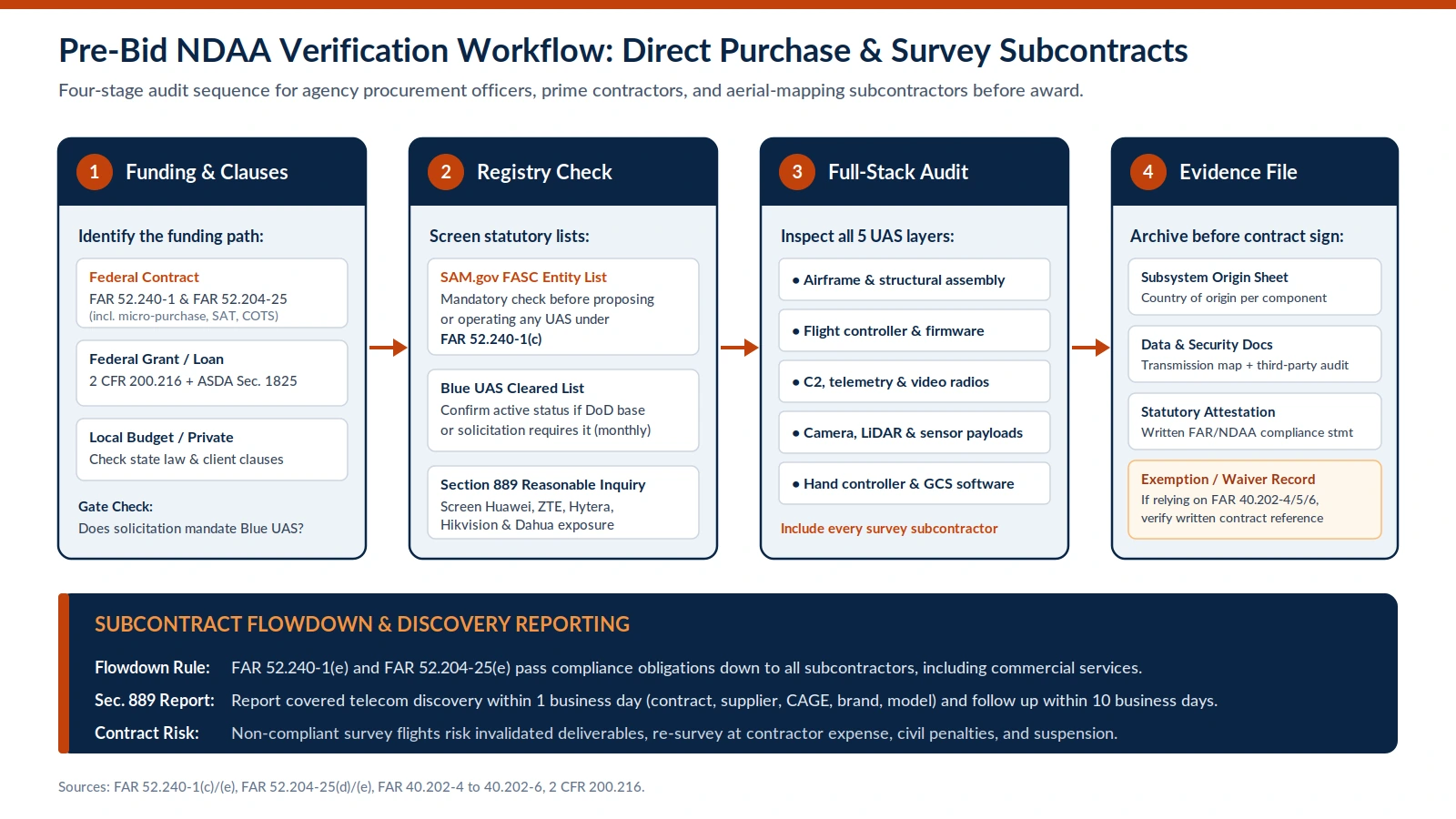
Use the same four-stage verification sequence for direct agency aircraft purchases and subcontracted aerial mapping or inspection services before contract execution.
Pre-bid agency and contractor compliance verification checklist
Build a single procurement compliance packet before issuing a purchase order or signing a bid proposal. Record each verification item alongside the exact contract clause and aircraft serial numbers logged in your Remote ID serial number fleet registration file.
| Verification file item | Governing clause or basis | Evidence to collect before award |
|---|---|---|
| Funding source and solicitation gate | FAR 52.240-1, FAR 52.204-25, or 2 CFR 200.216 | Written determination of federal contract, federal grant, or local budget funding, plus whether Blue UAS is mandatory |
| SAM.gov FASC entity screening | FAR 52.240-1(c) (section 1822, Pub. L. 118-31) | Dated screenshot or log confirming airframe and associated-element manufacturers are not on the FASC list in SAM.gov |
| Subsystem country-of-origin sheet | FAR 52.204-25 and 49 U.S.C. 44801(12) | Vendor origin declaration covering airframe, flight controller, radio links, camera/sensor payloads, and hand controller |
| Data storage and transmission map | Section 889 reasonable inquiry and cybersecurity review | Manufacturer documentation showing telemetry routing, cloud/offline storage behavior, and firmware update architecture |
| Independent security audit and attestation | Vendor NDAA compliance verification | Third-party security audit summary and signed manufacturer compliance statement referencing the applicable statutes |
| Blue UAS or exemption/waiver record | Executive Order 14307; FAR 40.202-4 to 40.202-6 | Current monthly Blue UAS listing confirmation (if required) or written contract text documenting an agency exemption, exception, or OMB-approved waiver |
What contract risks do surveying and infrastructure subcontractors face?
Aerial surveying and infrastructure subcontractors face full prime-contract compliance obligations on federally funded work because both FAR 52.240-1 and FAR 52.204-25 require mandatory subcontract flowdown across all tiers, including commercial products, COTS items, and small purchases. Flying a prohibited drone risks invalidated deliverables, re-survey at the contractor’s expense, civil penalties, and suspension.
Prime contractors on federal land surveys, transportation corridors, and federally funded infrastructure projects cannot shield themselves by outsourcing flights to a local mapping firm. Under 89 FR 89464, the FAR ASDA provisions apply to both supply and service solicitations and contracts, including exercising contract options or modifying existing contracts to extend performance.
Scope across micro-purchases, COTS, and commercial subcontracts
Small contract values and off-the-shelf drone purchases receive no carve-out. Under FAR 40.202-2, the ASDA prohibitions apply to all acquisitions, including purchases at or below the micro-purchase threshold and contracts for commercial products or commercial services. The FAR Council and the Administrator for Federal Procurement Policy likewise determined to apply FAR 52.240-1 to contracts at or below the Simplified Acquisition Threshold (SAT) and to Commercially Available Off-the-Shelf (COTS) items.
Both clauses mandate subcontract flowdown:
- FAR 52.240-1(e): Prime contractors must insert the substance of the ASDA clause, including paragraph (e), in all subcontracts and other contractual instruments, including subcontracts for commercial products or commercial services.
- FAR 52.204-25(e): Prime contractors must insert the substance of the Section 889 clause (including paragraph (e) and excluding paragraph (b)(2)) in all subcontracts and other contractual instruments, including commercial products and commercial services.
Mandatory reporting timelines and operational fallout
If a contractor identifies covered telecommunications equipment or services during contract performance—or receives notice from a subcontractor at any tier—FAR 52.204-25(d) imposes strict reporting deadlines to the Contracting Officer (or via dibnet.dod.mil for Department of Defense contracts):
- Within one business day: Report the contract number, applicable order numbers, supplier name, unique entity identifier (if known), Commercial and Government Entity (CAGE) code (if known), brand, model number, item description, and any readily available mitigation actions undertaken or recommended.
- Within 10 business days: Submit further mitigation actions undertaken or recommended, describe efforts undertaken to prevent use or submission of covered equipment, and document additional controls to prevent future recurrence.
Beyond statutory reporting, operational consequences hit project economics directly. Federal projects flown with non-approved platforms can result in invalidated work requiring a complete re-survey at the contractor’s expense, potential civil penalties, suspension from future federal work, and insurance liability gaps when non-compliance voids underlying contract terms. Before mobilizing a subcontracted flight crew on any federally funded corridor or facility, verify their aircraft serial numbers, SAM.gov FASC status, and vendor origin packet in writing.