A second control radio inside 2400–2483.5 MHz fails with the first when that 83.5 MHz band is occupied. Part 88 designates 5040–5050 MHz for non-networked control traffic, and §88.25(a) keeps payload off that assignment.
Independent explainer: this site is named after the domain once used by the First Responder UAS Triple Challenge and is not its organizer or affiliated with NIST or the universities involved.
Control-and-non-payload communications, in 47 CFR 88.5 as adopted on 8 January 2025, are any transmission between the uncrewed aircraft and its ground station that supports the safety or regularity of the flight. Payload is the other category: information sent to achieve mission objectives, and it is not that control traffic. A drone mesh network that moves video is payload. A second radio is a redundant command link only when the control transmission itself has a path the first failure does not take.
The band decides which radios fail together
| Record | What it prints | Dominant failure mode | Prevention |
|---|---|---|---|
| 47 CFR 88.5 and 88.25(a) | CNPC is the control transmission between the aircraft and its ground station. Transmissions on an NNA assignment are limited to CNPC. Payload is mission information and is not CNPC. | Video, maps, or a user mesh placed on the NNA assignment. | Keep mission traffic on a radio whose own rules allow payload. The data-relay explainer is that path. |
| 47 CFR 88.29 | 5040–5050 MHz is the NNA block for CNPC. Before the first DFMS operates, the interim access mechanism opens 5040–5060 MHz. Both sit inside 5030–5091 MHz. | Treating the whole 61 MHz allocation as the assigned control channel. | Quote 5040–5050 MHz for NNA after a DFMS exists, and 5040–5060 MHz only for the interim period. |
| 47 CFR 15.247(b)(3) and (c) | Digital modulation in 902–928, 2400–2483.5, and 5725–5850 MHz: 1 watt peak conducted. Gain above 6 dBi requires an equal conducted-power cut, except the fixed point-to-point cases in (c)(1). | Two control radios inside one of those bands, or a higher-gain antenna with the 1 watt left in place. | Split the backup into a different one of the three bands, and cut conducted power 1 dB per 1 dB over 6 dBi when the station is not fixed point-to-point. |
| 47 CFR 15.247(b)(1) | Frequency-hopping systems in 2400–2483.5 MHz: 1 watt only with at least 75 non-overlapping hopping channels. Other hopping systems in that band: 0.125 watts. | Applying the 1 watt digital-modulation line to a hopper with fewer than 75 channels. | Read the grant’s modulation. The 0.125 watt line is the cap when (b)(1) says so. |
| 47 CFR 15.204(d)(1) | An external amplifier sold for the §15.247 bands has to connect only as part of a system in which it was authorized, and its output must stay at or below that transmitter’s permitted power. The manual names the authorized system by FCC ID. | A booster box with no FCC ID for this radio, or an output above the grant. | Match the FCC ID. If the box has none for this transmitter, it is not the amplifier (d)(1) describes. |
| FAA Remote ID page, updated 19 March 2025 | Remote ID is the ability of a drone in flight to provide identification and location information by a broadcast signal. | Treating the broadcast as the command link, or the reverse. | Keep Remote ID on the serial audit. It does not fly the aircraft. |
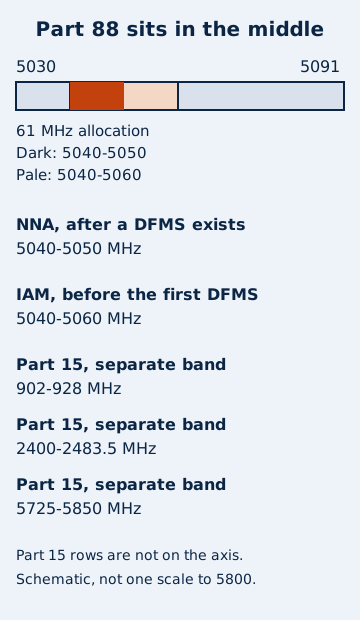
The 8 January 2025 document, 90 FR 1380, sets 7 February 2025 as the effective date and delays §§88.27, 88.31, 88.33, 88.35, 88.111, 88.113, 88.115, 88.135, 88.137, and 88.141. Section 88.27 is the registration duty that has to be met before a station transmits on the designated NNA frequencies, and §88.31 is the request for a temporary assignment tied to one submitted flight. A Federal Register search on 20 October 2026 for a Part 88 effective-date notice returned that January rule, a 17 March 2025 proposal on advanced air mobility, and an unrelated deletion notice. None of the three announces an effective date for the delayed sections. This page uses §§88.5, 88.25, and 88.29. It does not describe a live DFMS assignment.
Section 88.101, which is outside the delayed list, points transmitter power at RTCA DO-362A section 2.2.1.6.1. This page does not copy a watt figure out of a standard it has not opened. Section 88.109 likewise points the time-division duplex frame at DO-362A. The duplex fact is in the rule. The frame length is in the standard.
Rules of thumb
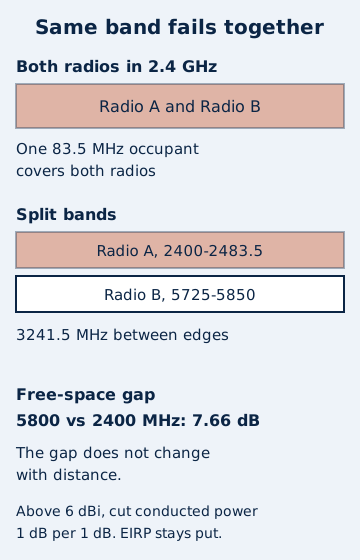
Rule of thumb. If both control radios are authorized only inside 2400–2483.5 MHz, count them as one link: the band is 83.5 MHz wide, and one occupant of that width takes both. If the second radio is authorized in 5725–5850 MHz, the near edges are 5725 and 2483.5, which are 3241.5 MHz apart, and the free-space gap from 2400 MHz to 5800 MHz is 7.66 dB at every distance. If directional gain is above 6 dBi and the station is not an exclusively fixed point-to-point link, cut conducted power 1 dB for each 1 dB over 6 dBi. At the 1 watt digital cap, compliant EIRP stays at 36 dBm.
A moving aircraft is not the fixed point-to-point station in §15.247(c)(1). That paragraph’s relief, including no conducted-power cut for high gain in 5725–5850 MHz, is for links used exclusively as fixed point-to-point. Paragraph (c)(1)(iii) excludes point-to-multipoint systems, omnidirectional applications, and multiple co-located radiators transmitting the same information.
Free-space loss at 2 kilometres
The comparison uses free-space path loss:
FSPL(dB) = 20 log10(4 π d / λ), with λ = c / f and c = 299,792,458 m/s.
At d = 2000 m the formula returns 106.07 dB at 2400 MHz, 112.52 dB at 5040 MHz, and 113.74 dB at 5800 MHz. The distance term cancels in a ratio. 20 log10(5800/2400) = 7.66 dB, and 20 log10(5040/2400) = 6.44 dB. Subtracting the rounded 2400 and 5800 results gives 7.67 dB. The 0.01 dB is rounding.
A §15.247 digital transmitter at the 1 watt cap is 30 dBm conducted. With 0 dBi antennas and no feeder loss, free-space power at 2 km is 30.00 − 106.07 = −76.07 dBm at 2400 MHz, and 30.00 − 113.74 = −83.74 dBm at 5800 MHz. Those two lines are the same 1 watt into different free-space loss. They are not a measured flight, and they are not a receiver sensitivity. No sensitivity is printed in the sections cited here, so this page stops at the path loss.
The same 1 watt into a 9 dBi antenna, with no conducted-power cut, is 39 dBm EIRP. The compliant pair at this cap is 30 dBm into 6 dBi, or 27 dBm into 9 dBi. Both are 36 dBm EIRP. The extra 3 dBi does not extend the legal link. It is cancelled by the 3 dB cut §15.247(c) requires.
A booster that keeps 1 watt fails the cap
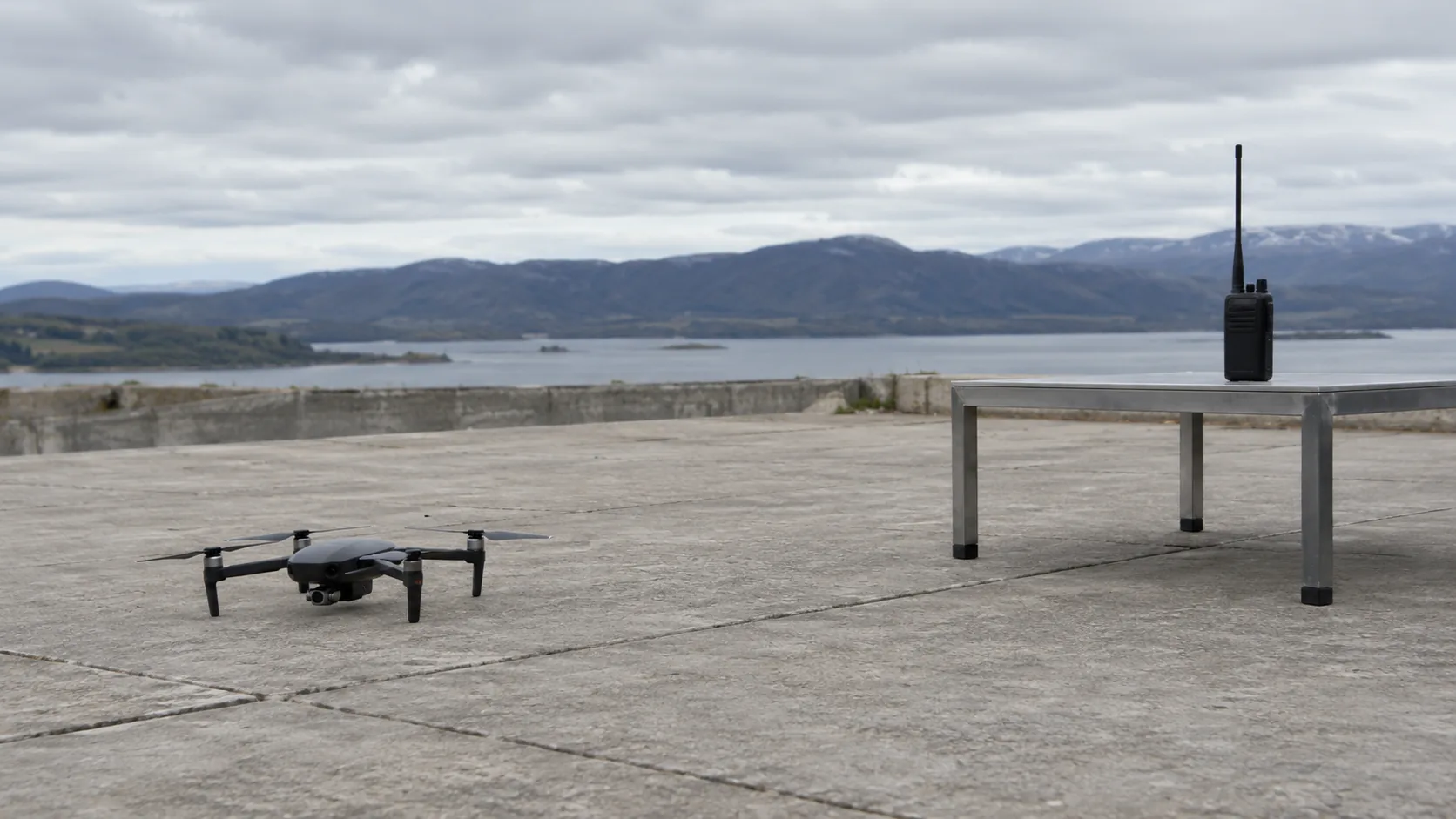
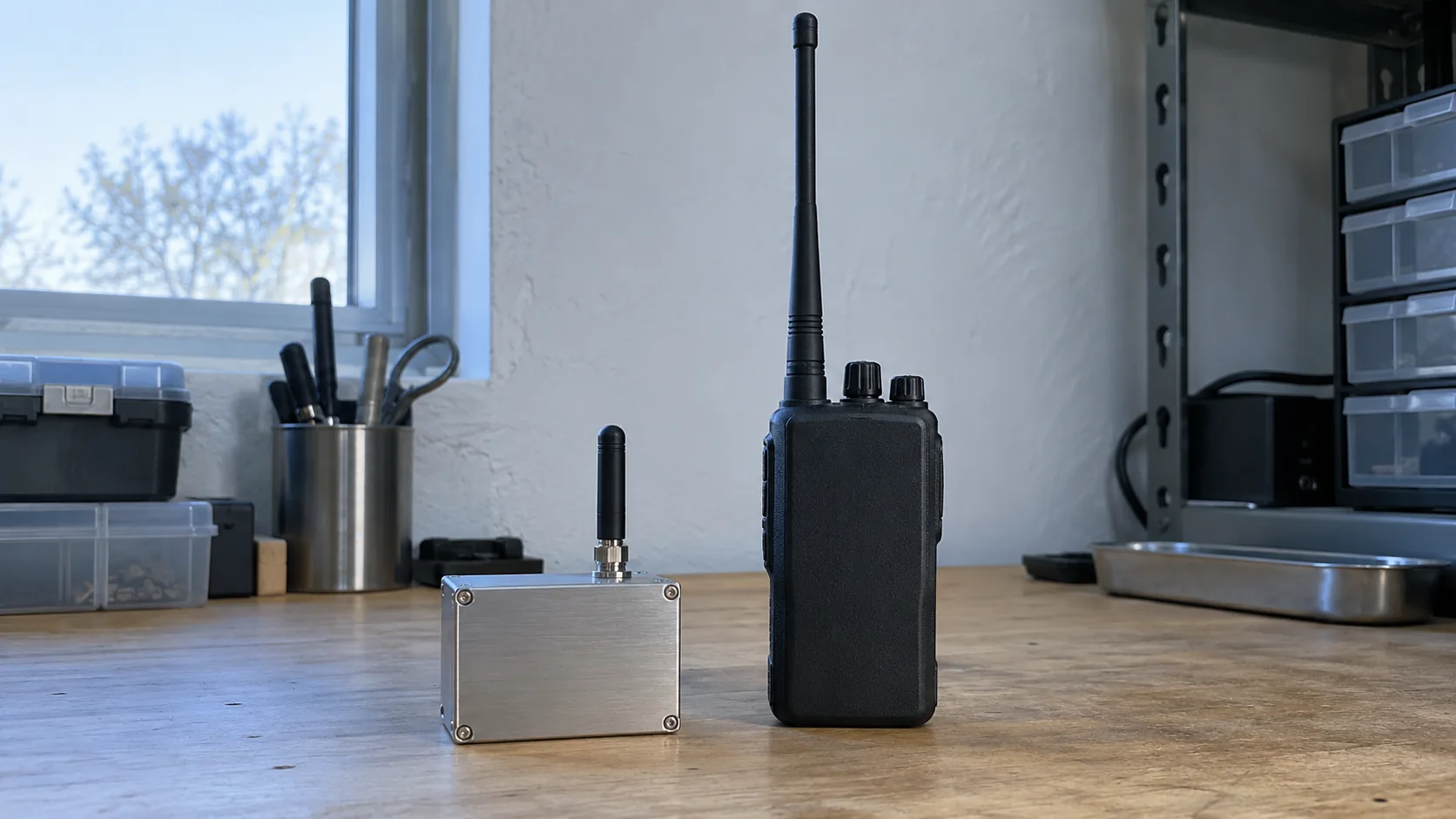
The photograph shows two unmarked radios and two different antennas. It does not show gain, conducted power, or an FCC ID. Antenna length is not a dBi measurement.
Section 15.204(a) bars an external radio-frequency power amplifier intended for a Part 15 intentional radiator, with the exceptions in (b) and (d). Paragraph (d)(1) allows individual sale of an amplifier for the §15.247 bands only when it connects as part of a system in which it was already authorized, and only when its output stays at or below that transmitter’s permitted power. Paragraph (d)(2) requires the packaging and the manual to name that system by FCC Identifier. A drone signal booster that omits the FCC ID, or that raises output above the grant, is outside that paragraph. The prevention is the second authorized band, with the 7.66 dB in the budget, not an amplifier on the first grant.
The hidden cost is a lost control link, not a line on an invoice. Two radios in one 83.5 MHz band stop together, so the second purchase does not buy a second failure domain. Three extra decibels of antenna gain, left on top of 1 watt, spend the compliance margin that was already used to reach 36 dBm. Mission video on 5040–5050 MHz spends a CNPC-only block on payload, and the video still needs a radio whose rules allow it.
A mesh that carries video is payload
A drone mesh network is a set of radios forwarding one another’s packets. The data-relay explainer separates a local mesh from an aerial cell site and from store-and-forward. That architecture page is about user traffic. User traffic matches the §88.5 payload definition: information sent to achieve mission objectives, and not CNPC. Section 88.25(a) then keeps it off the NNA assignment.
A mesh becomes a second command link only when the control transmission has its own path on that mesh, and when that path survives the failure that takes the first radio. Hopping the same 2400–2483.5 MHz channel through a second aircraft does not do that. The occupant that fills the band fills it for every radio in the band, on the ground or in the air.
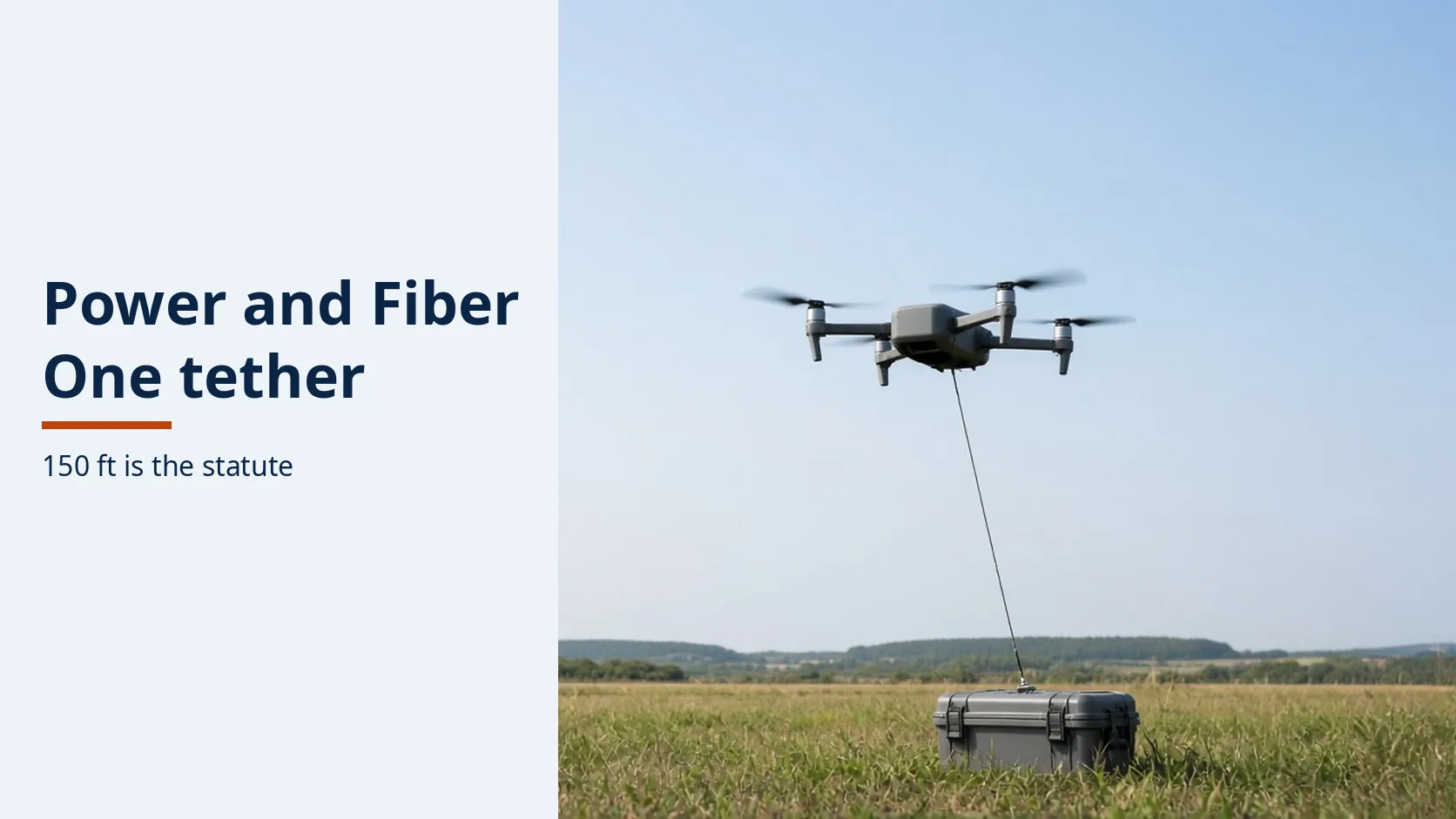
GNSS loss is a different failure. Jamming or spoofing the navigation solution does not, by itself, identify which control band failed. The navigation explainer keeps the control radio and the satellite solution apart. A tether can move the control transmission off the radio entirely and onto a conductor. The tether note separates that conductor from the fiber and from the Part 15 radio.
When this does not apply
- The operation is the network-supported service the 8 January 2025 rule deferred. This page is the non-networked block only.
- The link never leaves the ground and is exclusively fixed point-to-point. Section 15.247(c)(1) uses different antenna math, including no conducted-power cut for high gain in 5725–5850 MHz. An aircraft in motion is not that station.
- The grant is not §15.247. A Part 88 station follows §88.101, which points at DO-362A section 2.2.1.6.1. No watt figure from that section is repeated here.
- Someone treats §88.27 or §88.31 as effective because the band is designated. The designation is §88.29. The registration and assignment sections are on the delayed list in the same document.
- Remote ID is being used as proof the command link is up. The FAA page defines Remote ID as identification and location by broadcast. The serial audit is the inventory check. It is not a link budget.
Methods and sources
The CNPC definition, the payload definition, the 5040–5050 MHz block, the 5040–5060 MHz interim block, the delayed section numbers, and the DO-362A cross-references come from the Federal Register text of FCC 24-91, published 8 January 2025. The 1 watt and 0.125 watt caps, the three Part 15 bands, and the 6 dBi conducted-power cut come from 47 CFR 15.247 as posted by the Legal Information Institute. The amplifier limits and the FCC ID notice come from 47 CFR 15.204 on the same site. The Remote ID sentence comes from the FAA page last updated 19 March 2025, read 20 October 2026. The free-space figures use c = 299,792,458 m/s at 2000 m. No flight test is reported. The archive is the competition record. The data-relay explainer is the payload-architecture page.