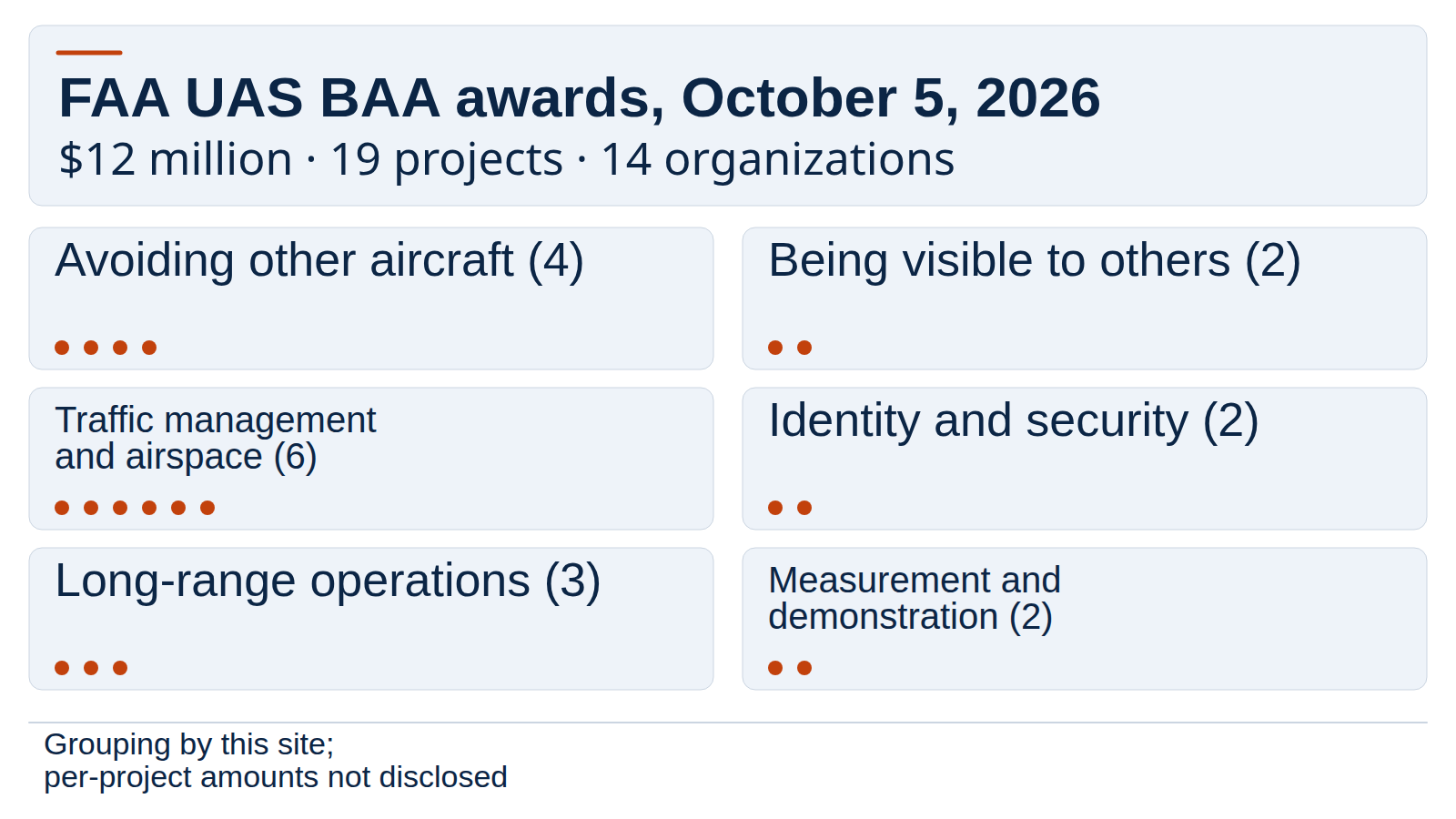
On October 5, 2026, the FAA announced $12 million in awards for 19 drone research and testing projects, made through its UAS Broad Agency Announcement (BAA) Program. This page groups the projects by technical area, explains how the program channels money through FAA-designated test sites, and lists what the announcement leaves out.
The FAA awarded $12 million for 19 drone research and testing projects through its UAS Broad Agency Announcement Program, which funds companies working with FAA-designated UAS Test Sites to test and evaluate technologies for safe drone integration (FAA release, October 5, 2026). The release says “19 companies,” but its project list names 14 organizations, including one university; some hold several projects. Most projects deal with avoiding other aircraft, making drones visible, managing drone traffic and identity, and long-range operations. The release does not give the amount for each project, which test site each works with, or project timelines. The program’s legal basis is Section 925 of the FAA Reauthorization Act of 2024, which makes $6 million available in each fiscal year from 2025 through 2028, divided evenly among the test ranges. The FAA’s BVLOS rule is still a proposal in the Federal Register docket.
Key points:
- Confirmed by the FAA: $12 million, 19 projects, the BAA program, the test-site partnership model, and the list of nine test sites.
- Our grouping: the 19 projects fall into about six technical areas; the FAA did not publish categories.
- Not disclosed: per-project amounts, test-site pairings, timelines, and the date of the next call.
- Related rule: the BVLOS proposal from August 2025 has no final rule in its docket as of October 7, 2026.
What did the FAA announce?
A batch of 19 research and test awards worth $12 million in total, tied to the FAA’s test-site network. The table separates what the release states from what it does not.
| Item | What the FAA release says | Status |
|---|---|---|
| Amount | $12 million in total | Confirmed |
| Recipients | “19 companies”; the project list names 14 organizations, one of them Oklahoma State University | Confirmed list; wording differs from count |
| Program | UAS Broad Agency Announcement (BAA) Program | Confirmed |
| Model | Companies work with FAA-designated UAS Test Sites to test and evaluate technologies | Confirmed |
| Policy link | Advances the “Unleashing American Drone Dominance” Executive Order of June 2025 | FAA statement |
| Test sites | Nine, listed by name | Confirmed |
| Per-project amounts, pairings, timelines | Not stated | Unknown |
FAA Administrator Bryan Bedford said the program “gives us another way to directly work with industry and our test site partners on technologies that are critical to safe drone integration,” and that the research will provide “better data” to inform how drones are integrated into the National Airspace System.
What are the 19 projects about?
Mostly the problems that stand between today’s drone operations and routine flights in shared airspace: seeing and avoiding other aircraft, being seen, managing traffic, proving identity, and flying long routes. The grouping below is ours; the FAA published only a one-line description of each project, quoted here in summary.
| Area (our grouping) | Projects (organization: FAA description) |
|---|---|
| Avoiding other aircraft | General Atomics: ground systems to help drones avoid other aircraft · OneRadio Corporation: passive radar to help drones avoid other aircraft · Skydweller: onboard systems to help large drones avoid other aircraft · NAVMAR: systems to help large drones fly safely |
| Being visible to others | SPS Aerial Remote Sensing: test of drone visibility technology · Oklahoma State University: drone visibility technology under the Aero Aware project |
| Traffic management and airspace | ANRA Technologies: tools connecting air taxi operations, vertiports and flight procedures · ANRA Technologies: tools to connect drone traffic systems with traditional air traffic systems at airports · ANRA Technologies: a common altitude reference for drones · Aerial Vantage: managing reserved airspace for drones in cities · ResilienX: software to coordinate drone missions and resources · SPS Aerial Remote Sensing: a sensor system for drone traffic management and counter-drone operations |
| Identity and security | DroneUp: a secure way to verify drone identity and approval to fly · ANRA Technologies: AI tools to identify different types of drones |
| Long-range operations | Devorto Corporation: long-range cargo drone service · Censys Technologies: satellite communications for long-range flights · Lighthouse Avionics: surveillance tools for long-range routes |
| Measurement and demonstration | SPS Aerial Remote Sensing: tools to measure sensor performance · Frequentis USA: a drone technology demonstration |
Two notes on the list. ANRA Technologies holds four of the 19 projects and SPS Aerial Remote Sensing three, so the list has 19 projects from 14 organizations, while the release says “19 companies.” And several projects (the satellite link for long-range flights, identity verification) touch topics we explain elsewhere: how drones carry data over distance is covered in our drone communications relay explainer, and threats to drone navigation and control links in our explainer on GPS spoofing and jamming. Delivery networks are among the operations these capabilities are meant to support; our explainer on Wing and Walmart’s Denver and Seattle plan shows the local-permit side of one such rollout.
How does the UAS BAA program work?
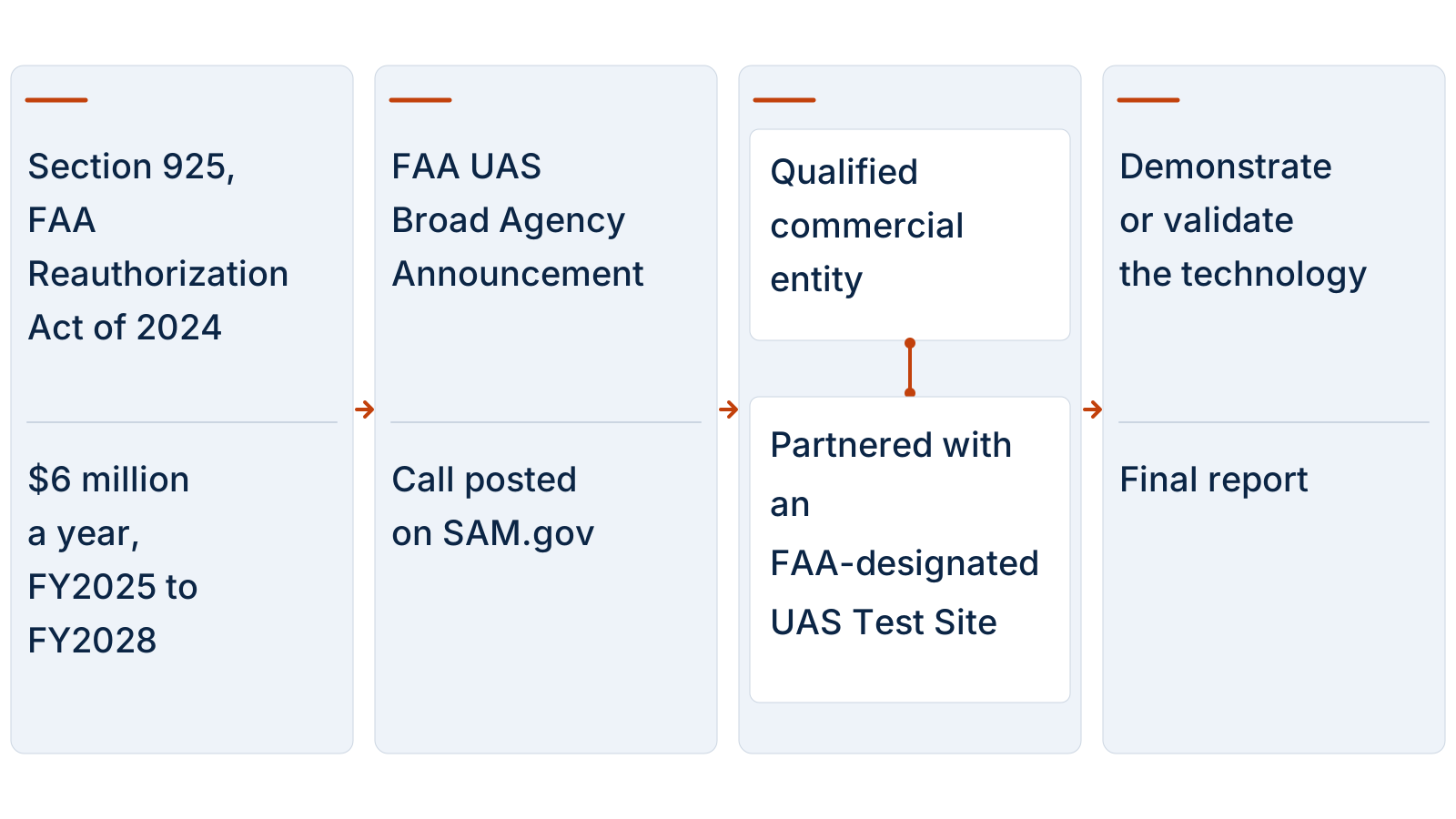
It pays commercial entities to demonstrate technologies at FAA-designated test sites, using money Congress set aside for that purpose. The FAA’s program page sets out the basis:
- Legal basis. Section 925 of the FAA Reauthorization Act of 2024 (Public Law 118-63) makes $6 million available for each of fiscal years 2025 through 2028 to provide matching funds to commercial entities that contract with a UAS test range to demonstrate or validate technologies the FAA considers essential to safe integration, and to support those activities. The funding is to be divided evenly among the designated test ranges.
- Who can take part. The BAA, which the FAA describes as an acquisition program, offers funding opportunities to qualified commercial entities partnered with an FAA-designated UAS Test Site.
- Track record. The page lists final reports for five earlier calls (Call 001 to Call 005).
- Future calls. The FAA tells interested parties to follow SAM.gov for updates.
Two details do not line up. The program page, last updated March 30, 2026, refers to seven test sites, while the October release and the FAA’s test-site page list nine; the test-site page says two were added in 2026. And the release does not say which fiscal years’ funds make up the $12 million.
How is it different from the FAA’s ASSURE research center?
They fund different kinds of organizations through different mechanisms.
| Channel | Who it funds | How | Source |
|---|---|---|---|
| UAS BAA | Qualified commercial entities partnered with an FAA-designated UAS Test Site | Acquisition program; statutory matching funds under Section 925 of the 2024 reauthorization, calls posted on SAM.gov | FAA BAA page (updated March 30, 2026) |
| ASSURE (FAA Center of Excellence for UAS) | University research, through a consortium led by Mississippi State University, selected in May 2015 | Cooperative agreements and a companion contract; the FAA said it committed to send all UAS-related academic research to the center | FAA overview presentation (August 2022) |
The ASSURE details come from a 2022 FAA presentation and may have changed. A university appears on this BAA list (Oklahoma State University) without the release explaining its role, so the line between the two channels is not absolute.
Who should pay attention?
Companies building detect-and-avoid, traffic-management and long-range systems, and the test sites they work with. The table is our reading of the announcement and program rules.
| Who | Why it matters | Basis |
|---|---|---|
| Drone and avionics companies with integration technology | The BAA is a recurring route to fund flight testing with FAA involvement, if they partner with a test site | BAA page; release |
| FAA-designated test sites | They are the required partners; the statute divides the funding evenly among test ranges | BAA page (Section 925) |
| Detect-and-avoid and visibility developers | Six of the 19 projects in our grouping are in these areas, which are also topics of the reopened BVLOS comment period | Release; Federal Register |
| University researchers | Academic UAS research is routed mainly through the ASSURE center rather than the BAA | FAA COE overview (2022) |
What happens next, and when?
The FAA release and BAA page we checked give no date for the next call or for this round’s reports; SAM.gov is where a new call would be posted. The table lists the dated steps that frame this round.
| Date | Event | Source | Source type |
|---|---|---|---|
| 2024 | FAA Reauthorization Act of 2024, Section 925, authorizes $6 million a year for fiscal years 2025 to 2028 | FAA BAA page | Official program page quoting the statute |
| June 2025 | “Unleashing American Drone Dominance” Executive Order | The White House; FAA release | Executive order; official release |
| August 7, 2025 | BVLOS proposed rule published | Federal Register | Proposed rule |
| January 28, 2026 | BVLOS comment period reopened on electronic conspicuity and right-of-way | Federal Register | Reopening notice |
| 2026 | Two test sites added, for nine in total | FAA test-site page | Official program page |
| October 5, 2026 | $12 million for 19 BAA projects announced | FAA release | Official release |
| Not listed | Next BAA call | FAA BAA page points to SAM.gov | To be checked on SAM.gov |
| Not listed | Final reports for this round; earlier calls’ reports are on the FAA’s BAA page | FAA BAA page | Official program page |
What is still unknown?
The amounts, pairings and timelines for each project, and when the next call opens. Each item lists who could settle it and which document would show it; we have not obtained any of these documents.
- Amount per project. Not in the release. The FAA or the award recipients, through the award documents.
- Which test site each project works with. Not stated. The FAA, the recipients or the test sites, through the award or partnership documents.
- Project length and deliverables. Not stated. The FAA or the recipients, through the award documents. Final reports have been published for earlier calls, which suggests where results may appear, but the FAA has not given a date for this round.
- “19 companies” versus 14 organizations. The release says 19 companies; we count 19 projects from 14 distinct organizations, one of them a university. Why the numbers differ is for the FAA to clarify.
- Next call. Not listed on the pages we checked. SAM.gov, per the FAA.
- Link to the BVLOS rule. The FAA did not tie any award to the rulemaking. The Federal Register docket would show a final rule when one is issued.
Our reading
This is a modest, targeted round rather than a broad research program: $12 million spread over 19 projects, aimed at the technical gaps that routine flights beyond visual line of sight depend on, such as avoiding and being seen by other aircraft and connecting drone traffic to air traffic control. For a company, the practical lesson is the entry route: the money flows through test-site partnerships and calls posted on SAM.gov. For everyone else, the useful output will be the final reports, if this round follows earlier ones.
Sources and update log
This explainer is based on the FAA’s October 5, 2026 release, the FAA’s BAA, test-site and Center of Excellence pages, and the Federal Register docket for the BVLOS proposal, all accessed October 7, 2026. Trade-press articles that republish or rewrite the FAA release are not counted as separate sources. The project grouping is our own. Nothing here judges any company’s technology.
Last checked: October 7, 2026. Next review: when the FAA posts a new BAA call or project results.