A fiber that goes dark does not remove power from the aircraft, and a slack tether fails the statute’s taut test. The conductor, the sheet, and the altitude ceiling decide which of those failures is in front of the crew.
Independent explainer: this site is named after the domain once used by the First Responder UAS Triple Challenge and is not its organizer or affiliated with NIST or the universities involved.
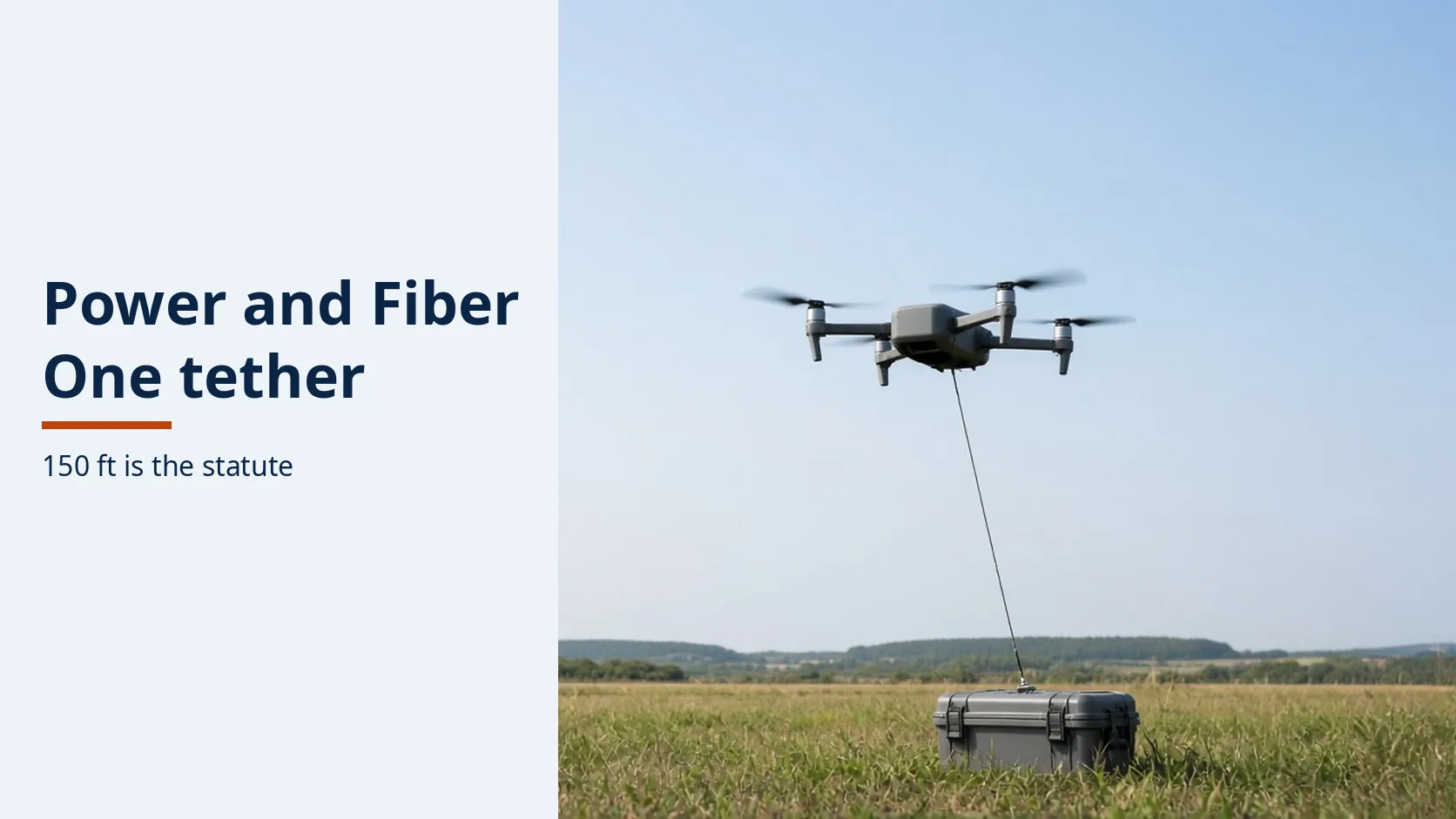
An actively tethered unmanned aircraft, in 49 USC 44801, weighs 55 pounds or less including payload and not including the tether, and it is held by a taut tether that supplies continuous power. The FAA’s August 2024 checklist for 49 USC 44806 stops that public-safety path at 150 feet above the ground unless the FAA authorizes more. Elistair’s Safe-T 2 leaflet prints up to 2200 watts continuous and an optional fiber beside broadband over the power pair. Those are three different records. None of them is a flight-time test.
The conductor decides the failure
| Record | What it prints | Dominant failure mode | Prevention |
|---|---|---|---|
| 49 USC 44801 and the August 2024 checklist | Taut, load-rated tether. Continuous power. Controlled landing if the tether separates. Safe flight control if power or flight control fails. At or below 150 feet above the ground on this public-safety path, unless authorized. Aircraft at or under 55 pounds including payload, tether excluded. | A slack line, a separation with no landing program, or an altitude taken from a brochure. | Keep the line taut. Stay at or below 150 feet unless the authorization is in hand. Weigh the aircraft without adding the tether. |
| Elistair Safe-T 2 leaflet | Up to 2200 watts continuous. Output 6S or 12S. Tether length 100 metres. Flight line in the same leaflet: 90 metres (295 feet). Secure dual communications: broadband over powerline and optional fiber. Source at least 4 kilowatts at 230 volts, or 3 kilowatts at 120 volts. | Treating the 4 kilowatt source line as aircraft power, or treating the fiber as the power path. | Quote the 2200 watt output and the source minimum as two numbers. Record whether the payload is on the fiber or on the power pair. |
| Elistair product page, retrieved 20 October 2026 | Cable length 110 metres. Operational altitude 100 metres (328 feet). Up to 2500 watts peak. Output 6S, 8S, or 12S. Optical fiber listed as an option. | Copying the leaflet’s 2200 watt continuous figure onto this page, or the reverse. | Write the document date next to the number. Peak and continuous are not the same word. |
| Hoverfly Spectre 2.0 sheet, 2024 | Operating altitude 60 metres (200 feet). Power under 2000 watts continuous and 2400 watts peak. No radio-frequency emission: command, control, and payload data on the secure tether. | Calling that tether a fiber because another vendor offers fiber. | The sheet does not name the conductor. Say “on the tether.” |
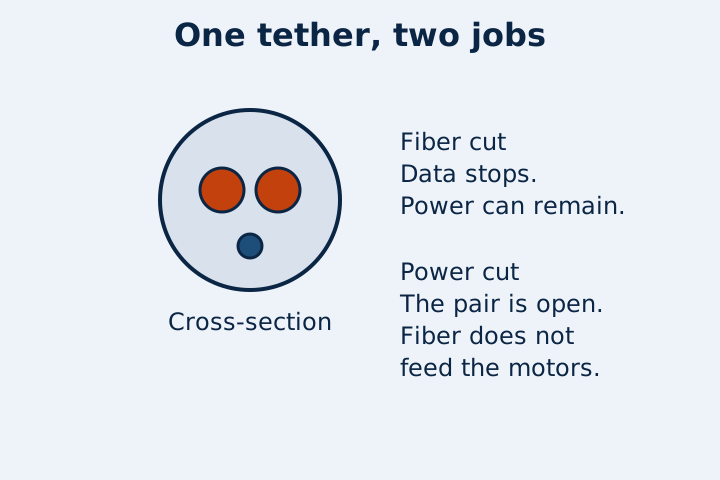
The leaflet also names a station Wi-Fi radio at 2.4 and 5 gigahertz. That line sits apart from “secure dual comms.” It is not the fiber, and it is not a statement that the aircraft has no radio.
The watts on the sheet are not one number
The leaflet’s power output is up to 2200 watts continuous. The same table says the source must be at least 4 kilowatts at 230 volts, or at least 3 kilowatts at 120 volts. The worked comparison is the pair of printed numbers, not an efficiency. 2200 watts is the continuous output line. 4000 watts is a minimum source rating. Dividing them does not produce a measured loss, because the sheet does not say the station draws 4000 watts while delivering 2200.
The output is printed as 6S or 12S. The sheet does not print a pack voltage, so this page does not convert S-count into volts. It also names Dynamic Voltage Optimization and does not print the voltage-drop equation. There is no drop to compute from this leaflet.
Tether mass is printed as a choice of 16, 20.5, or 26 grams per metre, and the table length is 100 metres. The heavy end of that range is 26 × 100 = 2600 grams, which is 2.6 kilograms, over the 100 metre length. The light end is 1.6 kilograms. The statute’s 55 pound limit excludes the tether, so these kilograms are not added to the aircraft. They are still mass the station has to manage. The leaflet’s flight line of 90 metres is a different sentence from the 100 metre length. A 90 metre piece of the 26 gram cable is 2.34 kilograms. Use the length that is actually off the reel.
If aircraft weight, payload included and tether excluded, exceeds 55 pounds, the actively tethered definition in 44801 does not cover that aircraft. If the line is slack, the “taut” clause is already missed, before any watt figure matters.
The altitude lines do not agree with each other
The checklist’s public-safety ceiling is 150 feet above the ground in Class B, C, D, E, or G, and not above the UAS Facility Map grid where that map shows a lower ceiling. Above 150 feet, the checklist says this statute needs prior FAA authorization. It also says tethered operations under Part 107 may be permitted over 150 feet. That permission is a different rule from 44806. A Part 107 flight does not borrow the statute’s waiver-free path, and a 44806 flight does not borrow a Part 107 altitude.
The product page’s operational altitude is 100 metres, printed as 328 feet. 150 / 328 = 0.46. Under 44806, without the extra authorization, the aircraft stops at about 46 percent of that printed altitude even though the page also lists a 110 metre cable. The leaflet’s flight line is 90 metres, printed as 295 feet. 150 / 295 = 0.51. Half of the leaflet’s flight line, roughly, is the statute ceiling. The table’s “altitude max” of 4000 feet mean sea level is a site elevation, not a flight height. It does not raise the 150 foot line.
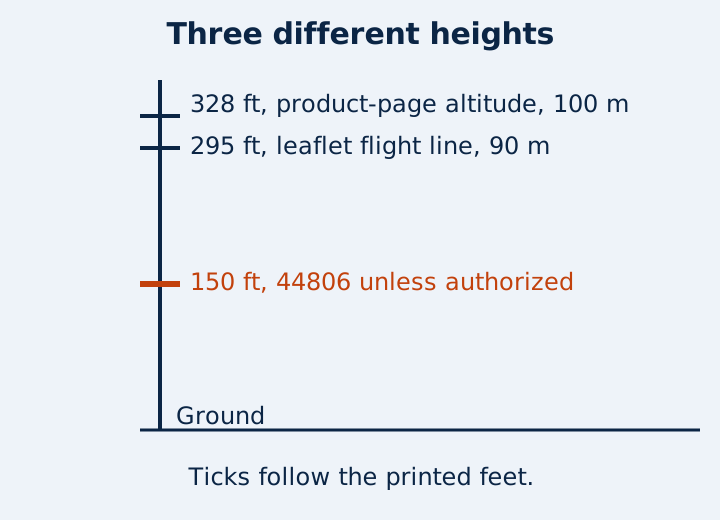
If the planned height exceeds 150 feet above the ground, 44806 does not authorize it. The checklist also keeps the operation inside visual line of sight, clear of people who are not part of the crew, and out of the way of other aircraft. Registration and Remote ID are on the same checklist. They are not waived by the tether.
The Spectre sheet prints a still different height: 60 metres, or 200 feet, with power under 2000 watts continuous. Two hundred feet is already above 150. The same test applies. A 200 foot operating line is not a 44806 altitude.
No radio is not the same sentence as fiber
The Spectre sheet says there is no radio-frequency emission and that command, control, and payload data go over the secure tether. It does not say the conductor is glass. The Safe-T 2 leaflet does say fiber, and it says the fiber is optional next to broadband over the power conductors. A relay design that has only the fiber, with no second data path, goes dark when the fiber breaks even if the motors still have power. The leaflet’s dual-communications line is the vendor’s answer to that single path. The Spectre sheet’s answer is different: it removes the radio and puts the data on the tether, and it prints a battery backup with an automatic landing on power loss.
Neither sheet prints a fiber bandwidth, a latency, or a user-device count. The data-relay explainer already separates an aerial cell site, a local relay, a mesh, and store-and-forward, and it records that the 2021 LifeLink conditions excluded tethers. This page starts where that exclusion stopped. A tethered relay still needs a spectrum and a backhaul story for whatever radio it does use. The fiber does not answer that story by itself.
When this does not apply
- The flight is under Part 107 rather than 44806. The checklist itself separates those altitude rules. Do not paste the 150 foot ceiling onto a Part 107 authorization that says something else.
- The only sheet in the file is the product page, and someone has written 2200 watts continuous on it. That continuous figure is on the leaflet. The page retrieved on 20 October 2026 prints 2500 watts peak.
- The tether is being called fiber because the Spectre sheet says “no RF.” That sheet does not name fiber.
- The 55 pound check is being done with the tether on the scale. 44801 excludes the tether from that weight.
Methods and sources
The weight, taut tether, continuous power, separation landing, visual line of sight, and 150 foot ceiling come from the FAA checklist of August 2024, which cites 49 USC 44801 and 44806, and from the statute text retrieved the same day. Safe-T 2 watts, S-count, tether length, 90 metre flight line, fiber option, and source ratings come from the leaflet hosted by Elistair. The 110 metre cable, 100 metre operational altitude, 8S output, and 2500 watt peak come from the product page retrieved 20 October 2026. Spectre altitude, power, and the no-radio sentence come from the 2024 specification sheet. The 2.6 kilogram tether mass and the 150/328 and 150/295 ratios are worked examples from those printed figures. No fiber bandwidth is added. The data-relay explainer is the architecture page. The archive is the competition record.