An aircraft price leaves much of a drone as first responder cost comparison unfinished. Compare proposals over the same operating period, launch-site scope and staffing assumptions, with startup, recurring operations and maintenance recorded separately. This worksheet helps a public-safety procurement team reconcile agency-run and contracted proposals without inserting an average price or treating an omission as free.
A gray quadcopter beside an open equipment case on a scuffed workshop bench.
An unquoted cost is unknown, not zero. Use the editable cost worksheet (CSV) and staffing assumptions sheet (CSV) alongside the tables below. Each proposal needs its own copy. Amounts, quantities and hours are deliberately blank; fill them from a dated quote or an approved agency estimate.
Fix the comparison scope before entering money
Write a common service description first. A proposal covering selected shifts cannot be compared directly with one covering a different schedule. Likewise, a subscription that includes equipment replacement needs a different treatment from an equipment purchase with separately priced support.
Use this blank header for both proposals. Where scopes differ, ask for a revised proposal or record the difference explicitly before comparing totals.
| Scope field | Agreed comparison basis | Proposal A exception | Proposal B exception |
|---|---|---|---|
| Agency, jurisdiction and intended service | |||
| Launch sites and equipment quantities | |||
| Service start date and comparison end date | |||
| Operating days, shifts and coverage windows | |||
| Agency-run, contracted or mixed staffing | |||
| Dispatch, viewing and evidence-system interfaces | |||
| Data retention, storage and export scope | |||
| Currency, tax treatment and quote validity | |||
| Contract term, renewal and exit assumptions |
These are proposed procurement fields, not a flight authorization or a prescribed staffing model. For policy inputs such as access and retention, use the separate DFR policy review matrix. Bring the locally approved requirements back into the cost scope.
Separate startup, operations and maintenance
The CJTTEC implementation report provides the starting framework: Table 2 on printed page 19 separates initial, operating and maintenance costs. It includes hardware and setup, staff and recurring services, and repair or replacement. The discussion on printed page 20 cautions that program design and scale make definitive totals or reliable ranges difficult to provide. Its agency examples are not prices for your proposed configuration. Read the report, accessed 16 October 2026.
The worksheet below adds comparison fields to that framework. The rows are prompts to investigate, not a claim that every agency must buy each item. Split a row when it contains different units, payers or billing periods.
| Cost group | Line items to resolve in the quote | Scope question |
|---|---|---|
| Startup: equipment | Aircraft, payloads, peripherals and any proposed docks | Purchased, leased or included in a service? Who owns them at exit? |
| Startup: site and setup | Launch-site preparation, installation and integration | Which site work, agency labor and interface work are excluded? |
| Startup: preparation | Initial training, program planning, policy and outreach work | Which deliverables and staff time are included? |
| Operations: people | Agency personnel and contracted operating services | Which roles, shifts and coverage hours does each party supply? |
| Operations: services | Software, connectivity, support and ongoing training | What is the billing unit, service period and usage allowance? |
| Maintenance | Equipment repair, batteries, replacement and software updates | Which events are covered, capped, separately billed or excluded? |
For each line, record the following fields in the downloadable cost CSV. The table keeps the fields vertical so they remain usable on a phone.
| Worksheet field | What to enter |
|---|---|
| Item ID and cost group | A unique reference and startup, operations or maintenance |
| Description and quantity | Exact deliverable and quantity from the proposal |
| Unit and unit price | Per aircraft, site, license, staff-hour or other stated unit; quoted currency |
| Rate period and billed periods | One-time, monthly, annual, hourly or another explicit basis |
| Inclusion status | Included, excluded, optional or unknown |
| Bundle reference | The priced parent item when this component is already included |
| Payer and budget owner | Vendor payment or agency cost, plus responsible local owner |
| Source and date | Quote/version/page, or approved internal estimate and its date |
| Amount and unresolved assumption | Supported line total, conditions and missing information |
An included component may have no separate price. Keep its price blank, mark it included and identify the priced bundle. Count the bundle once. An excluded item instead needs a separate agency estimate or another quote; until then, leave its amount unknown.
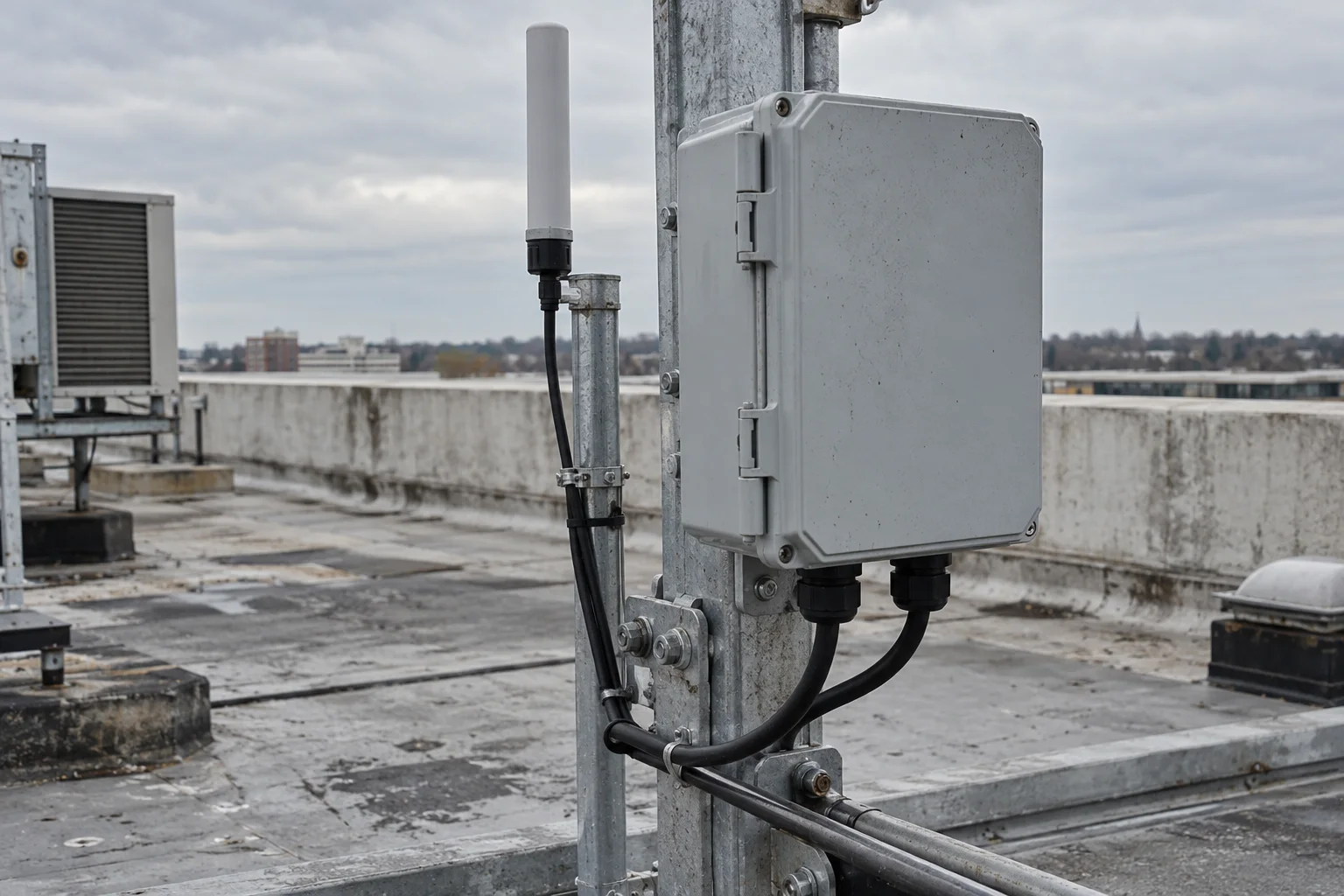
A weatherproof enclosure with cables and an antenna mounted on a rooftop rail.
For site and network rows, ask who supplies the physical installation and who pays the recurring connection charge. Record installation and service separately when the proposal does. The photograph identifies a physical infrastructure category; it establishes no required network design.
Reconcile staffing hours for agency-run and contracted options
Build a role-by-role hours record before attaching a rate. Do not infer staffing from the aircraft count or assume a person assigned elsewhere has unlimited time available. CJTTEC discusses agency, contractor and mixed approaches on printed pages 17–18; it does not supply a universal staffing ratio.
| Staffing assumption | Agency-run proposal | Contracted proposal | Source / date / owner |
|---|---|---|---|
| Role and responsibilities | |||
| Simultaneous staffed positions | |||
| Coverage hours per day and days in period | |||
| Coverage shared across sites, with documented basis | |||
| Relief, training and backfill hours | |||
| Agency hours retained outside the vendor service | |||
| Approved hourly cost basis and included benefits | |||
| Cost included in another priced line |
As a planning calculation, required position-hours equal simultaneous positions multiplied by coverage hours per day and covered days. Add separately identified relief or training time only if it is outside those hours. This calculates hours to cover, not a headcount recommendation. HR and the program owner still need to establish workable schedules and productive hours per employee.
Use the same role definitions for both options. For a contracted service, identify agency supervision, dispatch coordination, IT and evidence work that remains with the agency. For an agency-run option, distinguish incremental payroll or backfill spending from existing staff time allocated to the program. Keep those views separate so a cash-budget comparison does not quietly erase staff workload.
To define interface responsibilities before pricing integration labor, use the first responder drone software handoff checklist. Its proposed checks do not establish that your installed connection works.
Check replacement coverage and contract boundaries
Read the actual service schedule before adding a maintenance allowance. Ask whether batteries, accidental damage, shipping, spare equipment, updates and equipment refresh are included, limited or excluded. These are quote questions; no coverage is assumed here.
Two dark battery packs and a charger on a worn metal service bench.
Record replacement triggers, caps, deductibles, the responsible party and the written contract reference. Leave replacement intervals blank without configuration-specific documentation. Avoid counting an included replacement service again as a separate forecast purchase.
Also record what happens when the agreement ends: equipment ownership, removal responsibilities, data export, transition support and any stated charges. Keep optional renewals separate from committed spending. A year with installation work should remain distinguishable from a later operating year.
Turn the worksheets into a comparable budget
For a fixed recurring line, quantity × unit rate × billed periods gives the line amount only when the rate unit and period match. For hourly labor, use documented hours × the approved hourly cost basis. Keep minimum charges, partial billing periods, usage charges and escalation clauses explicit; do not silently annualize them as flat subscriptions.
Prepare a dated summary with startup cash, recurring costs by service year, maintenance costs not already included, retained agency costs and unresolved exclusions. Sum only supported amounts. If a material exclusion remains unpriced, label the result a priced subtotal with unresolved costs, and list those costs beside it. A complete-looking total should not hide missing scope.
Before using the comparison, have the budget owner reconcile these questions:
- Do both proposals cover the same sites, schedule and dates?
- Does every amount trace to a quote or approved agency estimate?
- Are bundled items counted once, with exclusions still visible?
- Are contracted hours and retained agency hours accounted for separately?
- Are startup, renewal, replacement and exit obligations distinguishable?
If the answer changes when a missing item is priced, the comparison remains open. Resolve that item with its named owner before choosing on cost. This worksheet supplies no savings, return-on-investment or funding-eligibility conclusion.
Method and sources
This is an independent editorial worksheet based on the public CJTTEC implementation report opened on 16 October 2026, especially printed pages 17–20 and its implementation questions on page 24. The cost groupings come from the report; the blank reconciliation fields and calculation instructions are our proposed procurement method. No agency budget, supplier quote, flight performance or deployment was tested.
The downloadable CSVs contain no preset prices, staffing ratios or replacement intervals and no automatic formulas. They are intended for local editing alongside the scope header above. The photographs show generic equipment and work environments; they document no named agency installation or quoted configuration.
Last updated: 16 October 2026.