Moving lab samples by road costs rural hospitals time: Munson Healthcare staff drive more than 90,000 miles a year doing it, according to the project’s phase-one report. Munson and its partners have announced a second phase of their drone delivery trial in Traverse City, Michigan, scheduled for October 6 to 30, 2026, with multiple drones, sensor technology and what the partners describe as FAA approval.
Phase two of the Munson Healthcare drone delivery pilot is scheduled for October 6 to 30, 2026, between Munson Medical Center and the Crystal Lake Health Center on Rosewood Drive in Traverse City, simulating deliveries of supplies, lab samples and medications. Traverse Connect, Munson, drone maker blueflite and Central Michigan University’s rural health institute announced it in a joint release on October 5. A Traverse Connect spokesperson told the local Ticker that the first flights would use visual observers and later flights would transition to beyond visual line of sight (BVLOS). Phase one, in May 2025, completed 61 of 67 flights (91%) within visual line of sight, according to the official report; the six failures came from winch, GPS and cellular-link problems. Which FAA authorization covers phase two, which aircraft fly it and what it achieves have not been published.
Key points:
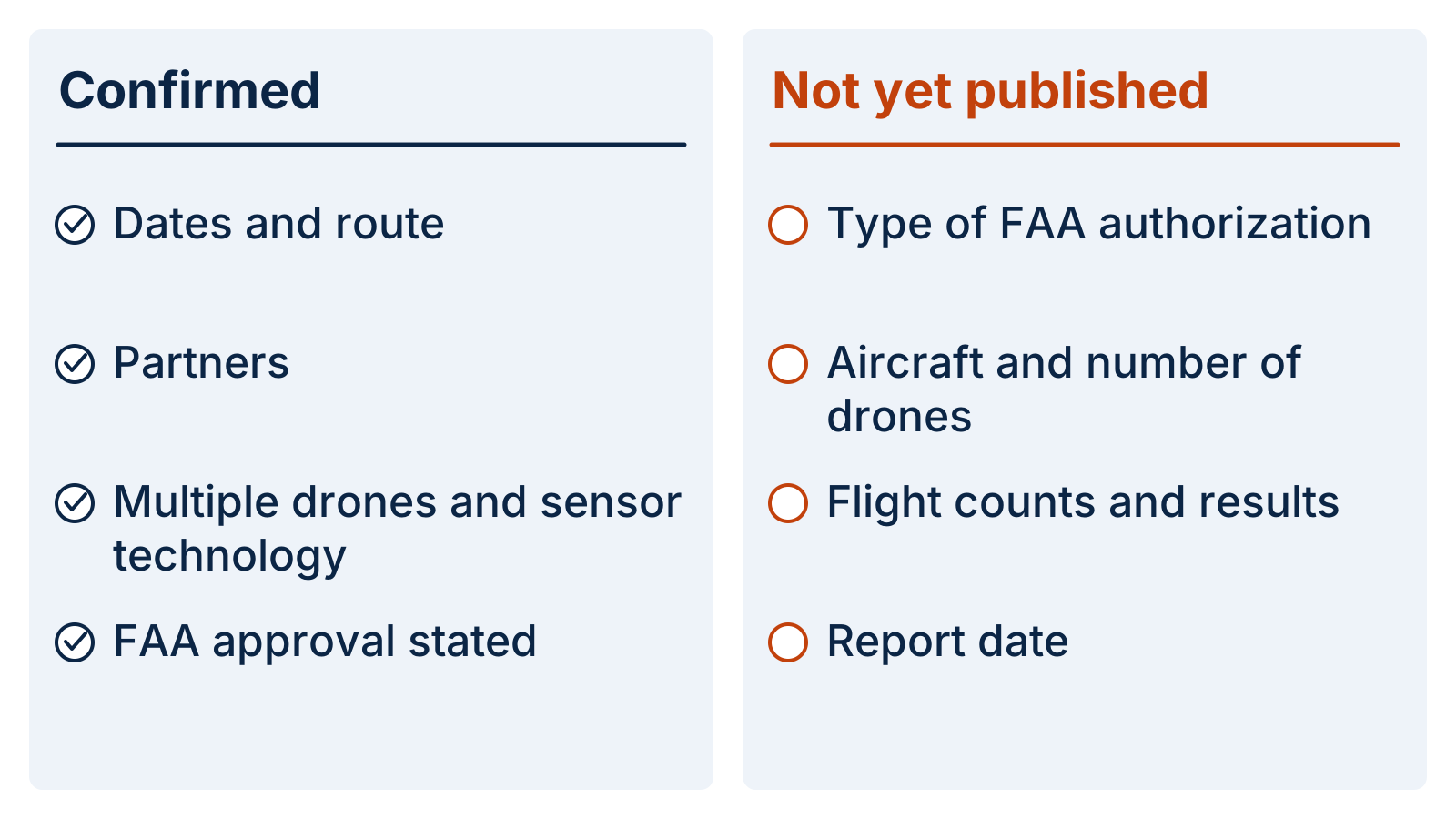
- Confirmed by the partners: dates, route, partners, multiple drones and sensor technology, and a statement of FAA approval.
- Reported locally: a planned move from observer-supported flights to BVLOS during the announced window.
- From the official phase-one report: 67 flights, 61 successful, all within visual line of sight under Part 107.
- Not public: the type of FAA approval, the aircraft, flight counts and any phase-two results.
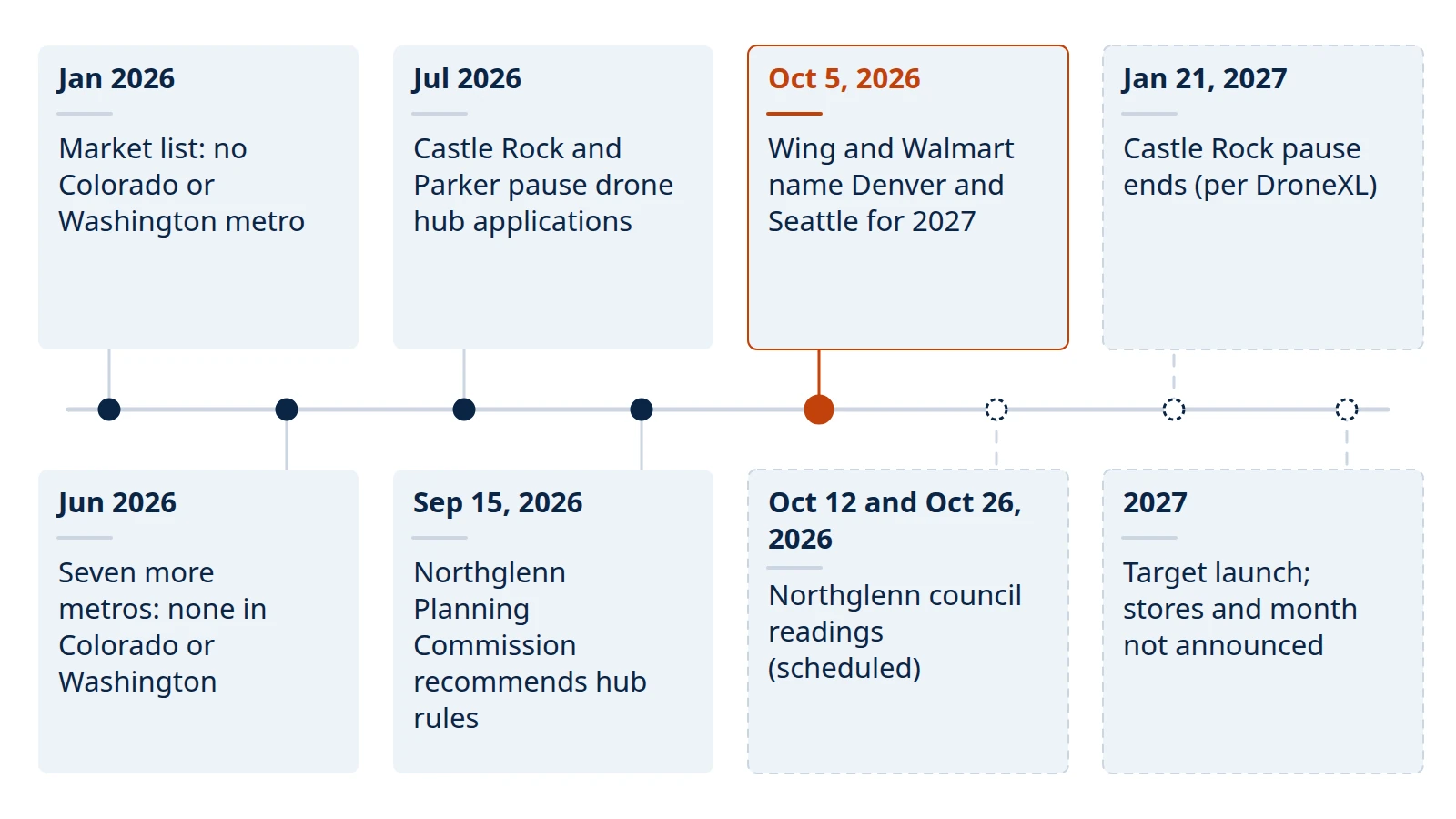
This page is part of our drone news coverage; for retail delivery in a metro setting, see our explainer on Wing and Walmart’s Denver and Seattle plan.
What is phase two, and who is running it?
A four-week test window, October 6 to 30, 2026, announced by Traverse Connect with Munson Healthcare. We have not seen a log of flights flown so far. The table separates the joint release from independent reporting.
| Item | What the sources say | Source type |
|---|---|---|
| Partners | Traverse Connect, Munson Healthcare, blueflite, Central Michigan University’s Rural Health Excellence Institute | Joint release |
| Dates | October 6 to October 30, 2026 | Joint release |
| Route | Munson Medical Center to the Crystal Lake Health Center at 5191 Rosewood Drive, Traverse City | The Ticker; DroneXL (corrected) |
| Distance | “About three miles” (The Ticker); about 2.2 miles by air (DroneXL) | Local and trade press |
| Cargo | Simulated supplies, lab samples and medications | Joint release |
| What is new | Longer flight duration, multiple drones, sensor technology, “with approval from the Federal Aviation Administration” | Joint release (quote from Traverse Connect’s CEO) |
| How flights run | First flights “with visual observers,” later “transitioning to BVLOS” | Traverse Connect spokesperson, quoted by The Ticker |
| Operator | blueflite, since DroneUp left the project in spring 2026 | WCMU |
One correction matters if you read early coverage. DroneXL’s first version placed the clinic in Frankfort, about 30 miles away; on October 6 it corrected this after Traverse Connect said the clinic is the Rosewood Drive location in Traverse City. The two distance figures above may measure differently (straight line versus unspecified), so treat the route as roughly two to three miles.
Takeaway: Phase two is a short, multi-drone test over a route of a few miles, not a launched service.
What did phase one show?
That short, observed flights worked most of the time, and where they failed. Traverse Connect’s December 2025 report gives these results for May 9 to 20, 2025:
| Measure | Phase one result |
|---|---|
| Flights | 67 |
| Successful | 61 (91%) |
| Failed | 6: three winch-related, one GPS malfunction, two cellular connectivity problems that triggered automatic return to launch |
| Rules and crew | 14 CFR Part 107, visual line of sight only, three to four visual observers |
| Routes | Munson Dialysis Center, about 1,000 to 1,030 meters (55 of 67 flights); Copper Ridge Surgery Center, about 2,200 to 2,244 meters. The report also describes operations “within a one-mile radius” of the hospital without reconciling the two figures |
| Cargo | Water bottles and temperature loggers first, then real patient lab samples |
| Payload temperature | The payload environment averaged 17.3 °C on flights where temperature was monitored |
| Equipment | blueflite aircraft with winch delivery and ground infrastructure developed by DroneUp |
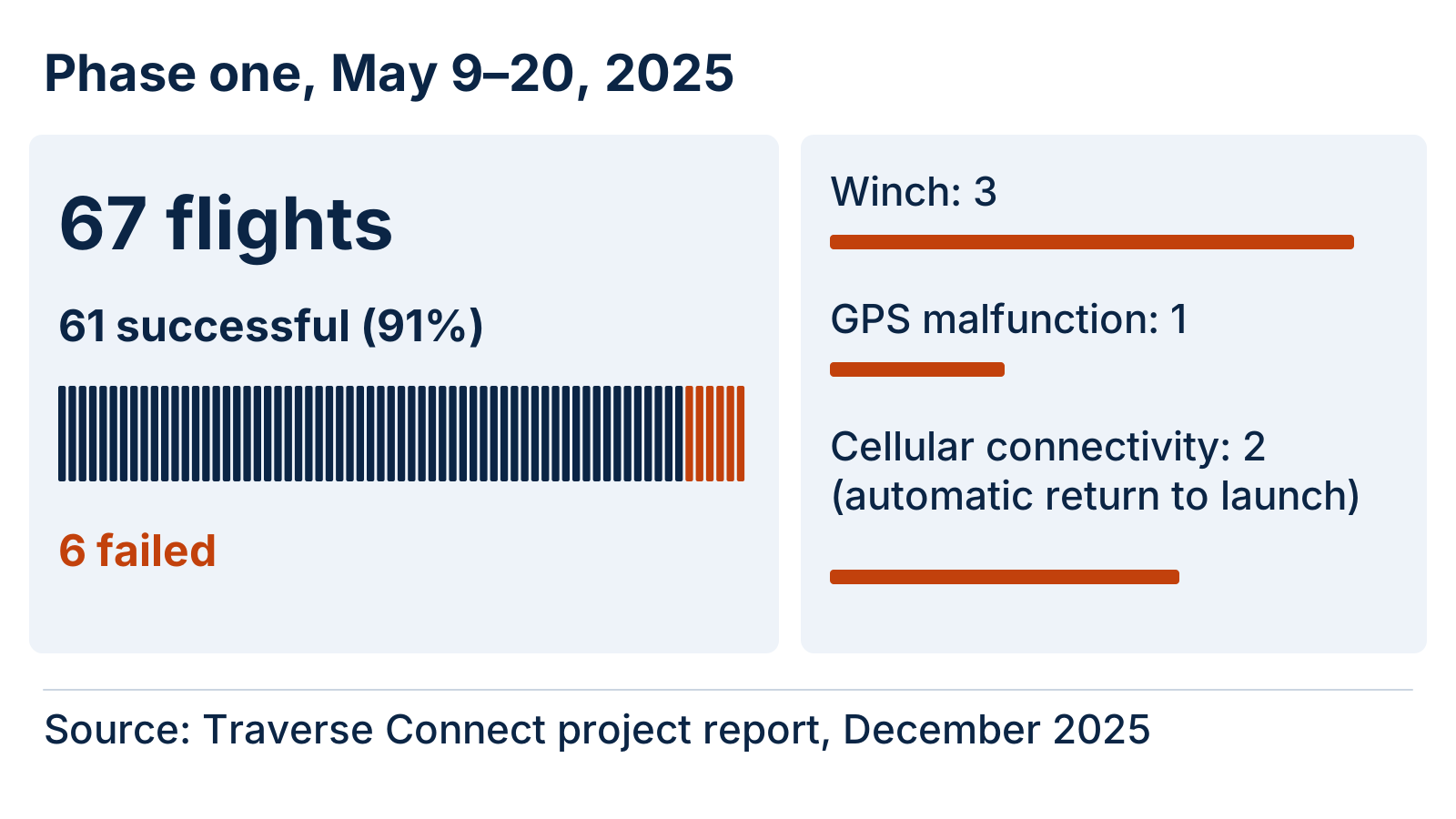
The failure causes are the useful part. Two flights were lost to cellular links, which is why the communications path matters as much as the aircraft; our drone communications relay explainer covers the options. One was a GPS malfunction; how an aircraft behaves when its satellite position degrades depends on its failsafe settings, as our explainer on GPS jamming, spoofing and drone failsafes describes.
Not every account matches the report. In July 2025, WCMU quoted Munson’s supply-chain vice president describing “over 100 flights” and gave the dates as May 5 to 22. We use the report’s figures.
Common mistake: Reading phase one’s 91% as the reliability of a delivery service. It was 67 short flights within sight of observers, mostly on a route of about one kilometer.
Takeaway: Phase one tested feasibility on short routes and named its failure causes; it does not predict phase-two performance.
How is phase two different from phase one?
Multiple drones, a different route and a planned step beyond visual line of sight. The comparison below uses only what the sources state.
| Phase one (May 2025) | Phase two (October 2026) | |
|---|---|---|
| Dates | May 9 to 20, 2025 | October 6 to 30, 2026 |
| Destinations | Dialysis Center and Copper Ridge Surgery Center | Crystal Lake Health Center, Rosewood Drive |
| Longest route | About 2.2 km | About 2.2 miles by air (DroneXL) or about three miles (The Ticker) |
| Aircraft | blueflite; number not stated in the report | Multiple drones; model not named |
| Observation | Visual line of sight only, three to four observers | Observers at first, then BVLOS, per Traverse Connect |
| Operator | DroneUp with blueflite | blueflite |
| Authorization | Part 107 | “Approval from the Federal Aviation Administration”; type not stated |
Flying beyond visual line of sight is what would let a hospital network use longer routes; whether it also reduces the observers needed depends on the conditions of the FAA authorization, which have not been published. Under 14 CFR 107.31, the crew of a Part 107 flight must be able to see the aircraft throughout the flight, and 14 CFR 107.205 lists that rule among those the FAA can waive; our drone search and rescue explainer explains how those rules shape a search.
Takeaway: The test to watch is the switch from observed flights to BVLOS, and under which FAA authority it happens.
Why did phase two start in October 2026?
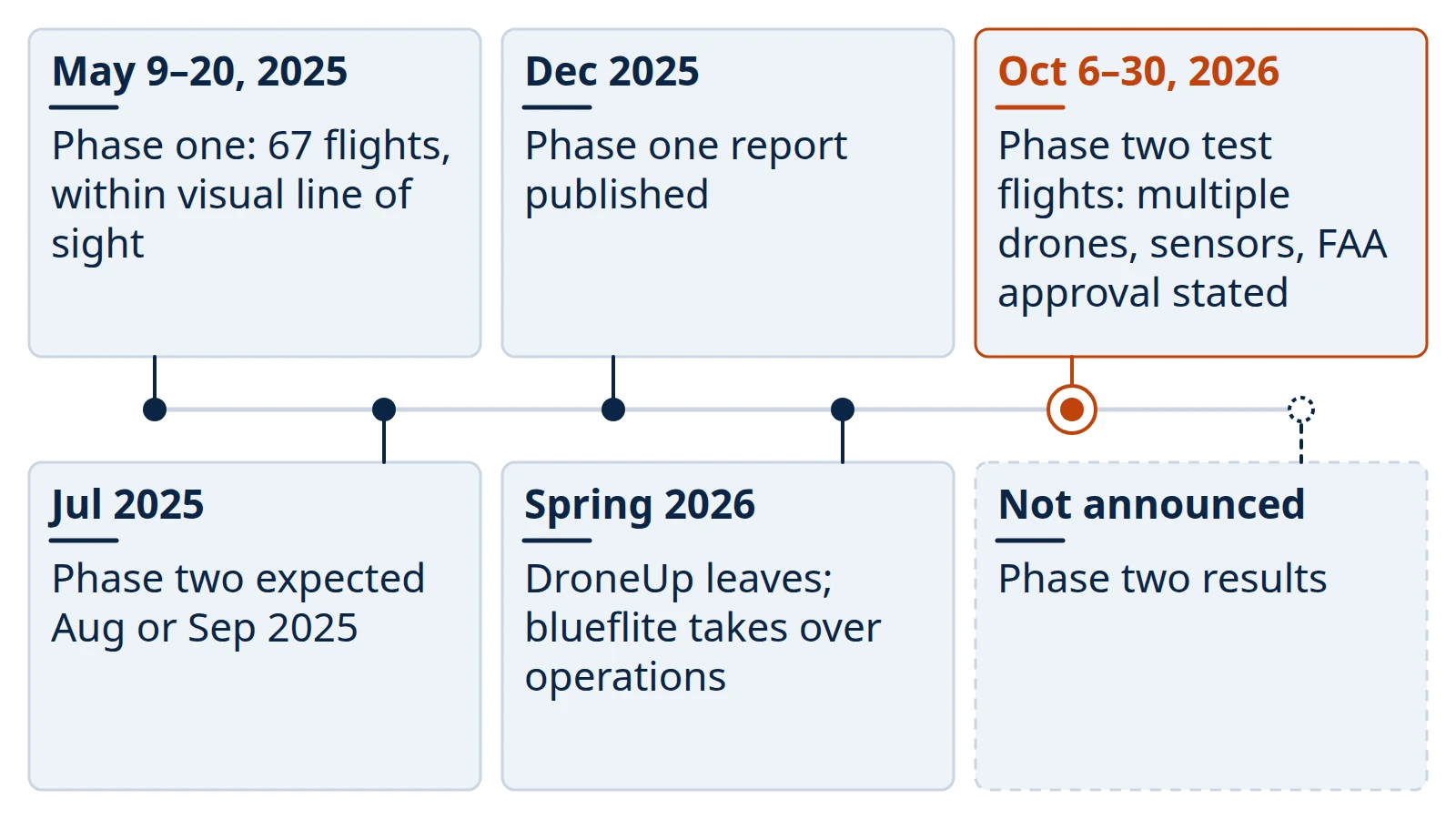
The record shows two slips. Phase two was first expected in 2025, then planned for May 2026, and WCMU reported that DroneUp’s exit delayed the May 2026 flights. The partners have not explained the 2025 slip.
| Date | Event | Source | Source type |
|---|---|---|---|
| May 9 to 20, 2025 | Phase one flights | Project report | Official report |
| July 2025 | Munson expected phase two in August or September 2025 | WCMU | Public radio |
| December 2025 | Report says phase two BVLOS operations are scheduled to begin in 2026 | Project report | Official report |
| January 2026 | Plan to fly in May 2026 | WCMU (June 3, 2026) | Public radio |
| Spring 2026 | DroneUp leaves; blueflite takes over operations and FAA approvals | WCMU | Public radio |
| October 5, 2026 | Joint release announces phase two | Joint release | Partner release |
| October 6 to 30, 2026 | Announced phase two test window | Joint release | Partner release |
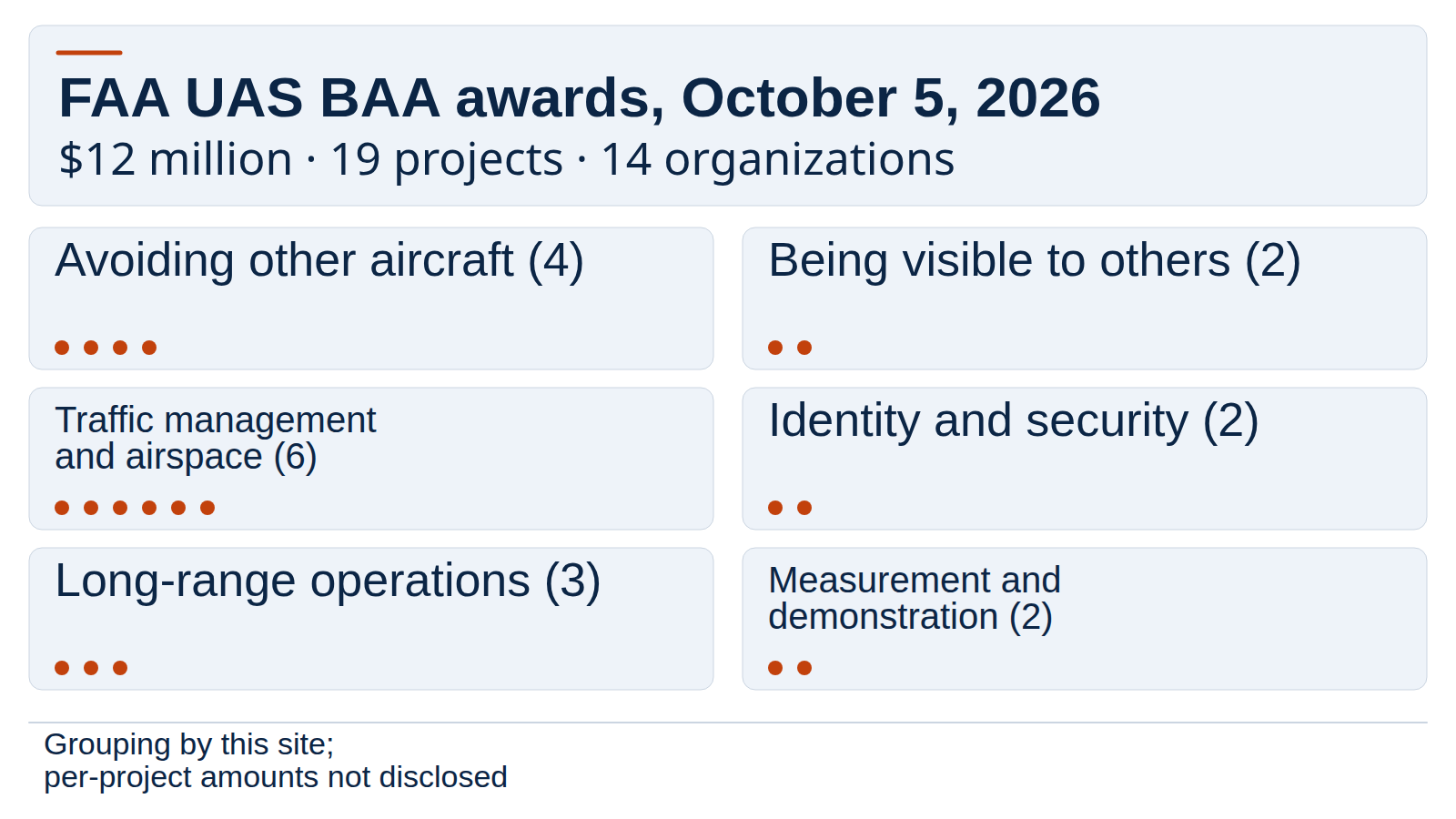
DroneUp told WCMU it was moving away from delivery operations to focus on “scalable platform, autonomy, and airspace-management capabilities,” citing “current market timing and delivery economics at scale.” Separately, the FAA’s October 5, 2026 list of research awards includes a DroneUp project on verifying drone identity and approval to fly; see our explainer on the FAA’s $12 million drone research awards.
Takeaway: The operator change explains the most recent delay on the record; the earlier slip is unexplained.
Who should pay attention?
Rural health systems and the companies that want to serve them. The table is our reading.
| Who | Why it matters | Basis |
|---|---|---|
| Hospital logistics teams | A documented route-by-route trial with failure causes and sample temperatures | Project report |
| Drone makers and operators | A manufacturer taking on the operator and FAA paperwork after an operator left | WCMU |
| State AAM funders | A state-funded pilot through the Advanced Aerial Mobility Activation Fund (MDOT, OFME, MEDC) | Traverse Connect |
| Retail delivery planners | Medical routes between fixed facilities differ from neighborhood retail delivery; compare with Wing and Walmart’s metro rollout | Our reading |
Takeaway: The value of this pilot is its documentation, if phase two is reported as openly as phase one.
What is not public yet?
The authorization, the aircraft and the results. Each item lists who could confirm it.
- Type of FAA approval. The release says “approval from the Federal Aviation Administration” without naming it. Traverse Connect or the FAA, through the authorization document. The FAA’s proposed rule for routine BVLOS flights had no final rule in its Federal Register docket as of October 7, 2026, as our FAA research awards explainer notes, so any BVLOS flying here would rest on project-specific authority.
- When and how BVLOS starts. Reported by The Ticker from a Traverse Connect spokesperson; no published authorization. Traverse Connect, through its operating plan.
- Aircraft and number of drones. Not named. blueflite or Traverse Connect, through the operating plan or phase-two report.
- Flight counts and results. Traverse Connect, through a phase-two report. Phase one’s report came out about seven months after the flights; no date has been given for phase two.
- Funding. blueflite’s site describes a new $950,000 Advanced Aerial Mobility Activation Fund grant building on an initial $689,500 award; DroneXL reports the $950,000 was announced in May 2025. The fund’s administrators (MDOT, OFME, MEDC) could confirm the totals in the award records.
- Institute name. The release says Central Michigan University’s Rural Health Excellence Institute; Traverse Connect’s project page says Rural Health Equity Institute. Central Michigan University’s own institute pages.
Takeaway: Until the authorization and results are published, phase two is an announced test, not evidence of a BVLOS medical network.
When should readers check back?
At the end of the test window and when a report appears. These dates are what is known; none of them is a report date.
| When | What to check | Where |
|---|---|---|
| After October 30, 2026 | Whether the announced window ended as planned | Traverse Connect announcements |
| When published | Phase-two report: flights, failures, authorization | Traverse Connect project page |
| Any time | The FAA authorization type and its conditions | Traverse Connect or the FAA |
| Any time | Funding totals | MDOT, OFME and MEDC award records |
Phase one’s 91% does not carry over to these questions: it came from 67 short flights within sight of observers, mostly on a route of about one kilometer.
Takeaway: Check the project page after October 30 and judge phase two on its own report, not on phase one’s numbers.
Our reading
This is a modest test with a useful paper trail: phase one’s report named its failure causes, which helps anyone judge the operating limits. Phase two adds the steps that matter for a real hospital network, multiple drones and flights beyond the crew’s sight, which depend on reliable data links and on how the aircraft handles degraded satellite navigation. Two questions stay open: which FAA authority covers flights beyond visual line of sight here, and on what terms, and whether the winch, GPS and link problems seen in phase one recur. Both would show in a phase-two report as specific as the first.
Takeaway: Watch for the named FAA authorization and a phase-two report before treating this as a model for other rural systems.
Sources and update log
This explainer is based on Traverse Connect’s December 2025 project report and project page; the October 5, 2026 joint release, which we read in full as republished by sUAS News (9&10 News and DroneLife covered the same release, which we count as one source); reporting by The Ticker, WCMU and DroneXL; blueflite’s website; the FAA’s October 5, 2026 release; and, for rules, eCFR (14 CFR 107.31 and 107.205), the FAA’s remote pilot page and the Federal Register docket for the BVLOS proposal. All were accessed on October 7, 2026. We did not find the phase-two release on the partners’ own websites. Company and partner statements are labelled as such, and conflicts between sources are shown rather than resolved.
Last checked: October 7, 2026. We will review this page after October 30, 2026, or when the partners publish phase-two results.
Takeaway: Every phase-two fact here traces to the joint release or to named local reporting; phase-one figures trace to the official report.