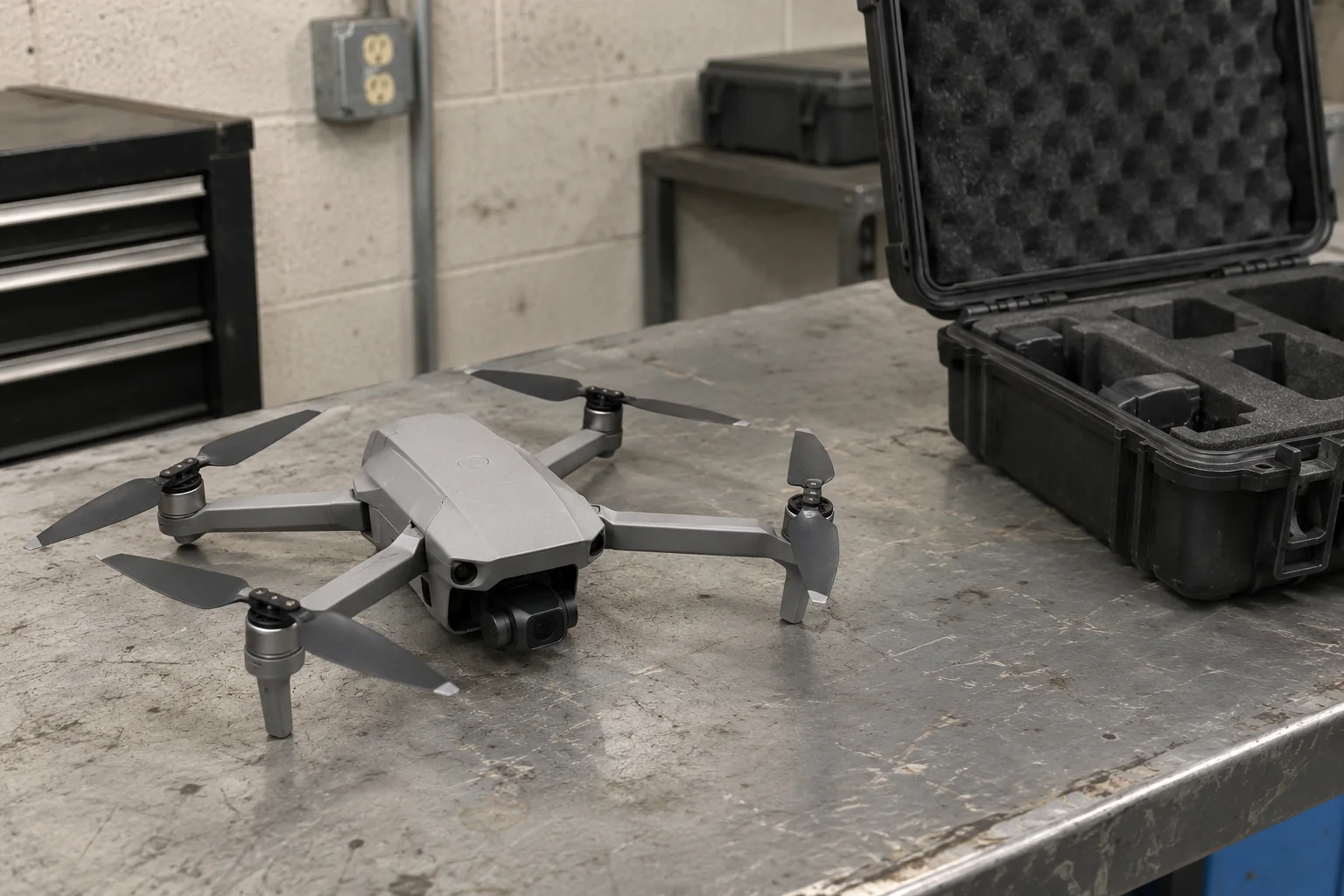
Treating an airborne perception software announcement as a drop-in payload capability risks incompatible camera drivers, unbudgeted processor heat, and failed integration checks. When evaluating Teledyne FLIR Prism A-ISR (Model 110-0201-92), separate what the public specification table commits to from the optical, interface, benchmark, and licensing questions that require written confirmation from the manufacturer.
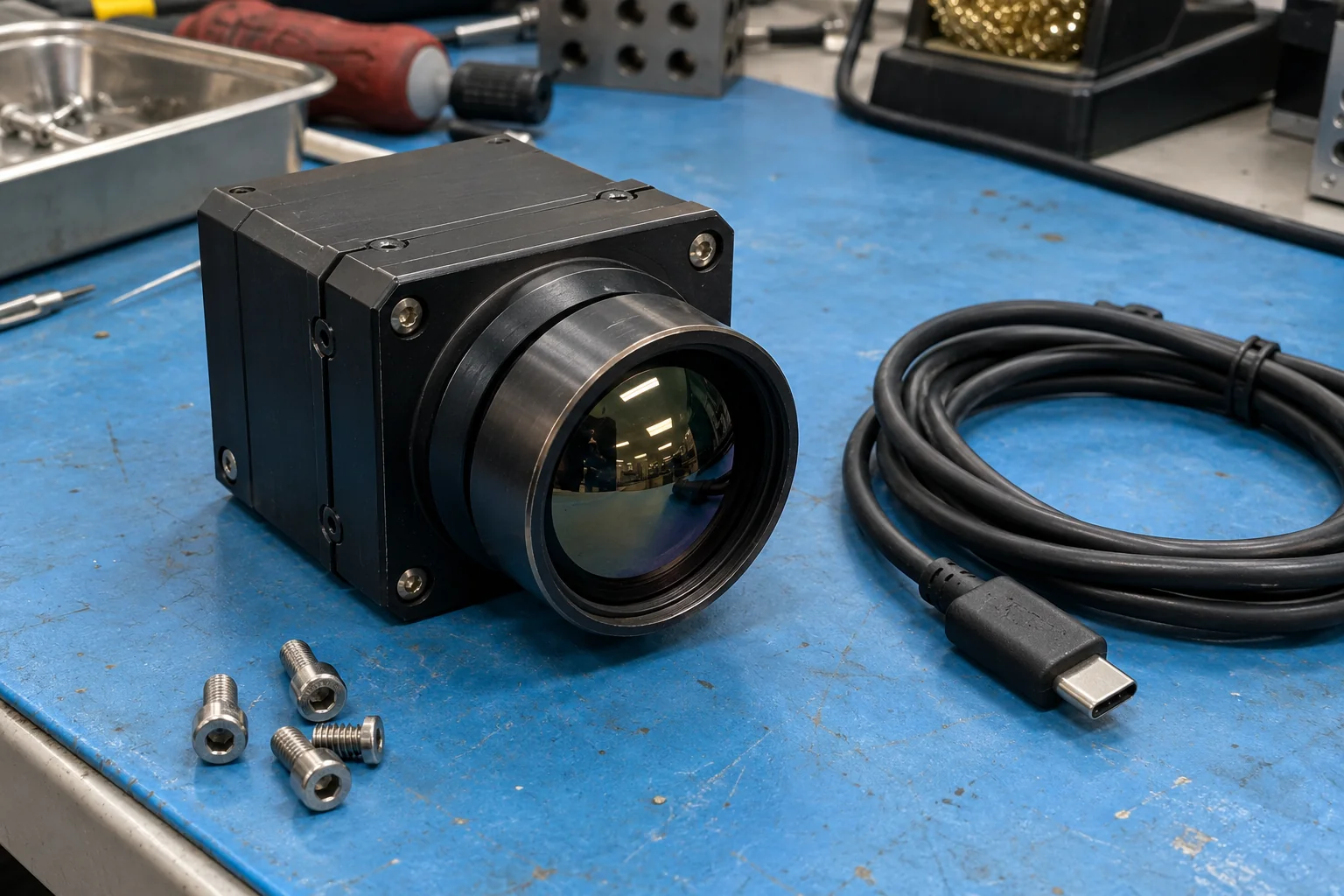
Unbranded thermal camera module and coaxial USB-C harness on an electronics workbench mat. Illustrative hardware environment; does not depict a Teledyne FLIR evaluation kit.
Independent explainer: this site is named after the domain once used by the First Responder UAS Triple Challenge and is not its organizer or affiliated with NIST, Teledyne FLIR, or any university.
Teledyne FLIR OEM unveiled Prism A-ISR on 9 September 2025 ahead of DSEI UK 2025 as an airborne intelligence, surveillance, and reconnaissance (ISR) software package for real-time air-to-ground detection, classification, and tracking. Public product specifications for Model 110-0201-92 define its supported wavelengths (EO, MWIR, LWIR), four named Teledyne FLIR infrared camera series, two embedded processor families (NVIDIA Orin NX/AGX and Qualcomm 8550), a <12 W average / <15 W maximum power envelope, a ~10 ms inference time, a ≥10×10 pixel-on-target threshold for >60% classification confidence, and an eight-field metadata output. They do not publish a third-party camera compatibility list, continuous-zoom telemetry protocols, software-level export or NDAA classifications, or benchmark flight conditions. Use the downloadable integration verification checklist (CSV) to track those open items as unknown until verified.
Key boundaries to keep clear during technical review:
- Mission positioning: Teledyne FLIR OEM markets Prism A-ISR for defense and airborne ISR missions (persistent surveillance, force protection, and actionable intelligence), not as a civil public-safety search-and-rescue product. Civil or dual-use payload teams reviewing its public specifications should not conflate airborne ISR marketing with wilderness or urban search-and-rescue validation.
- Evidence boundary (
partial): This guide is compiled from the public HTML specification tables on Teledyne FLIR OEM’s product pages and trade launch coverage. The gated datasheet asset linked on the product page (flir.netx.netasset78211) was not inspected, and no physical SDK, camera module, or flight test was executed. - Unpublished parameters stay unknown: Any third-party camera pairing, lens serial handshake, per-rail thermal budget, or runtime license cost not stated on the public page is marked
Unknown — verify with manufacturer.
What the public Prism A-ISR specification table states
On Teledyne FLIR OEM’s official Prism A-ISR product page (read 17 October 2026) and in DRONELIFE’s September 9, 2025 launch report, Model 110-0201-92 is listed as In Production. It combines image signal processing (ISP) filters, moving-target indication (MTI), artificial-intelligence object classification, and track-while-scan target tracking into an embedded software stack.
The table below organizes every parameter published on the public Model 110-0201-92 product page alongside the immediate engineering question each line raises for a UAS payload integrator.
| Subsystem | Public specification (Model 110-0201-92) |
Integration question not answered on the public page |
|---|---|---|
| Input wavelengths & bit depth | EO, MWIR, and LWIR; accepts 14-bit IR-camera data across 640 × 512 and 1280 × 1024 thermal resolutions in fixed focal length and continuous zoom (CZ) configurations |
Which pixel formats (such as Y16 vs packed 14-bit CSI-2) and frame rates (30 Hz vs 60 Hz) are sustained when running dual EO + IR pipelines simultaneously? |
| Named IR cameras | Boson+ with UVC, Boson SX8 with UVC, Neutrino LC with USB, Neutrino SX8 with USB |
Does the production binary support direct MIPI CSI-2 or CMOS parallel input for these cores, or is UVC/USB required in the default Prism A-ISR build? |
| Visible EO input & third-party sensors | 4 MP with UVC Input Typical (larger format will affect frame rate); narrative text notes compatibility with third-party IR and visible EO cameras |
Which specific third-party EO/IR sensor models, UVC descriptors, and lens controllers have validated drivers in the SDK? |
| Embedded compute platforms | NVIDIA ORIN NX/AGX, Qualcomm 8550 |
Which JetPack/CUDA version or Qualcomm Linux LE release is required, and does the package run as a Docker container or native binary on each target? |
| Power requirement | <12 W (average), <15 W (maximum) |
Is this figure measured on NVIDIA Jetson Orin NX/AGX or Qualcomm QCS8550, and does it include camera power or only SoC compute? |
| ISP filters | Spec table lists Denoise, Super Resolution, Electronic Stabilization; body copy also references dehaze algorithms |
How much additional frame latency and GPU/NPU load is added when Super Resolution, Denoise, and Electronic Stabilization are enabled together? |
| Inference & tracking | ~10 ms inference time; simultaneous targets tracked: Default is 16, Configurable (Maximum is System Dependent) |
At what input resolution, batch configuration, and active track count was ~10 ms measured? |
| Detection & classification thresholds | Object classification (>60% confidence): ≥10x10 Pixels on Target (minimum); small-target detection confidence threshold: ≥60% for Small Targets (<32 x 32 pixels), Configurable |
What were the background clutter, thermal contrast ($\Delta T$), look-down depression angle, and false-alarm rate behind the >60% confidence threshold? |
| Object classes | Person, vehicle (umbrella class car, bus, truck, van, construction), boat (umbrella class for all types of vessels on water) |
If an integrator needs subclass separation (for example distinguishing a civilian pickup from a construction vehicle), is custom retraining via Prism AIMMGen mandatory? |
| Metadata & video outputs | Video: WebRTP, RTSP, and HDMI; Metadata (8 fields): Bounding Box Area, Bound Box Location, Category ID, Object Class Label, Confidence, Time Stamp, Track ID, Frame Number |
How are the 8 metadata fields framed on the wire (JSON, protobuf, or STANAG 4609 / MISB KLV), and how is Time Stamp synchronized to aircraft autopilot/GNSS time? |
| Deliverables | User Graphical Interface (GUI), Software Development Kit (SDK) with Prism A-ISR solution package, Technical Documentation, plus sample C++ reference application and libraries |
What are the SDK evaluation terms, per-unit runtime royalty structure, ECCN/ITAR export classification, and software NDAA status? |
How Prism A-ISR differs from sibling Prism software modules
Teledyne FLIR OEM uses the Prism name across multiple software products and a synthetic-data training service. Evaluators searching for Teledyne FLIR Prism A-ISR frequently encounter overlapping pages for Prism C-UAS, Prism Ground ISR, Prism SKR, Prism AI - Auto, and Prism AIMMGen.
Comparing their public specification tables side by side shows that each model number is tuned for a specific viewing geometry, target taxonomy, and hardware interface—and that sibling pages disclose several hardware nuances that clarify Prism A-ISR.
| Module & model number | Primary mission geometry | Listed compute targets | Listed camera inputs | Default object classes | Published latency & pixel thresholds |
|---|---|---|---|---|---|
Prism A-ISR (110-0201-92) |
Airborne air-to-ground ISR from UAS and aerial platforms | NVIDIA Orin NX/AGX; Qualcomm 8550 | Boson+ (UVC), Boson SX8 (UVC), Neutrino LC (USB), Neutrino SX8 (USB); 4 MP UVC EO typical | Person; vehicle umbrella (car, bus, truck, van, construction); boat umbrella |
~10 ms inference; ≥10×10 px for >60% classification; <12 W avg / <15 W max power |
Prism C-UAS (110-0201-90) |
Counter-UAS detection and tracking of small airborne targets | NVIDIA Orin NX/AGX | Boson+ (UVC), Neutrino LC (USB), Neutrino SX8 (USB); 4 MP UVC EO typical | Drone with Rotor, Fixed Wing, Birds, Person, and Vehicle |
MTI <2×2 px; classification >60% at ≥6×6 px; correlation tracker ~25 px; track initiation ≤100 ms (15 ms / 1-frame configurable); photons-to-display <150 ms |
Prism Ground ISR (110-0201-91) |
Ground-based perimeter and vehicle reconnaissance | NVIDIA Orin NX/AGX | Boson+ (UVC), Neutrino LC (USB), Neutrino SX8 (USB); 4 MP UVC EO typical | Specific military/civil vehicles (bmp-2, bmp-3, btr-80, T-72m2, chevrolet_s10_2003, toyota_rav4_2013, ford_bronco_1989, jeep patriot; family page notes up to 15 classes) |
MTI ≥4×4 px; classification >60% at ≥6×6 px; glass-to-glass latency ~90 to 150 ms (30 Hz); includes Turbulence Mitigation filter |
Prism SKR (110-0200-50) |
Closed-loop seeker, ATR, and terminal guidance for munitions/FPV | NVIDIA Jetson Orin (NX, AGX) vs Qualcomm QCS8550 | Boson, Boson+, Boson SX8, Hadron 640R+, Tau 2, Neutrino | Mission-specific target acquisition via WOSA interface and QGroundControl plugin | Explicitly splits power: 11.3 W avg / 14.8 W max on Jetson Orin vs 4 W avg on Qualcomm QCS8550 |
Prism AI - Auto (110-0133-40) |
Automotive ADAS and autonomous vehicle perception | Qualcomm RB5 (QRB5165), Gen 2 (QCS8550); NVIDIA Xavier, Orin |
FLIR ADK, Boson, Boson+, Tau 2 via USB, GMSL1, GMSL2, and FPD-Link III with 256-bit camera-to-ECU authentication |
Person, car, large vehicle, bicycle, motorcycle, traffic light, large animal (7 classes) |
Automotive-grade thermal/visible fusion; <12 W avg / <15 W max power |
Prism AIMMGen (110-0200-25) |
Cloud/service synthetic data & automated AI model generation | Outputs custom model packages for edge processors | Simulates EO, LWIR, and MWIR sensor profiles | Customer-defined classes drawn from >1,000,000 ITAR-free synthetic training assets |
Service deliverable (trained weights + validation metrics) rather than onboard runtime |
Two cross-family details stand out for hardware architects:
- Why
<12 Waverage /<15 Wmaximum appears on Prism A-ISR: While the Prism A-ISR page lists<12 W (average)and<15 W (maximum)as a single row across both NVIDIA Orin NX/AGX and Qualcomm 8550, the sibling Prism SKR specification table breaks the two processors apart: it lists11.3 W (average), 14.8 W (maximum)on NVIDIA Jetson Orin (NX, AGX) running JetPack 6.0+ and Docker, versus4 W (average)on Qualcomm QCS8550 running native execution on Qualcomm Linux LE. Integrators designing a small-UAS power distribution board should verify whetherPrism A-ISRexhibits that same ~4 W vs ~11–15 W split between Qualcomm QCS8550 and Jetson Orin. - Umbrella classes vs specific vehicle recognition: Unlike
Prism Ground ISR(110-0201-91), which names individual armored and civilian vehicle models in its public class list,Prism A-ISRgroups land vehicles into a singlevehicleumbrella class (car, bus, truck, van, construction) and watercraft into a singleboatumbrella class. Programs that require fine-grained air-to-ground vehicle type identification must verify whether pre-trained subclass weights exist or whether a customPrism AIMMGen(110-0200-25) engagement is required.
Sensor, compute, and SWaP-C integration boundaries
For small and medium unmanned aircraft, size, weight, power, and cost (SWaP-C) constraints are governed by the physical camera core and vision processor paired with the software. Reading the public hardware pages for the components named in the Prism A-ISR specification table helps ground the physical integration envelope.
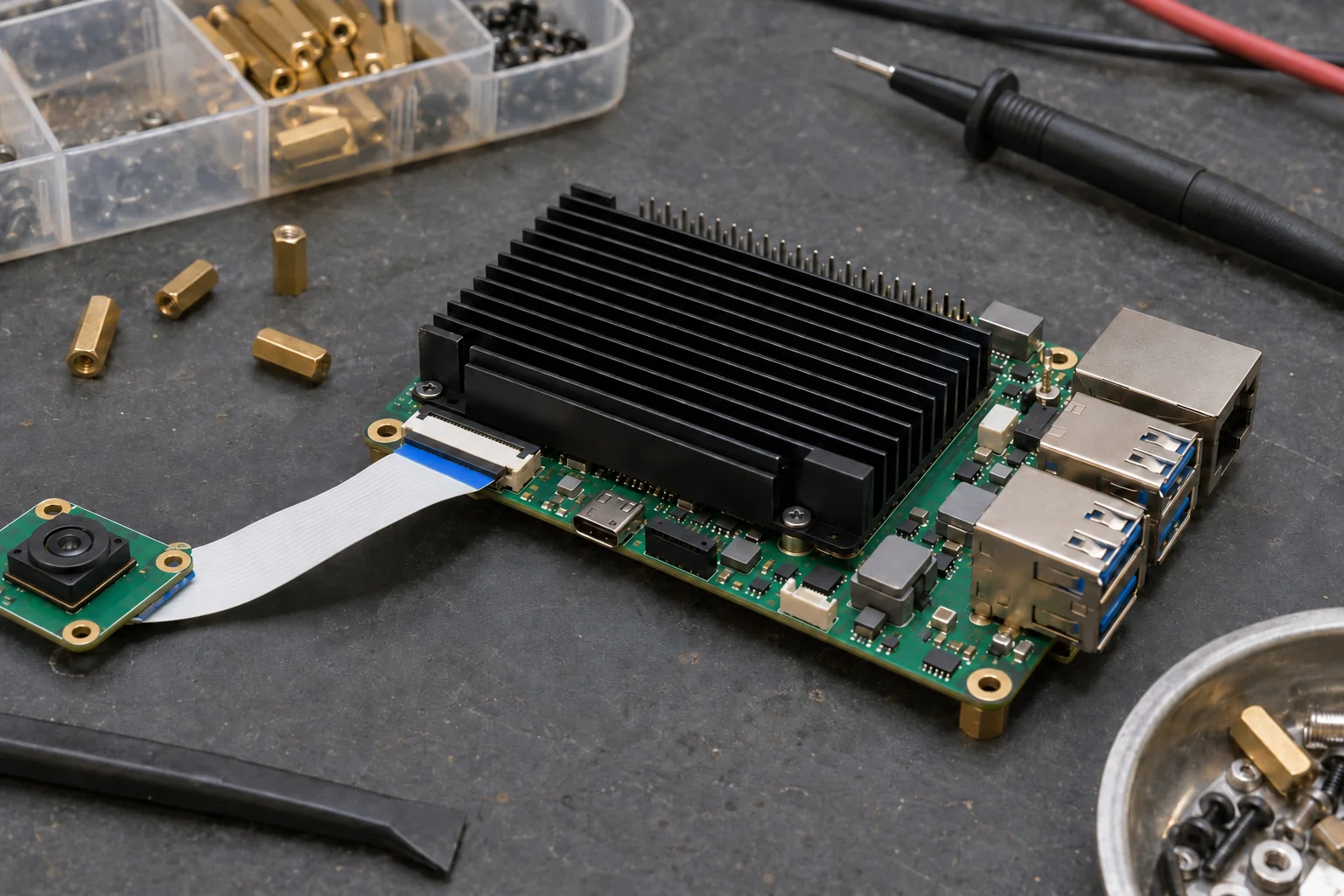
Unbranded embedded system-on-module carrier board with passive aluminum heatsink and camera ribbon interface on an ESD mat. Illustrative bench setup.
1. Thermal camera modules (Boson+, Boson SX8, Neutrino)
On Teledyne FLIR OEM’s thermal camera pages (read 17 October 2026):
- Boson+ is an uncooled longwave infrared (LWIR) module available in
640 × 512and320 × 256resolutions with a12 µmpixel pitch, thermal sensitivity (NEDT) of≤20 mK,60 Hzfull-frame rate, and a core mass of7.5 g(21 × 21 × 11 mmwithout lens). - Boson SX8 increases uncooled LWIR resolution to
1280 × 1024(SXGA) at an8 µmpixel pitch,<25 mKor<35 mKsensitivity,60 Hzframe rate over 14-bit CMOS or USB3 UVC,1.5 Wpower consumption, and22 gmass (23 × 28 × 19.6 mm). - Neutrino LC and Neutrino SX8 provide cooled midwave infrared (MWIR) sensing (
640 × 512and1280 × 1024respectively) for longer-range airborne gimbals where MWIR optics and active cooling are accommodated.
Because Prism A-ISR requires at least 10 × 10 pixels on target to reach >60% classification confidence, moving from a 640 × 512 detector (Boson+ or Neutrino LC) to a 1280 × 1024 detector (Boson SX8 or Neutrino SX8) doubles the linear pixel count across a given field of view—provided the optical MTF, gimbal stabilization, and processor frame rate keep pace. As explained in our guide on how a UAS search is optimized under real terrain conditions, instantaneous field of view (IFOV), slant range, and atmospheric or foliage occlusion determine whether a detector actually delivers usable target pixels in flight.
2. Embedded vision processors (Qualcomm 8550 / FLIR AVP vs NVIDIA Orin NX/AGX)
The Qualcomm 8550 entry in the Prism A-ISR specification table corresponds to the Qualcomm Dragonwing QCS8550, which Teledyne FLIR OEM packages into its own FLIR AVP (Advanced Vision Processor) System-on-Module:
- FLIR AVP physical profile:
40.27 × 33.41 mmLGA module weighing5 g(without thermal shield), equipped with16 GB LPDDR5x,256 GB UFS 3.1, an 8-core Kryo CPU (up to 3.36 GHz), Adreno 740 GPU, Spectra 680 ISP, and a Hexagon NPU rated at up to48 TOPS (INT8)runningLinux LE r76at3.6 Vinput (-20 °C to +60 °Coperating range). - Camera interface mismatch to verify: While the
FLIR AVPhardware page highlights three 4-lane MIPI CSI interfaces alongside USB 3.1 Gen 2 Type-C (and notes support for Boson, Boson+, Boson SX8, Neutrino LC, Neutrino SX8, Hadron 640R+, and Sony IMX577/IMX477 visible sensors), thePrism A-ISRsoftware table explicitly sayswith UVCnext toBoson+,Boson SX8, and4 MPEO, andwith USBnext toNeutrino LCandNeutrino SX8. Integrators should confirm before PCB layout whether theirPrism A-ISRsoftware build ingests raw 14-bit frames over MIPI CSI-2 or requires USB/UVC enumeration.
Metadata, video streaming, and downstream handoff checks
Getting bounding boxes on a lab HDMI monitor is only the first step of airborne integration. In a fielded UAS, the perception node must pass compressed video and target coordinates across an air-to-ground radio link to a ground control station (GCS) or mission network without dropping track continuity or desynchronizing timestamps.
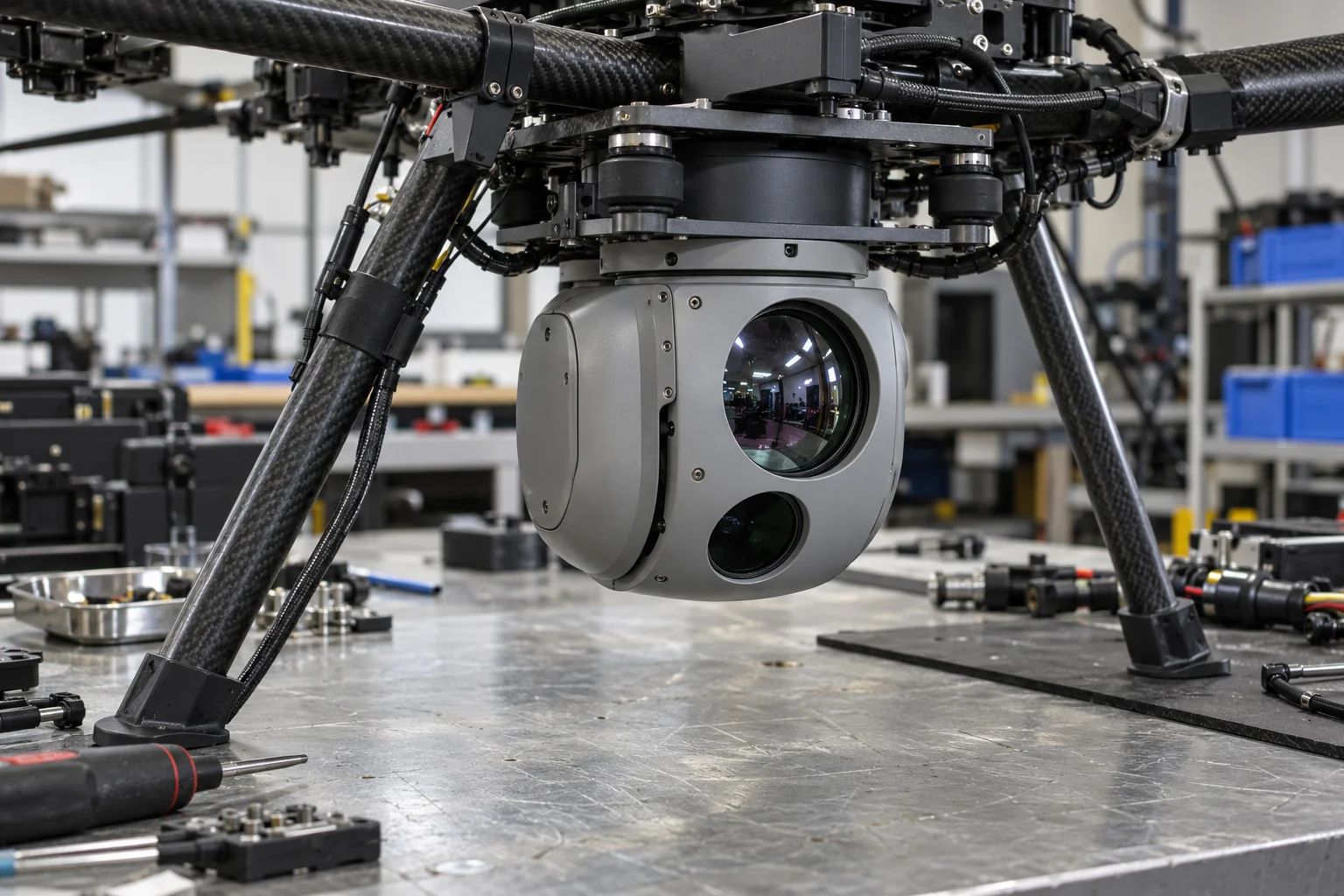
Unbranded dual-sensor gimbal payload mounted beneath carbon-fiber airframe rails on a workshop test stand. Illustrative physical integration fixture.
The public Prism A-ISR specification lists three video output options (WebRTP, RTSP, and HDMI) and eight metadata output fields:
Bounding Box AreaBound Box LocationCategory IDObject Class LabelConfidenceTime StampTrack IDFrame Number
Before committing to a flight-control or ground-station integration schedule, verify three interface mechanics that are not detailed on the public web page:
- Pixel-space vs geo-registered coordinates: All eight listed metadata fields (
Bounding Box Area,Bound Box Location,Frame Number,Track ID) describe image-plane detections in sensor pixel coordinates. Transforming a 2D pixel bounding box into an actionable ground latitude/longitude/elevation requires fusing gimbal pan/tilt encoders, aircraft attitude (roll/pitch/yaw), GNSS position, and terrain elevation or laser rangefinder data. Verify whether your team or a separate autopilot/gimbal middleware layer is responsible for that geo-pointing math. - Wire transport and link behavior: Streaming
RTSPorWebRTPvideo alongside per-frame detection metadata over a tactical or commercial radio link requires explicit bandwidth management and packet-loss behavior. Our explainer on UAS data-relay link budgets and failure modes outlines why video bitrate spikes and link dropouts must be tested separately from laboratory Ethernet connections. - Operator and evidence handoff: Once detections reach the ground station, someone must confirm how alerts, live streams, and recorded metadata are routed and retained. For civil or dual-use teams mapping ground-side software responsibilities, our first responder drone software handoff checklist shows how to assign sending and receiving owners to each stream and metadata boundary.
Blank pre-procurement and bench verification checklist
Use the table below—or download the editable CSV verification checklist—when requesting the gated Model 110-0201-92 documentation package or scoping an SDK bench evaluation with Teledyne FLIR OEM. Keep every row marked Unknown / not verified until you have recorded a specific document version, page number, or local bench measurement.
| Check ID & boundary | Public baseline (Model 110-0201-92) |
Question to verify with manufacturer or on bench | Local target config | Recorded evidence / doc ref | Status |
|---|---|---|---|---|---|
| CHK-01 Sensor interface | Boson+ (UVC), Boson SX8 (UVC), Neutrino LC (USB), Neutrino SX8 (USB); 4 MP UVC EO typical; 14-bit IR data | Which exact USB/UVC, CMOS, or MIPI CSI-2 drivers and third-party EO/IR camera models are validated in the current SDK release? | Unknown / not verified | ||
| CHK-02 Continuous zoom (CZ) telemetry | Supports fixed focal length and CZ LWIR/MWIR optics; Denoise, Super Resolution, Electronic Stabilization | Which serial protocol (e.g., UART/I2C lens controller commands) feeds real-time focal length to the stabilization and tracker algorithms during zoom? | Unknown / not verified | ||
| CHK-03 SoC BSP & container runtime | NVIDIA Orin NX/AGX; Qualcomm 8550 (QCS8550 / FLIR AVP) |
What exact OS kernel, JetPack/CUDA or Linux LE r76 version, and native vs Docker deployment model are required? | Unknown / not verified | ||
| CHK-04 Power & thermal dissipation | <12 W average, <15 W maximum |
What is the measured board power draw on your target SoC with dual EO/IR ingest, ISP filters, ~10 ms inference, and RTSP encoding active at max ambient temp? |
Unknown / not verified | ||
| CHK-05 Slant-range pixel geometry | ≥10×10 pixels minimum for >60% classification confidence; ≥60% small-target detection at <32×32 pixels |
At your planned altitude, depression angle, and lens focal length, what maximum slant range still puts ≥10×10 pixels on a person, vehicle, or boat? |
Unknown / not verified | ||
| CHK-06 Class taxonomy & AIMMGen | Person, vehicle umbrella, boat umbrella; default 16 simultaneous tracks |
Does your mission require finer vehicle subclasses or aerial target classes (Prism C-UAS), and what is the scope/cost of Prism AIMMGen (110-0200-25) retraining? |
Unknown / not verified | ||
| CHK-07 Metadata framing & time sync | 8 metadata fields + WebRTP, RTSP, HDMI video |
What schema (JSON, protobuf, or KLV/STANAG 4609) transports the 8 metadata fields, and how is Time Stamp locked to PTP/NTP or GPS time? |
Unknown / not verified | ||
| CHK-08 Export, NDAA & licensing | GUI, SDK package, C++ sample app, Technical Documentation; Boson+/SX8 hardware and AIMMGen data labeled ITAR-free |
What is the ECCN/ITAR classification and software-level NDAA status of Model 110-0201-92, and what are the SDK and per-unit runtime license terms? |
Unknown / not verified |
Notice CHK-08 in particular: Teledyne FLIR OEM explicitly marks the Boson+ and Boson SX8 camera modules as ITAR-free and NDAA-compliant, and describes Prism AIMMGen as utilizing over one million ITAR-free synthetic assets. However, the public Prism A-ISR (110-0201-92) web page does not state an export control classification number (ECCN), ITAR jurisdiction status, or software-level NDAA compliance statement for the compiled perception software package itself. Procurement and compliance officers should verify those classifications directly in writing before cross-border transfer or federal program bidding.
Method and sources
This technical guide and verification checklist were compiled on 17 October 2026 from public specification tables on Teledyne FLIR OEM’s product pages (Prism A-ISR Model 110-0201-92, Prism C-UAS Model 110-0201-90, Prism Ground ISR Model 110-0201-91, Prism SKR Model 110-0200-50, Prism AI - Auto Model 110-0133-40, Prism AIMMGen Model 110-0200-25, FLIR AVP, Boson+, and Boson SX8) and trade launch coverage in DRONELIFE (published 9 September 2025).
Evidence status for this page is partial: the gated downloadable datasheet PDF linked from the Teledyne FLIR OEM product page (flir.netx.net asset 78211) was not read, and we have not inspected the restricted SDK documentation or conducted bench or flight testing of Prism A-ISR. All unpublished camera compatibility details, lens control protocols, benchmark conditions, export classifications, and commercial terms are intentionally left as open verification questions. The workbench photographs are illustrative hardware scenes and do not depict Teledyne FLIR products or a tested airborne installation.
Last updated: 17 October 2026.